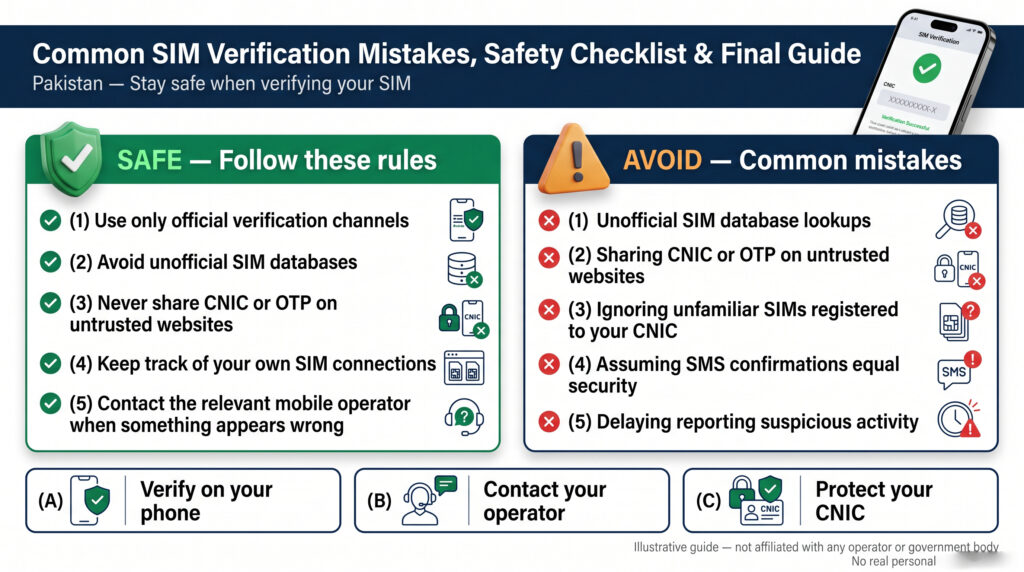
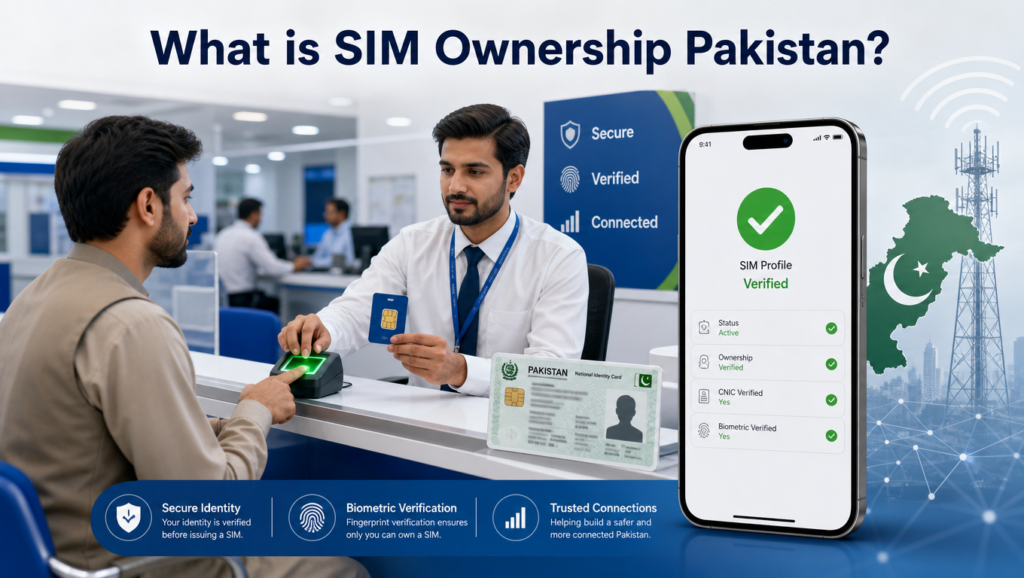
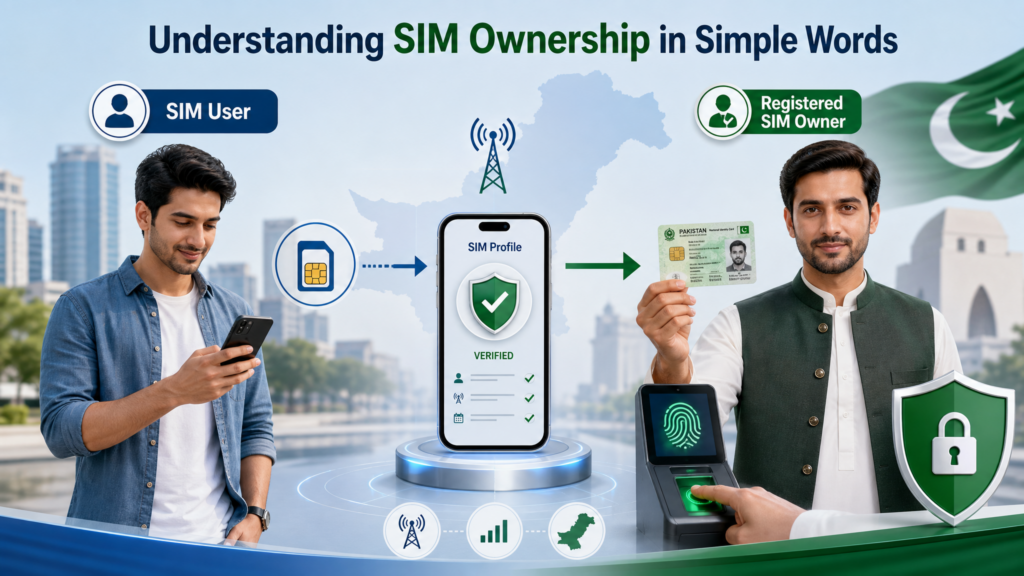
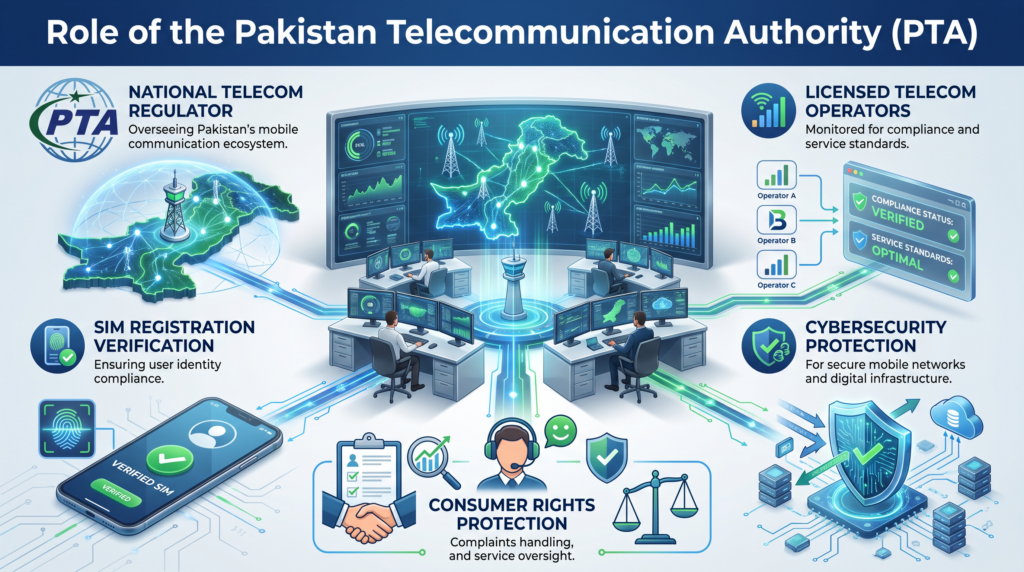
In Pakistan, checking the SIM cards registered against your CNIC is more than a routine verification step; it is an important part of managing your personal identity and mobile connections. Many people do not know exactly how many SIMs are registered under their CNIC, which networks those connections belong to, or whether an old or unused number is still associated with their record. This complete guide explains SIM Owner Details by CNIC in Pakistan, including how to check your registered SIMs, understand the information provided through official verification methods, identify unfamiliar registrations, and take the appropriate steps to keep your mobile records accurate and secure.
What Does SIM Owner Details by CNIC Mean?

SIM Owner Details by CNIC generally refers to checking the mobile connections that are registered against your own Computerized National Identity Card (CNIC) through legitimate verification channels. The important point is that this process is about your own subscriber record, not about obtaining private information belonging to another person.
When a SIM card is issued in Pakistan, subscriber information is associated with an identity record. Because of this connection, checking your CNIC-related SIM information can help you understand which mobile connections are associated with your identity and whether the information appears consistent with the SIMs you actually use.
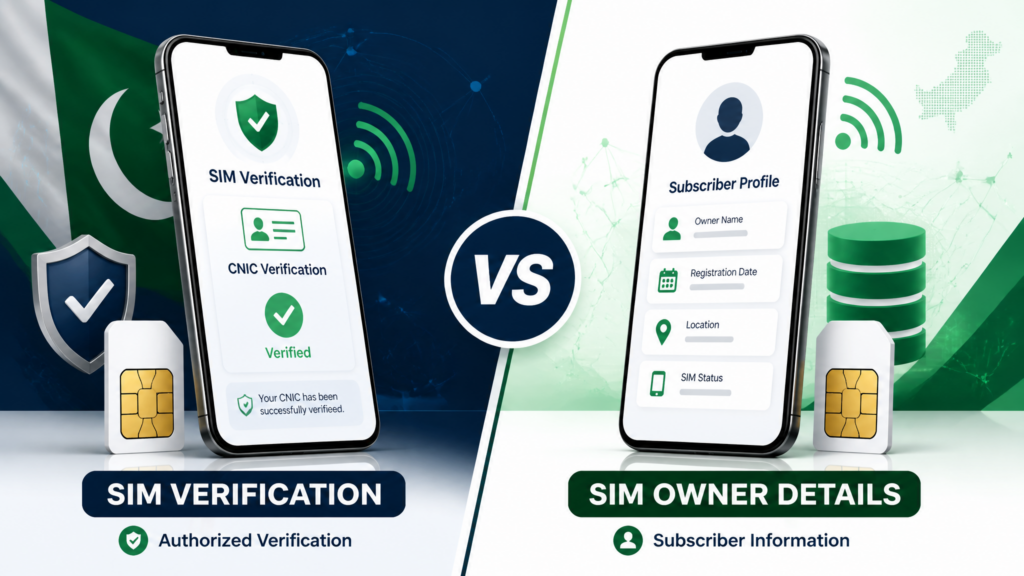
SIM owner information vs. SIM registration information
These two terms are often confused.
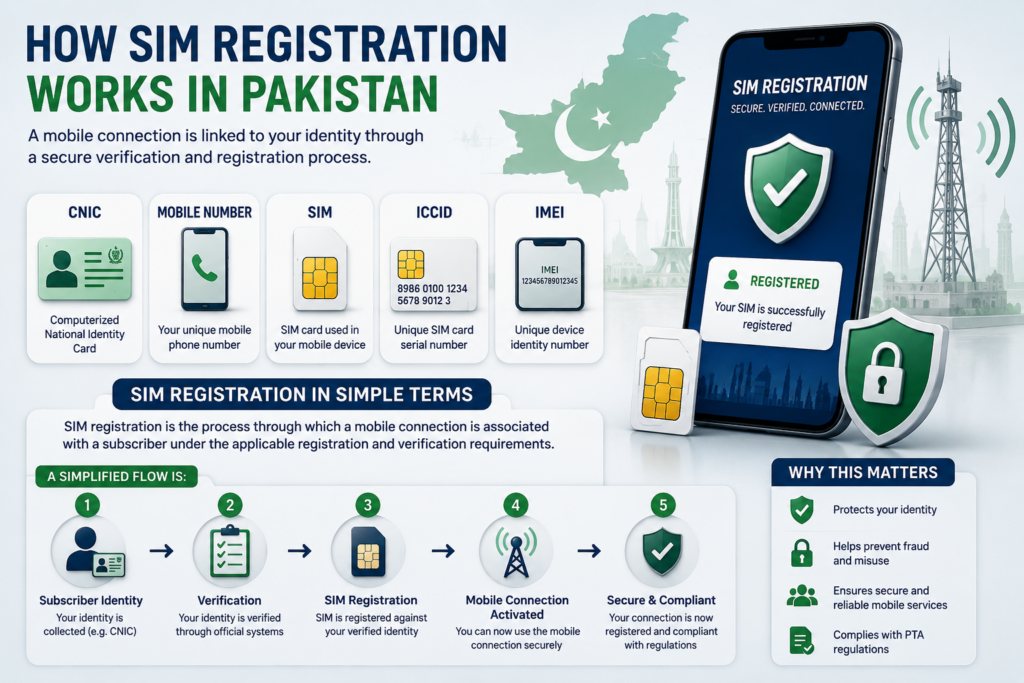
SIM registration information concerns the record connecting a mobile SIM with its registered subscriber identity.
SIM owner details, when used in a legitimate context, should therefore be understood as information about the registration of a SIM or the SIM connections associated with your own identity record.
It does not mean that every person can legally enter a random mobile number and obtain another person’s:
- full name
- CNIC number
- residential address
- family information
- location
- call history
- other private records
A website claiming to provide unrestricted personal information about a stranger should therefore be treated cautiously.
Why CNIC-based verification is useful
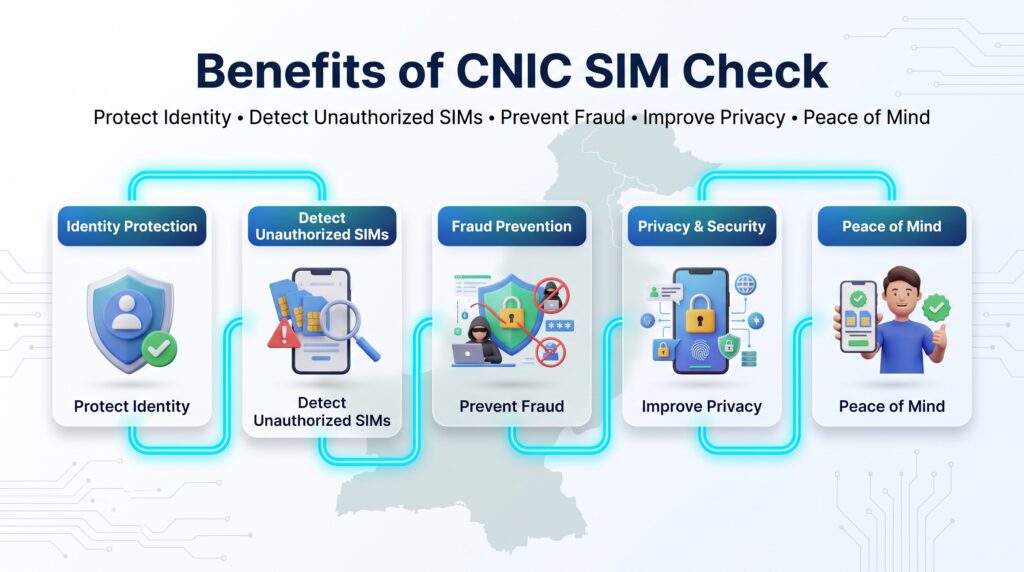
The main benefit of checking your own CNIC-related SIM record is identity awareness.
For example, you may have:
- an old SIM that you no longer remember;
- a number that you stopped using years ago;
- a replacement SIM whose previous connection you forgot about;
- a connection you do not recognize;
- concerns that someone may have used your identity without your knowledge.
Regularly reviewing your own record gives you an opportunity to identify something unusual and take appropriate action through the relevant official channel.
What this guide will and will not provide
This guide focuses on lawful self-verification. It will explain how to understand your own SIM registration situation, what official checking methods are designed for, how to interpret available information, and what practical steps to take when something does not look right.
It will not promote unofficial databases, unauthorized identity lookups, leaked records, or services claiming that anyone can obtain a stranger’s private subscriber information simply by entering a mobile number.
That distinction is important for both privacy and accuracy.
Google’s current guidance emphasizes original, reliable, comprehensive content that provides substantial value rather than simply copying or rewriting other sources.
For anyone searching for SIM Owner Details by CNIC in Pakistan, the focus should remain on legitimate self-verification and responsible management of personal SIM registrations. Using SIM Owner Details by CNIC information correctly means checking your own record, protecting your CNIC information, and contacting the relevant operator when an unfamiliar registration needs to be investigated.
Why Should You Check SIMs Registered on Your CNIC?
Checking the SIMs registered against your CNIC can help you maintain better control over your mobile identity records. Many people remember the numbers they currently use but forget about older connections, replacement SIMs, temporary numbers, or subscriptions that were activated several years ago. A regular review can help you identify connections that no longer have a clear purpose.
Your CNIC is an important identity document, and mobile connections registered against it should be treated with the same level of attention as other personal records. If you discover an unfamiliar SIM, the first step should not be to search for its owner through an unofficial service. Instead, you should verify the information through an appropriate official channel and contact the relevant mobile operator when necessary.
1. Find SIMs You No Longer Use
People frequently change mobile numbers, upgrade devices, switch networks, or stop using a particular SIM. An old connection may remain associated with your registration record even after you have stopped using it.
Checking your record gives you an opportunity to identify older connections and determine whether they still need to remain active.
2. Identify an Unfamiliar SIM
One of the most important reasons for checking your CNIC is to notice a connection that you do not recognize.
An unfamiliar SIM does not automatically prove that fraud has occurred. There may be an innocent explanation, such as an old number, replacement process, family-related registration, or an incomplete understanding of your previous connections.
However, anything you cannot explain should be investigated through the proper operator or official process rather than ignored.
3. Reduce the Risk of Identity Misuse
A mobile connection associated with your identity can potentially create complications if it is being used without your knowledge. Regular verification gives you an early opportunity to notice something unusual.
This is particularly useful if you have lost a SIM, changed your number, replaced a damaged SIM, or have not reviewed your registered connections for a long period.
4. Keep Your Mobile Records Organized
Checking your CNIC-related SIM information is also a simple form of digital housekeeping. Just as people review their bank accounts, email accounts, and important documents, reviewing mobile registrations can help keep personal records organized.
You can make the process more useful by keeping a dated personal note of the SIMs you actually use. If something unfamiliar appears during a later check, you will have a clearer basis for comparison.
5. Take Action When Something Is Wrong
The real benefit of verification is not simply seeing a number or count. It is being able to recognize an unexpected registration and respond appropriately.
Depending on the situation, you may need to contact the relevant operator, visit an authorized service location, request disowning or blocking of an unwanted connection, or use an appropriate complaint channel.
A simple habit can make verification easier
You do not need to wait until you suspect a problem before reviewing your record. Periodic checks can help you stay aware of the connections associated with your identity.
Most importantly, always distinguish between checking your own CNIC record and attempting to obtain another person’s private subscriber information. The first is the purpose of legitimate SIM verification; the second raises significant privacy and legal concerns.
Official Ways to Check SIMs Registered on Your CNIC in Pakistan
If you want to verify the SIM connections associated with your own CNIC, it is important to start with official and legitimate verification methods rather than relying on websites or applications that claim to reveal private subscriber information. Different methods may provide different types of information, so understanding their purpose before using them can save time and prevent confusion.
The most useful approach is to identify whether you want to check the number of SIMs associated with your CNIC, verify information about a SIM already in your possession, identify a mobile network, or resolve an unfamiliar registration. These are different tasks and should not be treated as one single type of lookup.
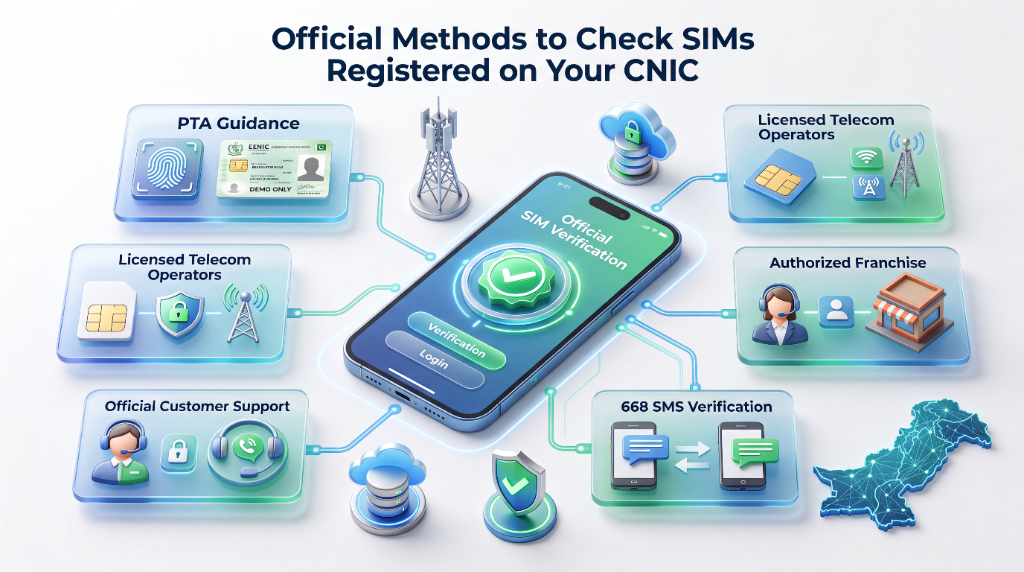
1. CNIC-Based SMS Verification
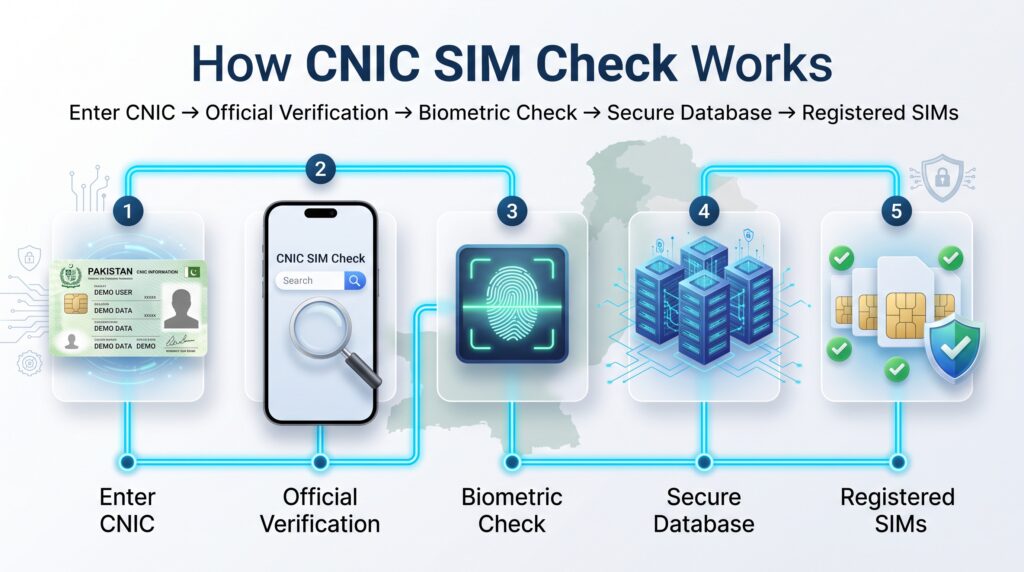
The SMS-based CNIC verification method is one of the simplest options for checking information associated with your own identity record. It is particularly useful when you want a quick overview without navigating through an online website.
The process generally involves using your own 13-digit CNIC information in the format required by the official service. The resulting response can help you understand the SIM registration situation associated with your identity.
Before using any SMS service, make sure you are following the current instructions provided by the relevant official authority or mobile operator, because service procedures and charges can change.
2. Official Online SIM Verification
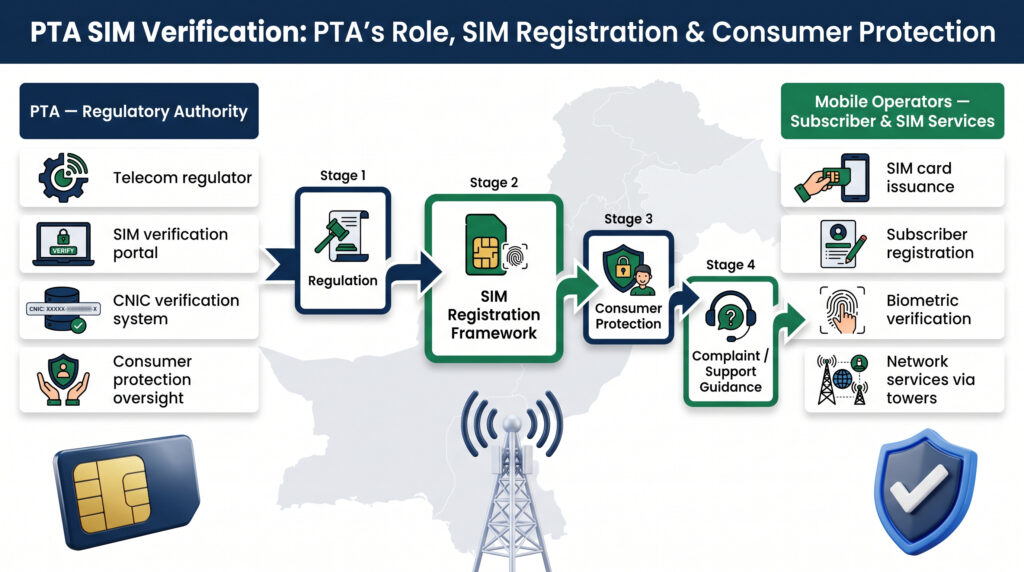
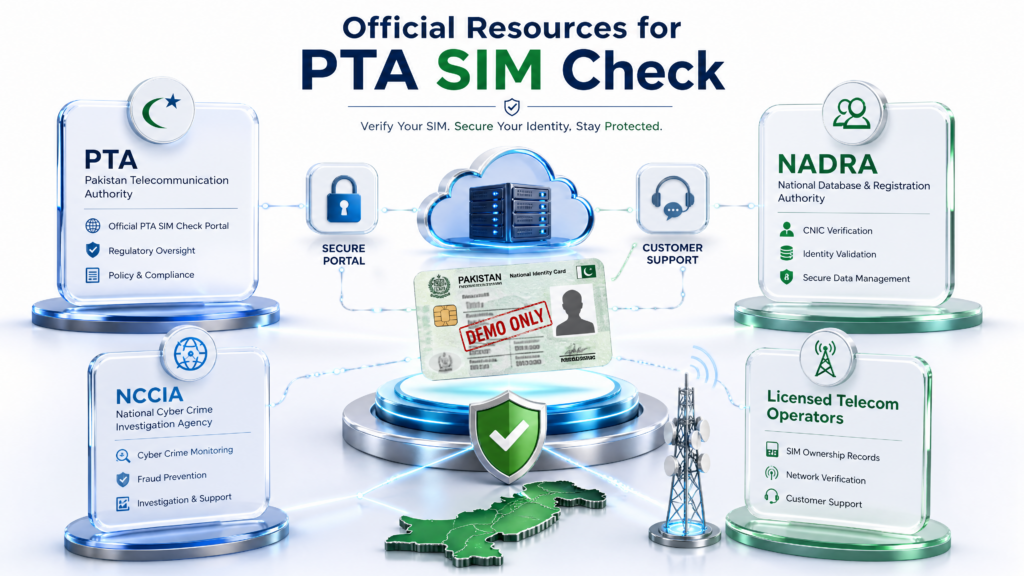
An online verification portal can be more convenient when you want to review information through a browser. The official PTA-related SIM verification system is designed to help users check information associated with their own CNIC.
Online checking can be particularly useful when you need to examine the information more carefully instead of relying only on a short SMS response.
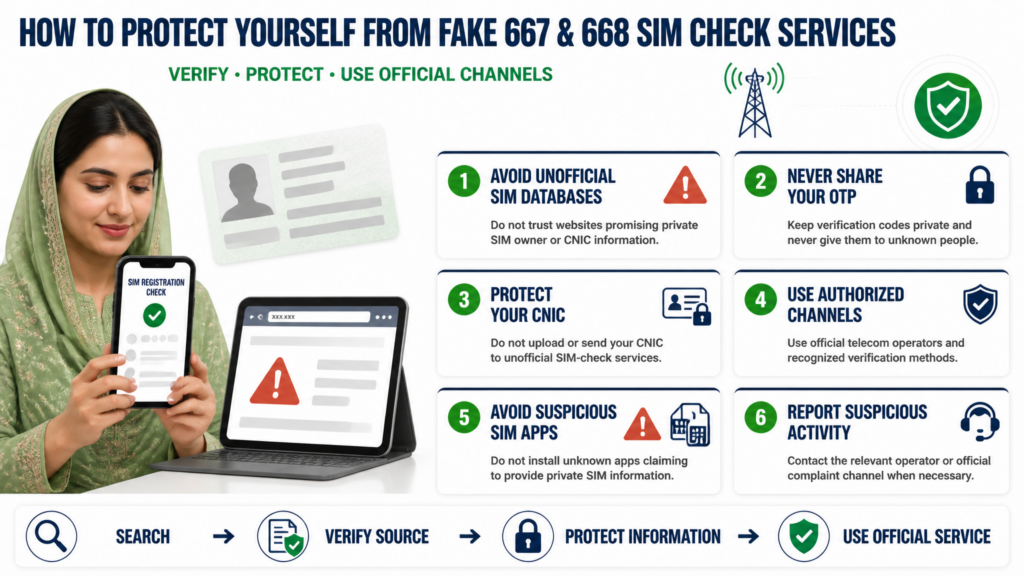
Always make sure that you are visiting the genuine official website. Avoid entering your CNIC into unfamiliar websites simply because they promise a detailed SIM owner report.
3. Verification Through a Mobile Operator
If your issue concerns a particular SIM that you physically possess, the relevant mobile operator can also be an important source of assistance.
This may become necessary when:
- a SIM is lost;
- a replacement SIM was issued;
- ownership information appears incorrect;
- you want to discontinue an unwanted connection;
- an unfamiliar registration needs investigation;
- or the online information does not resolve your problem.
An authorized operator service location may request identity verification before taking action on a subscriber record.
4. Network or SIM-Specific Checks
Some official services are designed for narrower purposes rather than providing a complete CNIC-based SIM record. For example, a service may help determine the network associated with a number or verify the registration status of a SIM already in your possession.
This distinction is important because not every official code performs the same function.
A common mistake is assuming that one code or portal can provide every possible piece of subscriber information. In reality, different services can have different purposes, limitations and eligibility requirements.
5. What You Should Avoid
Avoid websites claiming that you can enter any person’s mobile number and instantly obtain their complete name, CNIC, address, family information, live location or other private records.
Such claims should be treated with caution. A professional SIM verification process should focus on your own records and legitimate subscriber services, not unrestricted access to another person’s identity.
Choose the method according to your purpose
The best method depends on what you actually need to verify. If your goal is simply to understand which SIM connections are associated with your own CNIC, use the official CNIC verification route. If you have a problem with a particular SIM, the relevant operator may be more appropriate. If you need network-related information, use the official service designed for that specific purpose.
This approach keeps the verification process accurate, lawful, secure and easier to understand.
How to Check SIMs Registered on Your CNIC Through SMS
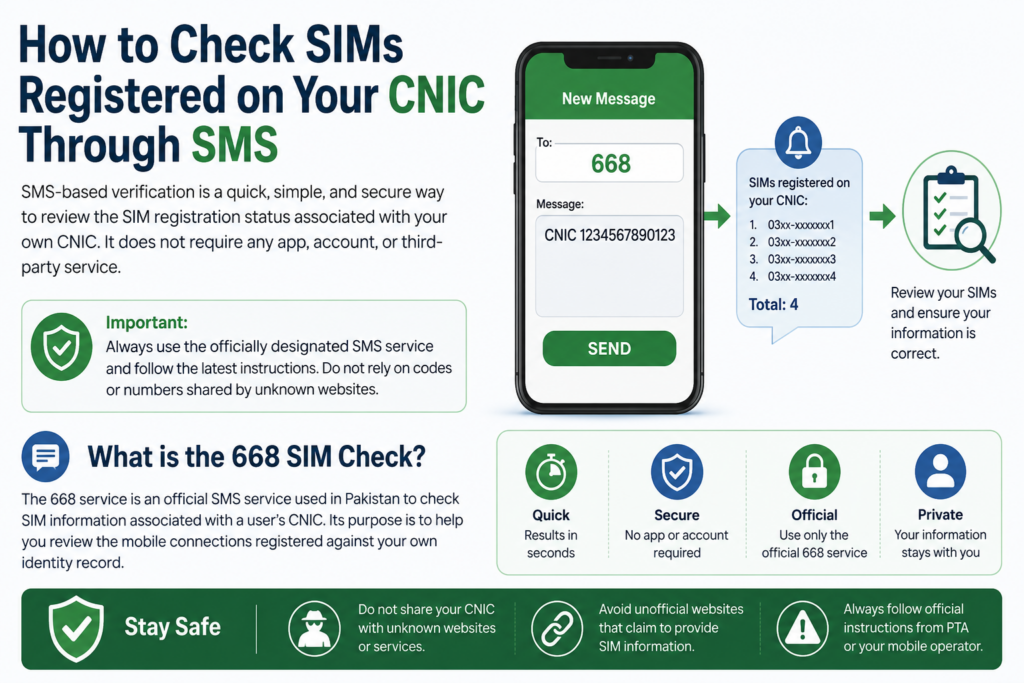
For users who want a quick way to review the SIM registration status associated with their own CNIC, SMS-based verification can be one of the most convenient options. It does not require installing an application, creating an account on an unfamiliar website, or sharing your identity information with a third-party service.
The important point is to use the officially designated SMS service and the current instructions rather than relying on codes or numbers circulated by random websites.
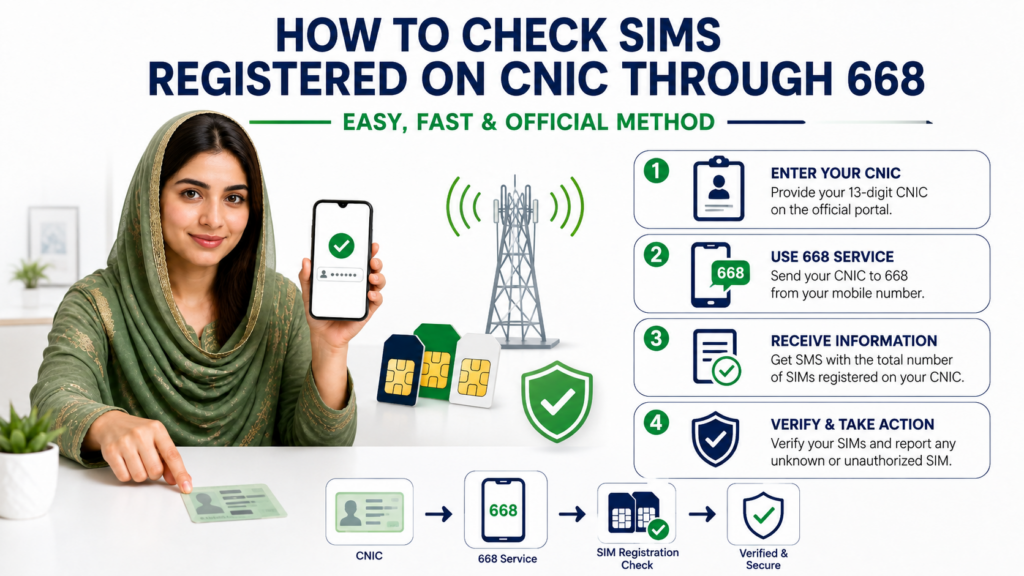
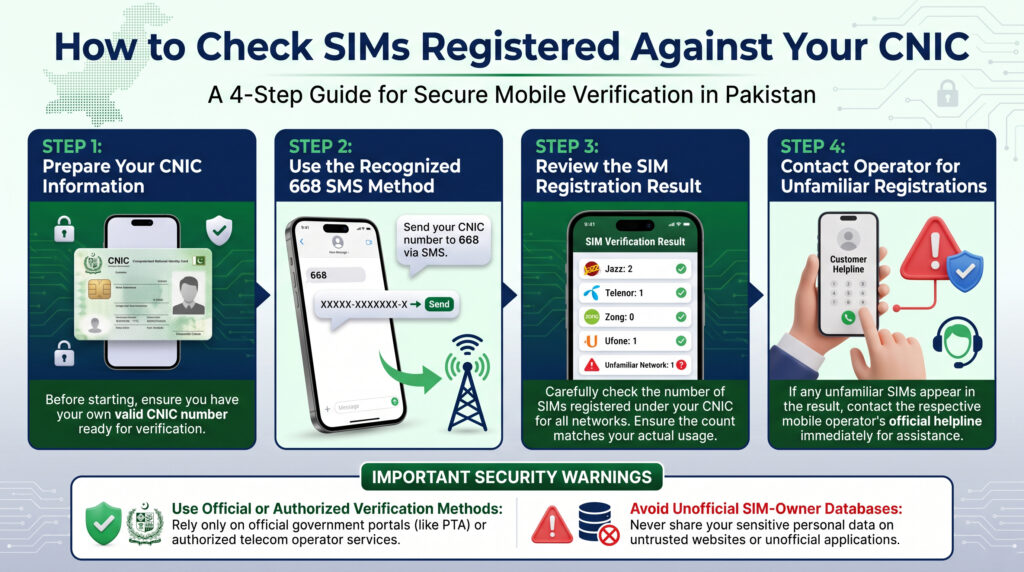
What is the 668 SIM Check?
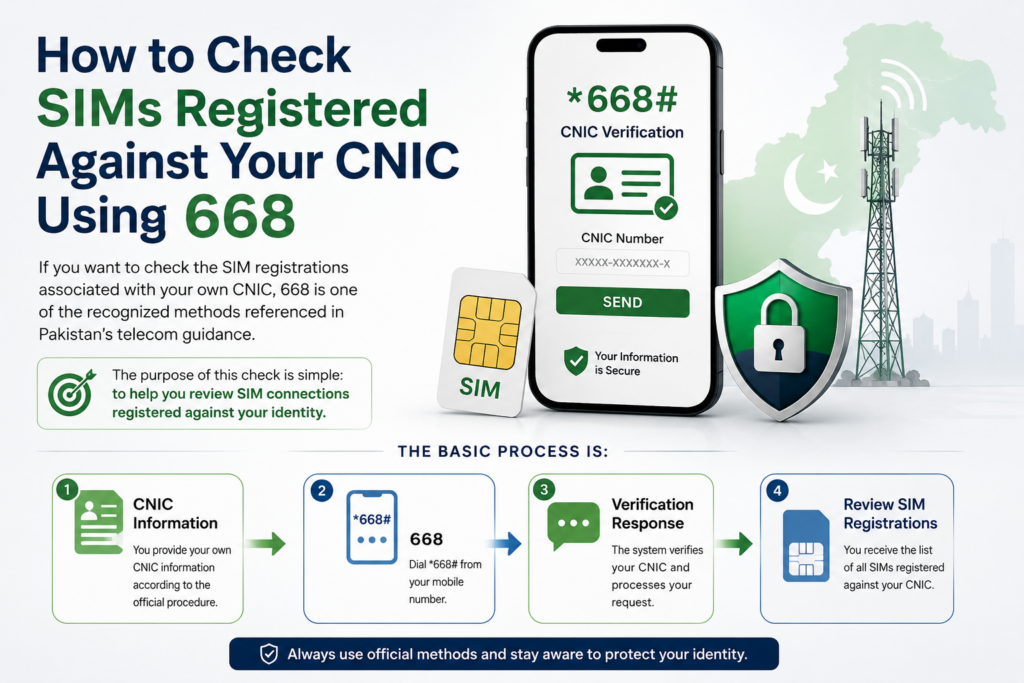
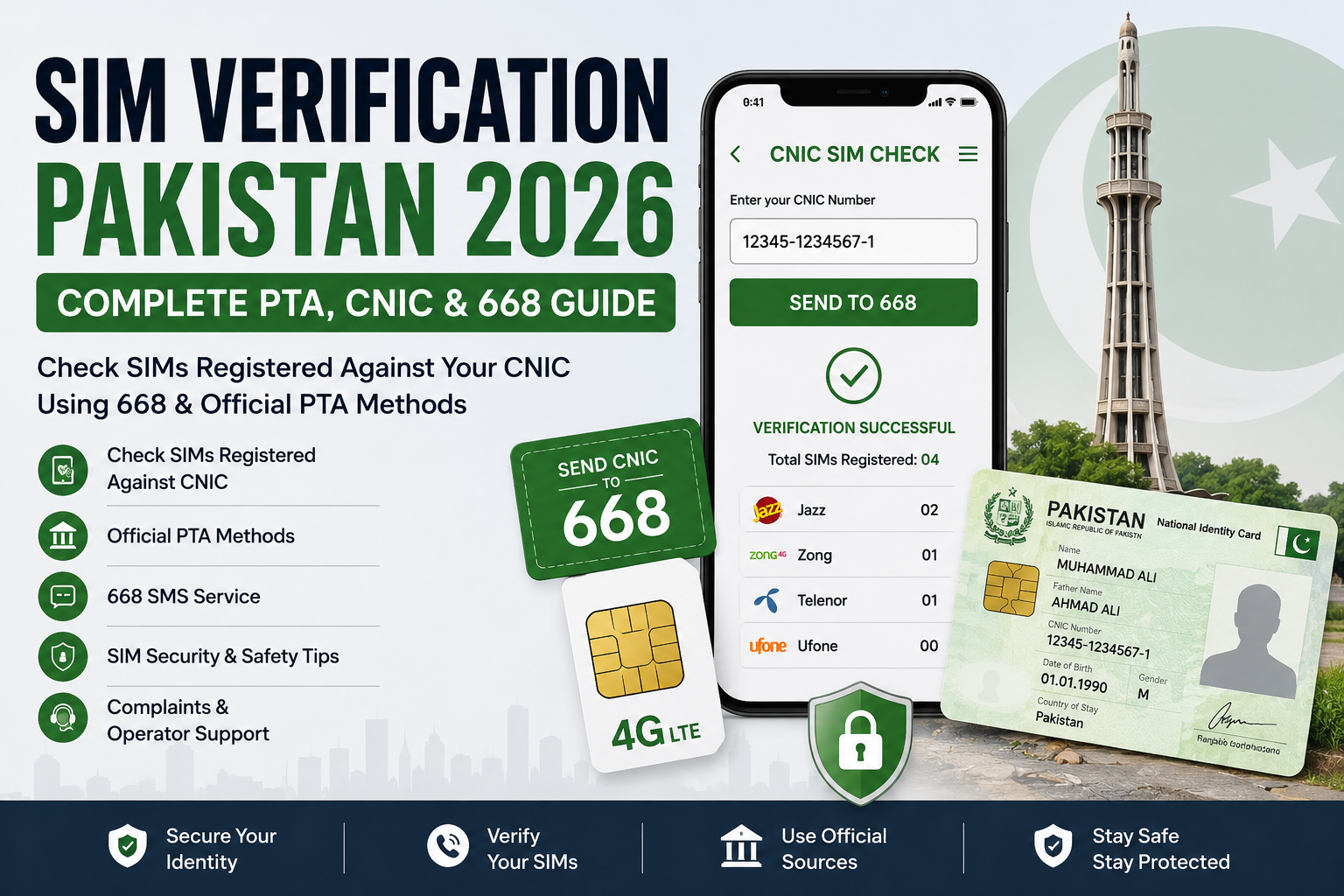
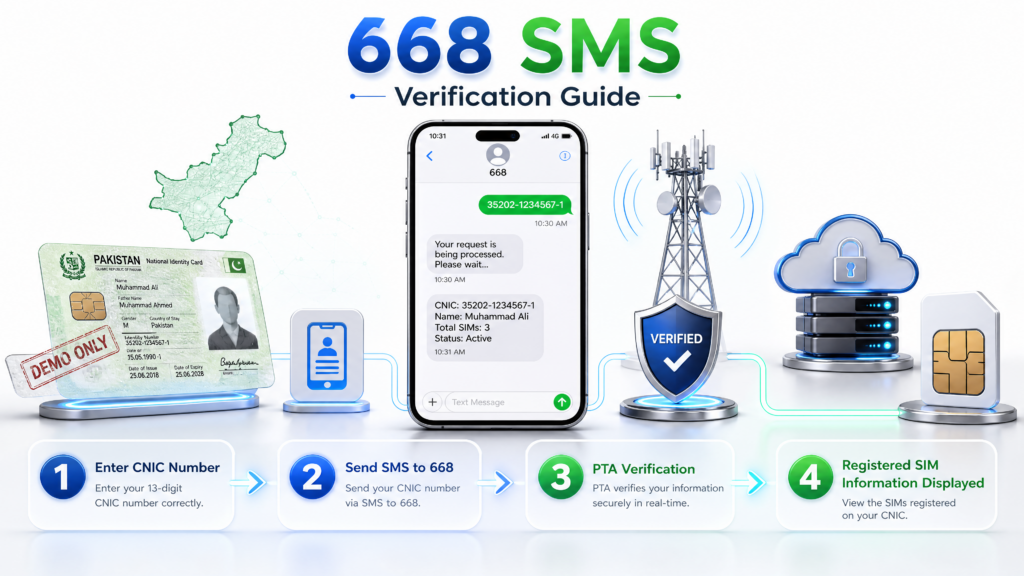
The 668 service is commonly used in Pakistan for checking SIM information associated with a user’s CNIC. The purpose is to help a person review the mobile connections registered against their own identity record.
This is fundamentally different from a public “SIM owner lookup” service. The purpose of the process is self-verification: you are checking information connected to your own CNIC rather than trying to obtain another person’s private identity details.
How to Check Your CNIC Through 668
Before sending anything, keep your own CNIC information available and make sure you are using the official procedure currently applicable to the service.
Step 1: Prepare your CNIC number
Use your 13-digit CNIC number in the format required by the service. If the instructions specify that dashes should be removed, enter the number without them.
For example, instead of entering a formatted identity number with separators, use the required continuous numerical format.
Step 2: Send the required SMS
Send your CNIC information to the officially designated 668 service according to the current PTA instructions.
Do not add unnecessary personal information, passwords, bank details, or other sensitive data to the message.
Step 3: Wait for the response
The service can return information related to the SIM registrations associated with the CNIC. The exact presentation and information available can depend on the current service configuration.
Read the response carefully rather than assuming that every number you remember must appear in exactly the same format.
Step 4: Compare the information
Compare the returned information with the SIM connections you actually use or recognize.
If the result appears consistent with your current connections, keep the information for your own records if useful.
If something appears unfamiliar, do not immediately assume that it represents fraud. First consider whether it could be an old connection, a replacement, a number you previously used, or another registration you may have forgotten.
What If You Find an Unknown SIM?
An unfamiliar registration deserves attention, particularly if you cannot explain why it is associated with your CNIC.
You can document the result and then contact the relevant mobile operator through its official customer-service or authorized service channel. Depending on the circumstances, you may need to request further verification, blocking, or disowning of the connection.
Do not attempt to investigate the person supposedly using the number through unofficial databases. The safer approach is to resolve the registration through the operator and official complaint mechanisms.
Is 668 a Complete Owner-Details Database?
No. It should not be treated as a public database that provides unlimited personal information.
Its purpose is related to legitimate verification of SIM registrations connected with your own CNIC. It should not be confused with websites claiming to provide a stranger’s complete name, CNIC, address, family information, location, or call records from a mobile number.
A useful rule to remember
668 is for checking your own registered SIM information — not for investigating another person’s private identity.
Because telecom procedures can change, always verify the current instructions through official PTA or operator information before relying on a particular SMS format, fee, or response structure.
How to Check SIM Registration Online Through the Official Portal
For people who prefer using a browser instead of SMS, an online verification method can be more convenient for reviewing SIM registration information associated with their own CNIC. It can also make it easier to read information carefully, especially when you are trying to understand whether the displayed registration matches the connections you currently use.
The most important rule is simple: use the genuine official portal and do not enter your CNIC information into an unknown website merely because it promises detailed SIM owner information.
What Is the Online SIM Verification Portal?
The official online route is intended to help users verify SIM-related information connected with their own identity record. Instead of depending on an unofficial database, the user interacts with an authorized system designed for subscriber verification.
This distinction matters because many websites use phrases such as “SIM owner details,” “SIM database,” or “CNIC SIM information” while offering services that are unrelated to official telecom verification.
An official verification portal should be treated differently from a third-party website claiming to expose another person’s private information.
How to Use the Online Method
Step 1: Open the official portal
Start by accessing the current official PTA-related SIM verification portal through a trusted source.
Before entering your CNIC, check the website address carefully. Avoid pages that have suspicious domain names, excessive advertisements, misleading download buttons, or requests for unnecessary personal information.
Step 2: Enter your own CNIC information
Use your own identity information exactly as requested by the portal.
Do not enter another person’s CNIC simply to investigate their mobile connections. The purpose of the system is legitimate self-verification.
Step 3: Complete any required verification
The portal may require a verification step before displaying information. Follow the instructions presented on the official website rather than using third-party tools that claim to bypass verification.
Never share an OTP, password, or authentication code with another person.
Step 4: Review the result carefully
Once the information is displayed, compare it with the SIM connections you recognize.
Do not judge the result solely by the number of connections. Think about whether the registrations correspond to your current or previous mobile usage.
An unfamiliar entry can have several explanations, so investigate it through the relevant official operator channel before reaching a conclusion.
What If the Portal Shows Something You Do Not Recognize?
If you discover a SIM registration that you cannot explain, save the relevant information for your records and contact the appropriate mobile operator through its official support channel.
Depending on the situation, you may need to:
- verify the registration;
- identify the relevant operator;
- request blocking or disowning;
- provide identity verification;
- visit an authorized service location;
- or submit a complaint through an official channel.
Do not try to identify the person using the SIM through unofficial databases. That approach can create additional privacy and security problems.
Online Portal vs SMS Verification
Both methods can serve useful purposes, but they are not necessarily identical.
| Feature | SMS Method | Online Portal |
|---|---|---|
| Internet required | No | Yes |
| Convenient for quick checking | Yes | Yes |
| Browser required | No | Yes |
| Easier to review detailed information | Limited | Generally better |
| Best use | Quick self-check | Browser-based verification |
The exact information, interface and procedure can change over time. Therefore, users should always confirm the current process from official PTA information before relying on an old screenshot or outdated tutorial.
Stay focused on your own record
The online portal should be viewed as a self-verification tool, not as a public search engine for people’s identities.
A legitimate SIM verification process helps you understand the mobile connections associated with your own CNIC. It should not be used to obtain a stranger’s private name, CNIC, address, location or other confidential information.
How to Check SIM Information Through Mobile Operators
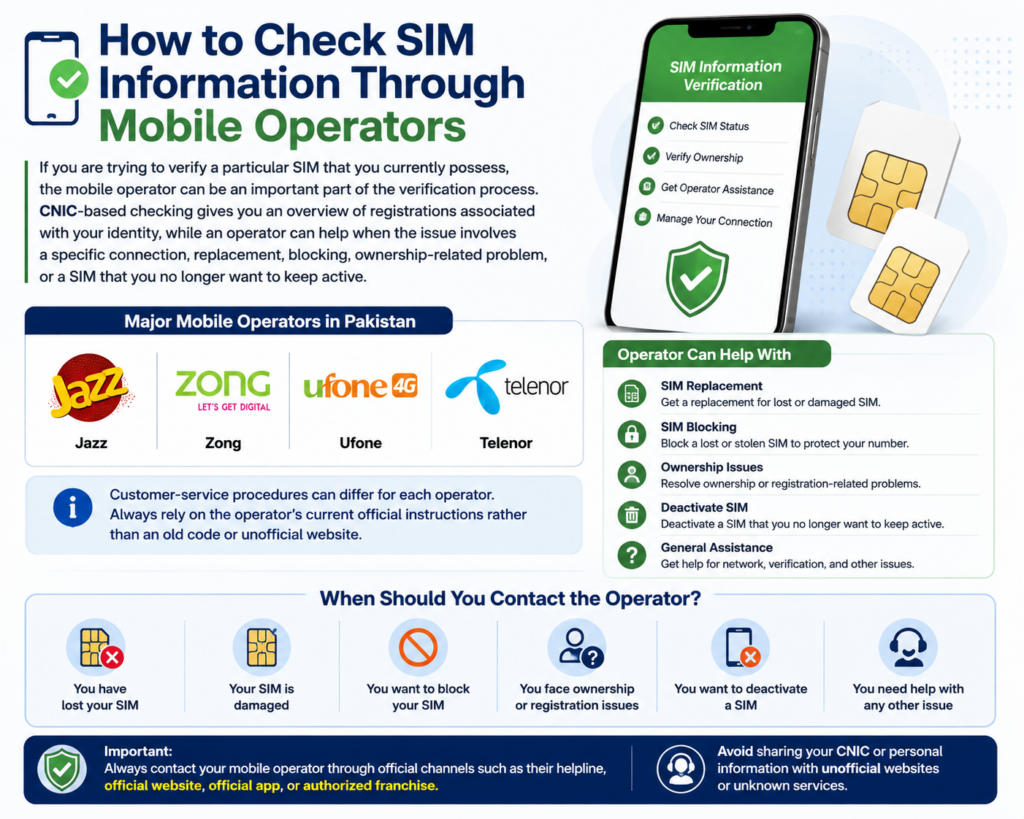
If you are trying to verify a particular SIM that you currently possess, the mobile operator can be an important part of the verification process. CNIC-based checking gives you an overview of registrations associated with your identity, while an operator can help when the issue involves a specific connection, replacement, blocking, ownership-related problem, or a SIM that you no longer want to keep active.
Pakistan has several major mobile operators, including Jazz, Zong, Ufone and Telenor. Their customer-service procedures can differ, so users should always rely on the operator’s current official instructions rather than an old code or unofficial website.
When Should You Contact the Operator?
You may need operator assistance when:
- you have lost your SIM;
- a SIM has stopped working;
- you need a replacement;
- an unfamiliar registration appears against your CNIC;
- you want to discontinue a connection;
- registration information appears inconsistent;
- you need clarification about a particular number;
- or an online verification result does not answer your question.
The operator is generally more appropriate for connection-specific issues than an unofficial SIM database.
Jazz SIM Verification
If the SIM belongs to Jazz, use Jazz’s official customer-support or authorized service channels for account and SIM-related assistance.
If your issue involves a lost, blocked, replacement, or registration-related SIM, be prepared to complete the identity verification requested by the operator. This protects the subscriber record from unauthorized changes.
Do not give your CNIC details, OTPs or account credentials to someone claiming to represent Jazz through an unverified channel.
Zong SIM Verification
Zong customers can similarly use Zong’s official customer-service and authorized service channels for SIM-related assistance.
If you need help with a particular connection, explain the actual problem clearly—for example, whether the SIM is lost, inactive, unfamiliar, or requires replacement.
The operator may require identity verification before making changes to the subscriber record.
Ufone SIM Verification
Ufone users should use Ufone’s official support channels or authorized service locations for problems involving their SIM or subscriber account.
If an unexpected registration is associated with your CNIC, avoid trying to identify the person using that connection yourself. Instead, ask the operator what official procedure is available to investigate or resolve the registration.
Telenor SIM Verification
Telenor customers can use the operator’s current official customer-support channels for SIM-related queries.
As with other operators, identity verification may be required before sensitive account or SIM actions can be performed.
Because telecom services and procedures can change, always confirm the latest instructions directly from the operator before visiting a franchise or relying on an older online guide.
What Should You Take to an Authorized Service Location?
If the issue requires an in-person visit, keep your original CNIC available and explain exactly what you need.
For example:
“A SIM registration appears on my CNIC that I do not recognize. I want to verify and resolve it through the official process.”
This is much safer than approaching an unofficial agent and asking for a private lookup.
Depending on the situation, the operator may guide you through verification, blocking, replacement, disowning, or another appropriate procedure.
Important Difference: Operator Help vs SIM Lookup Websites
A genuine mobile operator deals with subscriber records through its authorized systems. An unofficial website claiming that it can reveal a stranger’s complete identity from a mobile number is a completely different matter.
Do not assume that a website is legitimate simply because it uses terms such as SIM database, SIM owner, CNIC record, live tracker, or telecom verification.
Best approach
Use CNIC-based official verification when you want to understand your own registrations, and use the relevant mobile operator when you need help with a specific SIM or subscriber-account issue.
This two-step approach keeps the process practical, safer and focused on information you are actually authorized to access.
Understanding the Difference Between SIM Count, SIM Registration and Owner Information
When people search for SIM Owner Details by CNIC, they often expect one single result containing every piece of information about a SIM. In reality, different verification services can provide different types of information, and understanding this distinction is important before checking your record.
A CNIC-based SIM check, a network check, and the registration status of a particular SIM are not necessarily the same thing. Confusing these services can lead to incorrect assumptions about what information is officially available.
SIM Count and SIM Registration Are Different
A SIM count generally refers to the number of mobile connections associated with your CNIC or identity record.
For example, a verification result may tell you that your CNIC has registrations associated with particular mobile operators. This can help you determine whether the number of connections appears consistent with your own usage.
A count does not necessarily mean that the system is providing a complete personal profile for every number.
What Does SIM Registration Mean?
SIM registration refers to the association between a mobile connection and the subscriber identity used when that connection was registered.
When you check your own registration information, the purpose is to establish whether a particular mobile connection is associated with your identity record.
This becomes especially important when you:
- purchase a new SIM;
- replace an existing SIM;
- lose a number;
- stop using a connection;
- discover an unfamiliar registration;
- or need to resolve a subscriber-record issue.
What Is Owner Information?
The phrase “owner information” can be misleading because it is often used online to describe information that is not publicly available.
For legitimate self-verification, the relevant question is generally:
Which SIM connections are registered against my own CNIC?
That is different from asking:
Who is the person behind this stranger’s mobile number?
The first question concerns your own subscriber record. The second can involve another person’s private identity information and should not be treated as an ordinary public lookup.
Network Information Is Another Category
Sometimes a person only wants to know which network a mobile number currently belongs to.
That is a much narrower question than asking for subscriber identity information.
A network-related service may help identify the operator associated with a number, but that does not mean it provides the registered person’s complete name, CNIC, address or other private information.
Keeping these purposes separate prevents a lot of confusion.
Why Do Online Websites Mix These Terms?
Many websites use phrases such as:
- SIM owner details;
- SIM database;
- CNIC SIM check;
- SIM tracker;
- number owner;
- live SIM information.
These terms can sound similar even though the underlying services may be completely different.
Some pages may be describing legitimate self-verification, while others may make exaggerated claims about accessing private subscriber information. Users should therefore look at what the service actually verifies, not simply the keyword used on its page.
What Should You Check First?
If your goal is to protect your own identity, start with the simplest question:
How many SIM connections are associated with my CNIC?
Then compare the result with the connections you recognize.
If you find something unfamiliar, move to the appropriate operator or official complaint process rather than attempting to identify the person behind the number yourself.
If your goal is to determine a mobile network, use the official service designed for network identification.
If you need information about a SIM that you physically possess, use the relevant operator’s official support channel.
The key distinction
Think of SIM verification as several separate layers:
CNIC → SIM registrations → operator/network → specific SIM
These layers should not automatically be treated as permission to access another person’s private identity.
Understanding this distinction makes the rest of the verification process much easier and helps you avoid unreliable websites that promise more information than legitimate telecom systems are designed to provide.
How Many SIMs Can Be Registered on One CNIC in Pakistan?
One of the most common questions people have after checking their SIM registration record is whether the number of connections associated with their CNIC is within the permitted limit. Knowing the applicable limit can help you recognize an unusual situation and understand when further verification may be necessary.
The important thing to remember is that a SIM limit is not the same thing as a list of numbers you are currently using. A person may have changed numbers, replaced SIMs, stopped using older connections, or otherwise changed their mobile usage over time. Therefore, the most useful approach is to check your current registration record and compare it with the connections you actually recognize.
What Is the SIM Limit?
Pakistan has a limit on the number of SIM connections that can be registered against a single CNIC. The commonly cited national ceiling is 8 SIMs per CNIC, divided between voice and data connections.
The limit is important because it establishes a maximum registration capacity rather than simply describing how many SIM cards a person owns physically.
For example, someone may only carry one phone but still have several registrations associated with their identity because of previous or additional connections.
Why Does the Limit Matter?
The limit provides a useful reference when reviewing your own SIM record.
If your verification result shows registrations that you do not recognize, the number itself may be an important warning sign. However, even when your total is below the maximum, you should not assume that every registration is correct.
An unfamiliar SIM deserves attention regardless of whether your total is two, five or eight.
Voice and Data SIMs
The permitted number is commonly explained through separate categories for voice and data connections.
This distinction matters because a data-only connection and a traditional voice SIM may be treated differently within the applicable registration framework.
Instead of trying to calculate your limit from memory, the safest approach is to review your official record and use the current PTA information when determining whether a registration is valid.
What If You Reach the Limit?
Reaching the permitted number does not automatically mean that something is wrong.
You may legitimately have several connections for different purposes, such as:
- personal communication;
- business use;
- internet/data connectivity;
- secondary numbers;
- family-related usage.
The important question is whether the registrations are known and authorized by you.
If you have reached the limit and want another connection, you may first need to review your existing registrations and determine whether an older or unnecessary SIM should be discontinued through the appropriate official process.
What If Your Record Shows More Than Expected?
If your CNIC record contains more SIM registrations than you recognize, do not attempt to investigate the unknown number through an unofficial owner-lookup website.
Instead:
- Record the information shown by the official verification service.
- Identify the relevant mobile operator.
- Check whether the connection could be an old or previously used SIM.
- Contact the operator through its official channel.
- Follow the applicable procedure for blocking, disowning or resolving the registration.
This approach addresses the actual registration problem instead of creating another privacy issue.
Check the Current Rule Before Acting
Telecom rules, service procedures and verification systems can change. Therefore, an old article, social-media post or random website should not be treated as the final authority for the current SIM limit.
Use current information from PTA and the relevant operator when making decisions about SIM registration.
The practical takeaway
The SIM limit is useful as a reference point, but it should not be your only reason for checking your CNIC.
Even if you are well below the maximum, regular verification can help you discover old, unused or unfamiliar registrations before they become a larger problem.
What to Do If an Unknown SIM Is Registered on Your CNIC
Finding a SIM registration that you do not recognize can be concerning, but it is important not to panic or immediately assume that someone has committed fraud. There can be several explanations for an unfamiliar connection, including an old number, a forgotten registration, a replacement-related record, or a connection that genuinely requires investigation.
The safest response is to verify the information through official channels and resolve the registration with the relevant mobile operator.
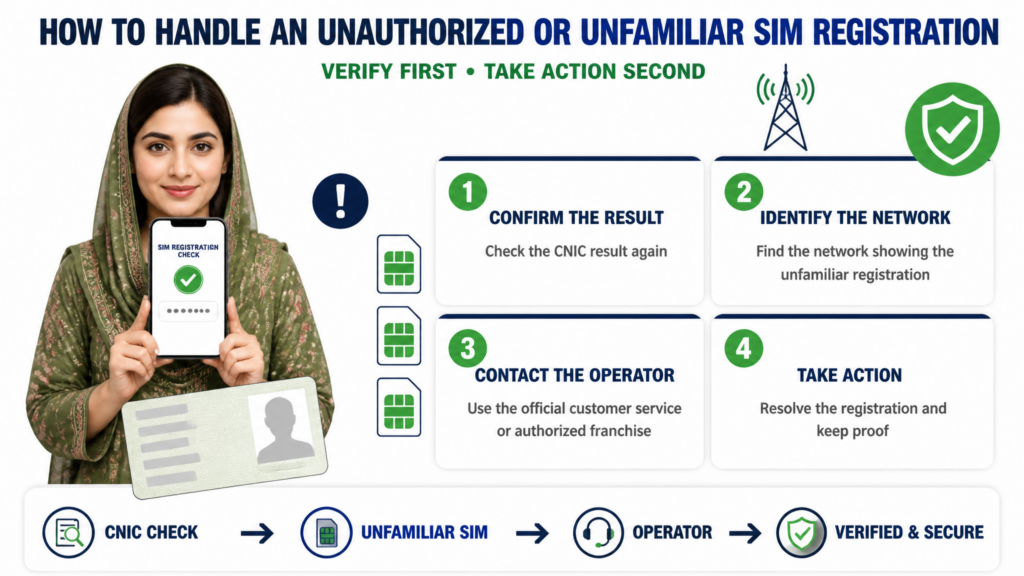
First, Confirm the Information
Before taking action, review the result you received from the official CNIC verification method.
Make a note of:
- the mobile operator;
- the number or registration information shown;
- the date you checked the record;
- any other information provided by the official system.
Keeping a dated record can be useful if you later need to explain the situation to the operator or submit a complaint.
Do Not Try to Identify the Person Yourself
An unfamiliar SIM may tempt you to search the number on websites claiming to reveal the owner’s name, CNIC, address or other personal information.
Avoid this approach.
Your objective is to determine why the SIM is associated with your CNIC, not to investigate another individual. Unofficial databases can contain outdated, inaccurate or improperly obtained information and may create additional privacy risks.
The correct route is to deal with the registration itself through the operator.
Identify the Relevant Operator
Once you know which network the unfamiliar SIM belongs to, contact that operator through its official customer-service channel or visit an authorized service location if required.
Explain the situation clearly:
A SIM registration appears to be associated with my CNIC, but I do not recognize the connection.
The operator can then explain what verification or procedure is available for the particular case.
Take Your Original CNIC If an In-Person Visit Is Required
If the operator asks you to visit a franchise or authorized service center, take the required identity document and follow its verification process.
Telecom providers have to protect subscriber records, so you may be required to verify your identity before information can be changed, blocked or disowned.
Do not hand your original CNIC to an unrelated agent or allow an unofficial person to perform a private “database check” for you.
Request the Appropriate Resolution
The exact action depends on the circumstances.
You may need to request:
- verification of the registration;
- blocking of an unwanted connection;
- disowning of a SIM;
- correction of a subscriber record;
- replacement-related clarification;
- or another operator-approved solution.
Do not assume that simply ignoring the unfamiliar SIM will make the registration disappear.
What If You Suspect Fraud?
If there are additional signs that your identity may have been misused—for example, repeated unexplained registrations, suspicious activity, or attempts to use your identity for telecom services—keep all relevant evidence.
Record dates, screenshots, messages and complaint references where appropriate.
Then use the official complaint and support channels relevant to the operator or authority involved.
Avoid publishing your CNIC, phone number, screenshots containing sensitive information, or other personal details publicly while asking for help online.
Check Again After the Issue Is Resolved
Once the operator has completed the required action, perform another official verification after an appropriate interval to confirm that your record reflects the change.
This creates a simple cycle:
Check → identify → contact operator → resolve → verify again.
That final verification step is important because it confirms that the registration issue was actually addressed rather than simply reported.
The key rule
An unfamiliar SIM on your CNIC should be treated as a registration issue that needs official verification, not as an invitation to search for another person’s private identity.
Use official verification services for your own record, work with the relevant operator to resolve unexpected registrations, and keep your personal identity information protected throughout the process.
How to Disown or Remove an Unwanted SIM From Your CNIC
If an unfamiliar, old, lost, or unnecessary SIM appears to be associated with your CNIC, identifying the registration is only the first step. The next objective is to resolve the registration through the relevant mobile operator. Leaving an unwanted connection attached to your identity can create unnecessary confusion when you check your record in the future.
The exact disowning procedure can vary between operators and can change when telecom policies are updated. For that reason, users should always confirm the latest requirements through the operator’s official customer-service channels before taking action.
What Does Disowning a SIM Mean?
Disowning a SIM generally means removing your association with a mobile connection that you no longer want registered under your identity.
This can be relevant when:
- you stopped using an old number;
- a SIM was lost;
- you replaced a connection;
- a SIM remains registered after you no longer need it;
- an unfamiliar registration appears on your CNIC;
- or you want to reduce unnecessary connections associated with your identity.
Disowning is different from simply removing the SIM card from your phone. Taking a SIM out of a device does not necessarily mean that its subscriber registration has been removed.
Step 1: Identify the Operator
Start by determining which network the unwanted SIM belongs to.
Your official CNIC verification result may help you understand which operator has the relevant registration. Once the operator is known, use that company’s official support channel or an authorized service location.
Do not rely on an unofficial agent who claims to have access to a private telecom database.
Step 2: Verify Your Identity
If the disowning process requires an in-person visit, you should expect to complete the operator’s identity verification requirements.
Your original CNIC may be required because the operator needs to confirm that the person requesting the change is actually the registered subscriber.
This verification is an important security measure. It prevents someone else from attempting to remove or change a SIM registration without authorization.
Step 3: Explain the Reason Clearly
Tell the representative exactly why you want the connection removed.
For example:
- “I no longer use this SIM.”
- “This is an old connection.”
- “I do not recognize this registration.”
- “The SIM was lost.”
Providing the correct reason can help the operator determine which procedure applies.
Step 4: Follow the Operator’s Current Procedure
The operator may ask for additional verification, documentation or confirmation before completing the request.
Do not assume that every SIM can be removed using the same process. A normal unused connection, a lost SIM, an ownership dispute and a potentially unauthorized registration may require different handling.
Follow the official procedure applicable to your specific situation.
Step 5: Keep the Reference or Confirmation
If the operator provides a receipt, complaint number, transaction reference or confirmation, keep it.
This can be useful if the registration does not disappear immediately or if you need to follow up later.
Avoid throwing away documentation until you have confirmed that the issue has been resolved.
Step 6: Check Your CNIC Again
After the operator confirms that the unwanted registration has been resolved, perform another official SIM verification when appropriate.
The purpose is to make sure your current record reflects the change.
Think of the complete process as:
Identify → Contact operator → Verify identity → Disown/resolve → Keep proof → Check again.
What You Should Not Do
Do not try to obtain the supposed user’s personal information simply because you found an unfamiliar SIM on your CNIC.
You do not need the stranger’s name, address or other private information to resolve the registration. The issue can be handled by addressing the SIM registration associated with your own identity through the authorized operator process.
Also avoid sharing your CNIC publicly on social media, forums or random websites while seeking assistance.
SIM Owner Details by CNIC is an important part of maintaining an accurate mobile subscriber record in Pakistan. By checking the SIM connections associated with your own CNIC, you can understand which registrations belong to you, review unfamiliar entries, and take the appropriate steps when a connection no longer matches your current records. Using official verification channels also helps protect your personal information while giving you a reliable way to manage your registered mobile connections.
Final Reminder
An unwanted SIM registration should be dealt with through the appropriate official channel rather than ignored. The goal is not to investigate another person’s identity; it is to make sure your own CNIC record is accurate and properly managed.
Because PTA requirements, operator procedures and applicable fees can change, always verify the latest disowning instructions before starting the process.
What to Do With Lost, Old, or Unused SIMs
Lost, old, and unused SIM cards are easy to forget, especially when a person changes mobile networks, upgrades a phone, replaces a number, or stops using a connection for a long period. However, forgetting about a SIM does not mean you should automatically assume that its registration has disappeared from your CNIC record.
This is why checking your own SIM registrations periodically is useful. It allows you to compare the connections associated with your identity with the numbers you actually recognize and use.
Lost SIM: Take Action Quickly
If you lose a SIM card, do not simply assume that the problem is solved because the physical card is no longer in your possession.
The first priority should be to contact the relevant mobile operator through its official support channel and follow the current procedure for a lost SIM.
Depending on your circumstances, you may need to:
- request that the lost connection be blocked;
- verify your identity;
- obtain a replacement SIM;
- or take another action recommended by the operator.
The correct procedure can vary, so always follow the operator’s latest instructions.
Why is a lost SIM important?
A SIM can remain associated with your subscriber identity even though you no longer physically possess it. If the number is important for account verification, communication, or other services, losing control of it can also create practical security concerns.
Therefore, treating a lost SIM as an account-management issue is better than simply replacing the physical card and forgetting about the old registration.
Old SIMs You No Longer Use
Many people have accumulated SIMs over the years.
You may have:
- changed from one network to another;
- stopped using a secondary number;
- replaced a SIM with a newer connection;
- used a temporary number;
- or kept a data SIM that is no longer necessary.
An old connection may remain relevant to your subscriber record, so review your CNIC-related registrations instead of relying only on memory.
If you are certain that you no longer need a connection, ask the relevant operator about the current process for discontinuing or disowning it.
Unused Does Not Always Mean Removed
A common misunderstanding is that simply leaving a SIM unused automatically removes it from your CNIC.
You should not rely on this assumption.
There can be a difference between:
not using a SIM and formally resolving its subscriber registration.
If you want an old connection removed from your identity record, confirm the applicable procedure with the mobile operator.
For users researching SIM Owner Details by CNIC, the first priority should always be accurate information about their own registered mobile connections. SIM Owner Details by CNIC can help users understand their subscriber record, review existing registrations, and recognize connections that may need further attention. When using SIM Owner Details by CNIC, always rely on legitimate verification methods and protect your personal identity information.
What About an Old SIM You Cannot Remember?
If an unfamiliar number appears during your CNIC verification, first think about your previous mobile history.
Ask yourself:
- Did I ever use this network?
- Did I replace a number?
- Did I have a second SIM?
- Did I use a data connection?
- Could this be an old registration I forgot?
If you still cannot explain it, contact the relevant operator rather than searching for the supposed user’s identity online.
Keep Your Own SIM List
A simple personal list can make future verification much easier.
Record the mobile connections you currently recognize and periodically compare that list with your official CNIC verification result.
This does not require publishing your numbers or sharing them with anyone. It is simply a private record that helps you notice changes.
The practical approach
For a lost SIM, secure the connection through the operator.
For an old SIM, confirm whether you still need it.
For an unused SIM, do not assume that inactivity automatically resolves its registration.
For an unfamiliar SIM, investigate the registration through the operator rather than trying to identify another person.
Keeping your SIM registrations organized is a small step, but it can make your overall mobile identity management much easier.
SIMs Registered on a Deceased Person’s CNIC
When a family member passes away, their mobile connections can become an overlooked part of the family’s administrative responsibilities. A SIM that was registered while the person was alive does not necessarily disappear from every record simply because the subscriber has died. Family members may therefore need to understand what should happen to those connections and how to handle them through the appropriate operator process.
This topic is especially important when a deceased relative had multiple mobile numbers, a number that is still being used by a family member, or a connection that is no longer required.
Why Should a Family Check the Record?
A deceased person’s CNIC may have been associated with one or more mobile connections. Some may have been actively used, while others could be old or forgotten.
Reviewing the situation can help the family determine:
- which connections existed;
- which numbers are still being used;
- which connections are no longer needed;
- whether a family member is relying on a number originally registered to the deceased;
- and what action should be taken with each connection.
The purpose is not simply to count the SIMs. It is to make sure that mobile registrations are handled properly after the subscriber’s death.
What If a Family Member Still Uses the Number?
A particularly important situation occurs when a son, daughter, spouse, parent, or another relative continues using a SIM that was registered under the deceased person’s identity.
The family should not assume that long-term use automatically changes the registered subscriber.
If the number needs to remain in use, contact the relevant mobile operator and ask about the current official ownership or transfer procedure applicable to the circumstances.
The operator can explain what documents and identity verification are required.
What Documents May Be Relevant?
The exact documentation can depend on the operator’s current procedure and the type of request being made.
A family dealing with a deceased subscriber may potentially need documents such as:
- the deceased person’s death certificate;
- relevant family documentation;
- identity documents of the family member making the request;
- and any other documentation required by the operator.
Do not rely on an old social-media post or an unofficial agent’s checklist. Requirements can change, so confirm them directly with the relevant operator before making a visit.
What About SIMs Nobody Uses?
If a deceased family member had connections that nobody needs anymore, ask the relevant operator what the appropriate process is for closing or resolving those registrations.
Do not simply distribute the SIMs among family members without first understanding the applicable subscriber-registration requirements.
A mobile connection should remain associated with the correct subscriber according to the operator’s current rules.
Why Is Timely Action Useful?
Telecom registration records are connected with subscriber identity information. Leaving old or unclear registrations unresolved can make future verification more complicated.
It is therefore useful for families to organize the deceased person’s mobile connections along with other important administrative matters.
Make a private list of the known numbers, identify which ones are still required, and then deal with each connection through the appropriate official operator channel.
Do Not Use Unofficial “Owner Lookup” Services
If the family discovers an unfamiliar number while reviewing records, there is no need to search for a supposed owner through an unofficial SIM database.
The objective should be to resolve the registration associated with the deceased person’s identity, not to obtain another individual’s private information.
A practical family checklist
1. Identify the deceased person’s known SIMs.
2. Determine which numbers are still being used.
3. Contact the relevant operator.
4. Ask about transfer, closure or other applicable procedures.
5. Prepare the required documentation.
6. Keep confirmation of any completed request.
7. Review the record again when appropriate.
Handling deceased-person SIM registrations through official channels helps keep family mobile records organized while reducing unnecessary privacy and administrative problems.
Expired CNIC and Its Impact on SIM Registration

An expired CNIC can create complications when you are managing mobile connections registered against your identity. Your CNIC is not only used as an identification document for everyday services; it is also connected with subscriber verification for mobile SIM registration. For that reason, keeping your identity document valid is an important part of maintaining accurate telecom records.
If your CNIC has expired, you should not ignore the situation simply because your existing SIM is still working. The practical impact can depend on current telecom rules and enforcement procedures, so users should always confirm the latest requirements through official PTA and NADRA information.
Why Does CNIC Validity Matter?
A SIM registration is associated with a subscriber’s identity. If the underlying identity document has expired, the information connected with that identity may require attention.
This becomes particularly important if you:
- need to purchase a new SIM;
- want to replace a lost SIM;
- need to update subscriber information;
- want to transfer or manage a connection;
- discover an unexpected registration;
- or are trying to keep several mobile connections properly organized.
An expired CNIC can therefore become more than an ordinary documentation issue.
Check Your CNIC Status
If you are unsure whether your CNIC is still valid, first confirm its status through the appropriate official NADRA service or documentation.
Do not rely on an old photograph of your identity card or assume that the expiry date is irrelevant because your phone is still receiving calls.
The safest approach is to keep your identity document current and follow the latest instructions provided by the relevant authorities.
What Should You Do If Your CNIC Has Expired?
The appropriate first step is generally to address the CNIC renewal itself through NADRA.
Once your identity document is renewed, keep the updated documentation available for situations where a mobile operator requires identity verification.
If you have multiple SIM connections, you should also review your registrations after dealing with the identity-document issue. This can help ensure that your mobile records remain consistent with the identity information you are currently using.
What If You Have SIMs Registered on an Expired CNIC?
Do not immediately assume that every SIM will stop working at the same moment or that the registration will automatically disappear.
Telecom systems and enforcement procedures can involve different stages, and current rules may change.
Instead:
- Verify the current status of your CNIC.
- Renew it through the appropriate NADRA process if required.
- Review your SIM registrations through an official verification method.
- Contact the relevant operator if you encounter a registration problem.
- Keep confirmation or documentation of any changes.
This approach is more reliable than depending on social-media claims about automatic blocking or deactivation.
Why Regular SIM Checks Still Matter
CNIC renewal does not replace the need to review your SIM registrations.
After your identity document is updated, it is useful to understand which connections are still associated with your record and whether they match the numbers you actually recognize.
If you find an unfamiliar SIM, deal with the registration through the relevant operator instead of trying to discover another person’s private identity.
Protect Your CNIC Information
An expired or renewed CNIC should still be treated as sensitive personal information.
Avoid uploading complete identity documents to random websites claiming to provide SIM owner details. Do not send your CNIC photograph, OTP or authentication information to unknown individuals.
Use official portals, authorized operator channels and trusted government services whenever identity verification is required.
Keep the whole record updated
Your mobile identity management should follow a simple cycle:
Valid CNIC → accurate SIM registration → periodic verification → prompt resolution of unexpected connections.
Because CNIC and telecom procedures can be updated by the relevant authorities, always check the latest official guidance before taking action based on a specific rule, deadline, fee or deactivation claim.
Keeping your CNIC current and periodically reviewing your registered SIMs can make it easier to maintain an accurate and secure mobile subscriber record.
SIM Owner Details by Mobile Number: What Can Actually Be Checked?
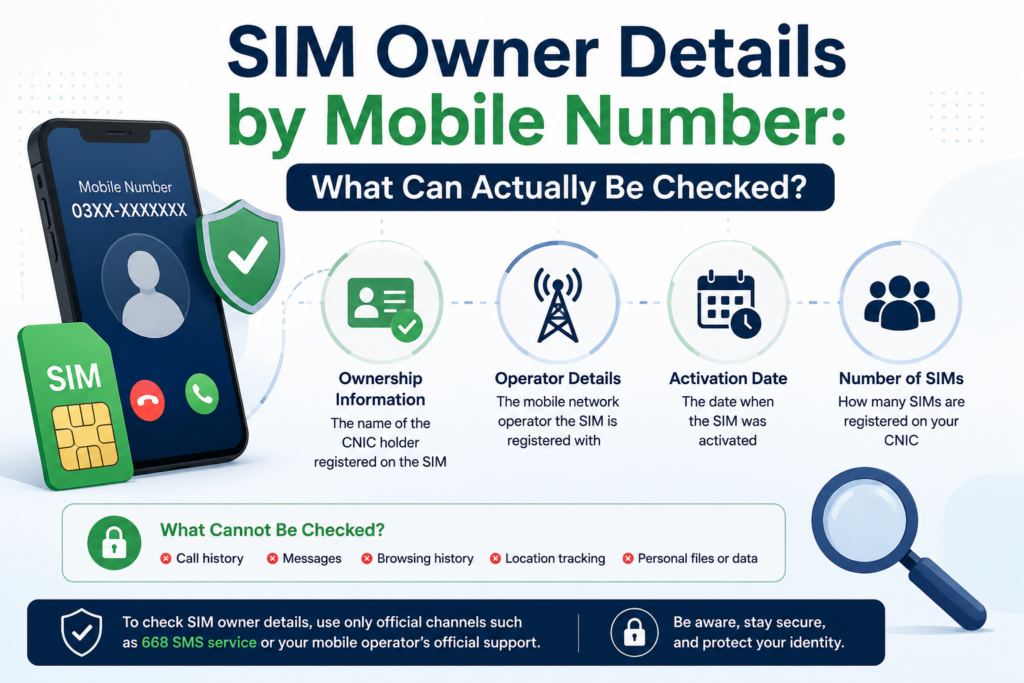
One of the most searched questions around SIM verification is whether a person can enter a mobile number and immediately discover the complete details of its registered owner. This is where many users become confused because number-based information and CNIC-based verification serve different purposes.
If your goal is to protect your own identity, the safest approach is to understand exactly what legitimate telecom services are designed to provide and what information should not be expected from a public lookup.
Can You Find a SIM Owner’s Complete Details by Number?
A mobile number is connected to a subscriber record, but that does not mean the subscriber’s complete private identity information is publicly available to everyone.
Information such as a person’s:
- full name;
- CNIC number;
- residential address;
- family information;
- location;
- call records;
- or other confidential subscriber data
should not be treated as ordinary public search information.
A website claiming that anyone can enter any Pakistani mobile number and instantly receive a complete private profile should therefore be approached with caution.
What Can a Legitimate Number Check Do?
Some legitimate services can provide limited information about a mobile number.
For example, a network-related check may help determine which operator is associated with a number. A SIM-specific verification process may also help a legitimate subscriber deal with a SIM that they physically possess.
These are very different from obtaining the complete identity profile of another person.
Understanding this difference prevents users from confusing a network check with an owner-identity lookup.
Why Do People Search for SIM Owner Details by Number?
There are several reasons people search this query.
Someone may have:
- received repeated calls from an unknown number;
- lost contact with a person;
- received suspicious messages;
- found a number associated with an unfamiliar account;
- received a scam call;
- or simply want to know who is calling.
Although the motivation may be understandable, the solution should still respect privacy.
If you are dealing with harassment, fraud, threats or suspicious communication, save the relevant evidence and use the appropriate official reporting or operator channels instead of purchasing private information from an unofficial database.
Be Careful With “SIM Database” Claims
Search results may contain websites advertising phrases such as:
SIM Owner Details, SIM Database, Live SIM Tracker, Number Owner, or CNIC Data.
The terminology alone does not prove that a service has legitimate access to current telecom subscriber records.
Some databases may contain old, inaccurate, incomplete or improperly obtained information. Even when a website displays a name or other personal information, that does not establish that the information is current, accurate or lawfully obtained.
What About Live SIM Tracking?
A mobile number is not the same thing as a public GPS tracking device.
Websites claiming that you can enter any phone number and instantly see another person’s exact live location should be treated very cautiously. Legitimate location services generally depend on authorization, device permissions, network systems or other controlled mechanisms.
A simple public number search should not be assumed to provide unrestricted real-time tracking.
What Should You Do Instead?
If the number belongs to you, use the relevant official verification method to check your own registration.
If you want to identify its network, use a legitimate network-identification service.
If the number is being used for harassment, fraud or another serious issue, preserve evidence and contact the relevant operator or official reporting authority.
The safest principle
Your own CNIC and SIM record can be verified through legitimate channels. Another person’s private identity should not be treated as publicly searchable information.
This distinction keeps SIM verification useful while protecting subscribers from unreliable databases, misleading lookup claims and unnecessary privacy risks.
SIM Fraud, Unauthorized Registration and Identity Misuse
A SIM registered against your CNIC can become a serious concern when you do not recognize the connection or cannot explain how it became associated with your identity. This does not automatically mean that fraud has occurred, but it is a situation that should be investigated through the appropriate official channels.
Your mobile identity is connected with important subscriber information, so keeping track of the SIMs registered against your CNIC can help you notice unusual activity earlier.
What Is Unauthorized SIM Registration?
Unauthorized registration generally refers to a situation where a mobile connection is associated with your identity without your knowledge or without your proper authorization.
There can be different reasons behind an unexpected registration. It may be an old connection you forgot about, a previous SIM that you stopped using, or a genuine registration problem that requires operator assistance.
For this reason, the first step should always be verification rather than accusation.
Common Warning Signs
You may want to investigate your record if:
- a SIM appears that you do not recognize;
- you receive unexpected telecom-related messages;
- you discover a connection you stopped using long ago;
- your SIM registration information does not match your records;
- you lose a SIM and do not immediately secure the connection;
- or you notice unusual activity connected with a mobile account.
One sign alone does not necessarily prove identity misuse, but multiple unexplained issues should not be ignored.
What Should You Do First?
Start by checking your own SIM registration information through an official verification method.
Once you have identified an unfamiliar registration, note the relevant operator and keep a record of the information shown.
Do not publish your CNIC or complete SIM information online while asking strangers for help.
Contact the Relevant Mobile Operator
After identifying the operator, use its official customer-service channel or authorized service location.
Explain that a connection appears to be associated with your CNIC and that you do not recognize it.
The operator may require identity verification before investigating or changing the subscriber record. Follow the current procedure provided by the operator and keep any complaint number, receipt or reference that you receive.
What If the SIM Is Being Misused?
If you have reason to believe that a SIM connected to your identity is being used for fraudulent, threatening or otherwise unlawful activity, preserve relevant evidence.
Useful evidence can include:
- screenshots;
- messages;
- dates and times;
- mobile numbers;
- operator correspondence;
- complaint references;
- and other relevant records.
Do not confront or attempt to investigate the suspected user yourself. Use the appropriate official reporting route for the nature of the problem.
Protect Your CNIC and Mobile Information
Identity misuse becomes more difficult when personal information is unnecessarily shared.
Avoid giving your CNIC number, CNIC photographs, OTPs or account credentials to unknown people. Be particularly careful with websites that request extensive personal information simply to perform a basic SIM-related check.
A legitimate verification process should have a clear purpose.
Prevention Is Better Than Waiting for a Problem
You do not have to wait until fraud occurs before checking your SIM registrations.
A simple routine can help:
Check your CNIC → compare the registrations → investigate unfamiliar entries → resolve unwanted connections → check again later.
Also keep your own list of active SIMs and review it whenever you change numbers, replace a SIM or stop using a connection.
Final takeaway
An unexpected SIM registration should be treated seriously but calmly. Verify first, contact the relevant operator, document the issue and use official complaint channels when necessary.
The objective is not to discover another person’s private identity. The objective is to ensure that your own CNIC and mobile subscriber record remain accurate, secure and under your control.
How to Keep Your SIM Registration Records Safe and Updated
Managing the SIMs registered against your CNIC should not be something you do only after a problem appears. A simple and consistent checking routine can help you keep track of your mobile connections, identify unfamiliar registrations earlier, and reduce confusion when you change numbers or replace SIM cards.
Your goal should be straightforward: know which SIMs you recognize, keep unnecessary connections under control, and use official channels whenever something needs to be changed.
Keep a Personal Record of Your Active SIMs
Start by maintaining a private list of the mobile numbers you currently use.
You do not need to upload this list anywhere. It can simply be a personal note containing:
- the mobile number;
- the operator;
- whether it is a voice or data connection;
- and whether you actively use it.
This makes future CNIC checks much easier because you can compare the official result with your own records.
Review Your SIM Registrations Periodically
People often remember their current numbers but forget connections they used months or years ago.
A periodic review can help you identify:
- old connections;
- unused SIMs;
- replacement-related registrations;
- connections you no longer recognize;
- or changes that need clarification.
There is no need to create unnecessary anxiety around every check. The purpose is simply to maintain awareness of your own subscriber record.
Update Your Records When You Change a SIM
Whenever you purchase, replace, discontinue or change a SIM, update your private list.
For example, if you stop using an old number and move to a new connection, record the change. If you replace a SIM because it was damaged or lost, keep note of what happened.
This small habit can prevent confusion later when an older registration appears during a verification check.
Protect Your CNIC Information
Your CNIC number is sensitive personal information, so avoid sharing it unnecessarily.
Be cautious when:
- submitting your CNIC to websites;
- uploading a CNIC photograph;
- responding to unknown messages;
- providing information to unofficial agents;
- or entering personal details into unfamiliar SIM-related services.
A website does not become trustworthy simply because it uses words such as “official,” “database,” “verification,” or “SIM owner” in its title.
Before providing personal information, understand why it is required and whether the service is actually appropriate for your purpose.
Protect Your OTPs and Authentication Information
Your CNIC is not the only information that needs protection.
Never casually share:
- OTP codes;
- account passwords;
- verification codes;
- banking credentials;
- or authentication messages.
If someone contacts you claiming to be from a telecom company and asks for a sensitive verification code, independently confirm the request through the operator’s official support channel.
Deal With Lost SIMs Promptly
If you lose a SIM, contact the relevant operator and follow its current procedure rather than waiting.
This is particularly important when the number is connected to important accounts, services or communications.
The quicker you secure a lost connection, the easier it can be to reduce unnecessary risk.
Review After Important Changes
A useful time to check your SIM registration is after a major change, such as:
- replacing a SIM;
- changing your mobile number;
- renewing identity documentation;
- discontinuing an old connection;
- or resolving an unfamiliar registration.
A follow-up check can help confirm that your records now match your actual mobile usage.
Use Official Information for Rule Changes
Telecom procedures can change over time. A method, fee, requirement or service process that was correct several years ago may not remain exactly the same.
When you need to make an important decision about your SIM registration, verify the current procedure through PTA, the relevant mobile operator, or another appropriate official source.
A simple long-term routine
You can keep your mobile identity records organized with five habits:
Know your SIMs → protect your CNIC → secure lost connections → resolve unfamiliar registrations → verify again.
This approach does not require complicated tools. It simply means taking responsibility for the mobile connections associated with your identity and using legitimate channels whenever you need assistance.
Common SIM Owner Details and CNIC Verification Mistakes
Many problems with SIM verification happen because users misunderstand what a particular service is designed to do. A person may enter the wrong CNIC format, use an outdated procedure, confuse a network check with a registration check, or rely on an unofficial website that promises information beyond the scope of legitimate telecom services.
Understanding these common mistakes can make the verification process easier and safer.
Mistake 1: Using an Unofficial Website First
One of the biggest mistakes is searching for a random “SIM owner details” website before checking the official options.
A third-party page may use attractive claims, but that does not establish that its information is current or officially sourced.
For your own SIM registration, start with the appropriate official verification method.
Mistake 2: Assuming Every Number Lookup Shows the Owner
A mobile-number check and a CNIC-based SIM check are not necessarily the same service.
Some legitimate services can provide limited network or SIM-related information, while subscriber identity information may be restricted.
Do not assume that entering any mobile number should produce the complete private profile of its registered subscriber.
Mistake 3: Entering the CNIC Incorrectly
A small formatting mistake can prevent a verification request from working correctly.
When using an official service, follow its current instructions exactly. If the service requires a 13-digit CNIC without dashes, use that format rather than adding spaces or unnecessary characters.
Do not repeatedly submit information without checking the instructions first.
Mistake 4: Assuming an Unknown SIM Means Immediate Fraud
Seeing a registration you do not recognize can be concerning, but it is not automatic proof of identity theft.
It may be:
- an old SIM;
- a previously used number;
- a replacement-related registration;
- a connection you forgot about;
- or a registration that genuinely requires investigation.
First verify the information and then contact the relevant operator if you cannot explain it.
Mistake 5: Ignoring Old or Unused SIMs
People often stop using a number and assume that removing the SIM card from their phone is enough.
Physical inactivity and subscriber-record management are not necessarily the same thing.
If you no longer need a connection, ask the relevant operator about the appropriate current procedure for discontinuing or resolving it.
Mistake 6: Sharing CNIC or OTP Information With Strangers
Never provide sensitive identity or authentication information simply because someone promises to “check your SIM details.”
Be especially careful with requests for:
- CNIC photographs;
- OTPs;
- passwords;
- verification codes;
- banking details;
- or unnecessary personal documents.
Use official channels instead.
Mistake 7: Following Outdated Information
Telecom procedures can change. An old article may mention a fee, code, process or requirement that is no longer current.
Before acting on a specific instruction, verify it through the relevant official authority or operator.
This is especially important when dealing with SIM blocking, ownership changes, disowning, verification requirements or identity-document issues.
Mistake 8: Not Checking Again After a Change
Another common mistake is assuming that a problem is resolved simply because an operator has accepted a request.
If appropriate, perform another official verification after the change has been processed.
This gives you a second confirmation that your current registration record matches your expectations.
Mistake 9: Publishing Your Personal Information While Seeking Help
If you have an unknown SIM or registration problem, do not post your full CNIC, phone number, screenshots containing sensitive information, or account details publicly on social media or forums.
Keep evidence private and share it only through appropriate official channels.
The safest verification habit
The simplest rule is:
Use official methods → enter accurate information → understand what the result means → resolve unexpected registrations through the operator → verify again.
Avoiding these mistakes can save time, protect your personal information and make the entire SIM verification process much more reliable.
How to Read and Understand Your SIM Verification Result
Getting a SIM verification result is only useful if you understand what the information means. Many users receive an operator-wise result or registration information and immediately try to interpret every entry as a current SIM they personally use. In reality, your result should be compared carefully with your own mobile history before you decide that something is wrong.
The purpose of reviewing the result is to understand which registrations are associated with your CNIC and whether those registrations make sense to you.
Start With the Overall SIM Count
First, look at the total information provided by the official verification method.
The number of registrations can give you a general idea of how many connections are associated with your identity. However, the total alone does not tell you whether every connection is currently being used by you.
A person may have several registrations because of old numbers, replacements, additional connections or previous mobile usage.
Therefore, do not judge your record solely by the total.
Check the Operator-Wise Information
If the result separates information by mobile operator, review each category individually.
For example, you may recognize your current number on one network while seeing another registration under a different operator.
Ask yourself:
- Have I ever used this network?
- Did I previously have a number from this operator?
- Did I replace or change a SIM?
- Could this be an older connection?
- Is there any family or business-related explanation?
This simple review can help distinguish a forgotten connection from a genuinely unexpected registration.
Compare the Result With Your Own Records
Your personal SIM list becomes useful here.
Compare the official result with the numbers you currently recognize. If you have kept records of previous connections, compare those as well.
Do not rely entirely on memory, especially if you have been using mobile services for many years.
An unfamiliar result deserves further attention, but it should not automatically be treated as proof of unauthorized activity.
What If Something Does Not Match?
If an entry remains unexplained after reviewing your own records, identify the relevant operator and contact it through an official channel.
Explain that the registration appears under your CNIC but you cannot identify the connection.
The operator may ask for identity verification or provide instructions for resolving the issue.
Keep any complaint number, receipt or reference provided during the process.
Understand What the Result Does Not Tell You
A SIM verification result should not automatically be interpreted as a complete personal profile of every subscriber.
It may provide information related to SIM registrations associated with your own identity, but that does not mean you can use the same service to retrieve another person’s private information.
Similarly, a network-related result should not be confused with subscriber identity information.
Knowing the network of a number is a different task from determining the private identity of the person using it.
Avoid Making Public Accusations
If you discover an unfamiliar registration, do not post the number or your CNIC information publicly and accuse someone of using your identity.
There may be an innocent explanation, and publishing personal information can create another privacy problem.
Resolve the matter through the operator and appropriate official channels instead.
Keep a Record of Important Changes
If you successfully resolve an unwanted registration, keep confirmation of the action. Later, perform another official check when appropriate to confirm that your record has been updated.
This gives you a useful timeline:
Original check → unexpected registration → operator complaint → resolution → follow-up check.
The most important principle
Your SIM verification result should be treated as a record to understand and manage, not as a tool for investigating other people.
Take your time, compare the information with your own records, verify anything unexpected through the relevant operator, and protect the personal information contained in your result.
This approach makes your CNIC SIM check more meaningful and helps ensure that your mobile subscriber record remains accurate over time.
What Information Can You Get From an Official SIM Check?
When you perform a SIM verification using an official method, it is important to understand what the result is designed to show. Many users search for “SIM Owner Details” expecting a complete personal profile, but legitimate telecom verification is more focused on subscriber registration and SIM connections associated with your own identity.
Understanding the scope of the result helps you avoid confusion and prevents you from relying on unofficial services that promise information beyond what a legitimate verification system is intended to provide.
SIM Registration Information
The most important purpose of a CNIC-based SIM check is to help you understand the mobile connections associated with your identity record.
Depending on the official service being used, the result may provide information related to the number or category of SIM registrations associated with your CNIC.
This can help you compare the result with the mobile connections you currently use.
Operator Information
A verification result may also organize information according to the mobile operator.
This is useful because you may recognize a registration once you know which network it belongs to.
For example, if you have only recently started using one network but discover an entry associated with another operator, you can consider whether it relates to an older connection.
Operator information can therefore make your personal record easier to understand.
Information About Your Own SIM
Some official or operator-specific services may provide information about a SIM that you physically possess or about the subscriber relationship associated with your own connection.
These services should not automatically be interpreted as public databases.
The exact information available depends on the purpose and design of the particular official service.
What an Official Check Does Not Mean
A legitimate SIM verification result should not be treated as permission to retrieve another person’s complete private profile.
For example, users should not assume that an official self-check provides unrestricted access to another person’s:
- residential address;
- family information;
- call history;
- private communications;
- real-time location;
- or other confidential records.
The purpose of self-verification is to help you understand your own subscriber information.
Network Information Is Different
A network identification service can answer a narrower question:
Which mobile network is associated with this number?
That is different from:
Who is the private individual using this number?
Keeping these two questions separate is important when researching SIM-related information online.
Why Information Can Sometimes Look Different
Your current mobile usage and your historical subscriber record may not always appear identical.
You may have:
- changed your mobile number;
- replaced a SIM;
- stopped using a connection;
- moved between operators;
- or maintained a secondary connection.
Therefore, an unexpected entry should first be compared with your own history.
If you still cannot explain it, contact the relevant operator rather than trying to obtain private information about another person.
Use the Result as a Verification Tool
The most useful way to think about an official SIM check is as a record-management tool.
Use it to:
- Understand your registered connections.
- Compare them with the SIMs you recognize.
- Identify anything unexpected.
- Contact the relevant operator when necessary.
- Confirm the record again after an issue is resolved.
This approach turns a simple SIM check into a useful part of your personal identity-management routine.
Keep your expectations realistic
No single verification method should automatically be assumed to provide every type of telecom information.
The exact result depends on the service, the purpose of the check and the current procedures established by the relevant authority or operator.
For that reason, always read the instructions associated with the official service you are using and avoid relying on third-party claims about what a particular code or portal can supposedly reveal.
The key principle is simple: use official SIM verification to understand and manage your own CNIC-linked registrations, while respecting the privacy of other subscribers.
SIM Owner Details by CNIC helps users understand the mobile connections associated with their own identity record. When reviewing SIM Owner Details by CNIC, users can compare their registered connections with the SIMs they currently use and identify registrations that may require further clarification. This makes SIM Owner Details by CNIC a useful starting point for maintaining an accurate and organized subscriber record.
What to Do When Your SIM Verification Information Is Incorrect
Sometimes the result of a SIM verification may not match what you expect. You may see a connection you do not recognize, discover that an old SIM is still associated with your record, or find that the information you have in your personal notes does not match the current subscriber record.
An unexpected result does not automatically mean that the system is wrong or that identity fraud has occurred. The right approach is to compare, verify and resolve the issue through the appropriate official channel.
1. Check the Information Again
Before taking any major action, review the result carefully.
Make sure you entered your CNIC correctly and followed the current instructions of the official verification service.
If you made a formatting mistake or misunderstood the displayed information, the apparent problem may simply be a verification error.
2. Compare It With Your Mobile History
Think about every SIM you have used in the past.
Consider whether the unfamiliar information could relate to:
- an old number;
- a previous operator;
- a replacement SIM;
- a secondary connection;
- a data connection;
- or a number you stopped using some time ago.
People often remember their current numbers but forget connections from several years earlier.
3. Identify the Relevant Operator
If the information still appears incorrect or unfamiliar, determine which mobile operator is associated with the registration.
This is important because the operator responsible for the subscriber record is generally the appropriate place to begin resolving a connection-specific issue.
Use the operator’s current official customer-service channel or visit an authorized service location when required.
4. Ask for Verification or Correction
Clearly explain the problem to the operator.
For example:
“This SIM registration appears against my CNIC, but I do not recognize or use this connection.”
The operator may require identity verification and may then explain what procedure applies.
Depending on the circumstances, the appropriate solution could involve clarification, blocking, disowning, replacement-related action, or another subscriber-record procedure.
Do not assume that every unexpected registration can be handled using the same process.
5. Keep Proof of Your Complaint
If you contact the operator, keep any relevant:
- complaint number;
- receipt;
- reference number;
- SMS confirmation;
- email;
- or other official response.
This information can become useful if the issue takes time to resolve or you need to follow up later.
6. Check Again After Resolution
Once the operator confirms that the issue has been addressed, perform another official SIM verification when appropriate.
The purpose is to determine whether your current record now reflects the expected situation.
A second check is particularly useful when you have requested the removal or resolution of an unwanted registration.
What If You Believe the Information Is Being Misused?
If the situation includes signs of identity misuse, fraud, harassment or another serious issue, preserve evidence and use the relevant official complaint mechanism.
Do not publish your complete CNIC or personal subscriber information publicly while seeking assistance.
Also avoid attempting to investigate the suspected user yourself. The issue can be addressed by resolving the registration connected with your identity.
Keep Your Personal Records Updated
One useful prevention method is maintaining your own private list of active SIMs.
Whenever you:
- activate a new connection;
- replace a SIM;
- discontinue a number;
- change operators;
- or resolve an unfamiliar registration,
update your record.
This makes future verification much easier because you have something reliable to compare against the official result.
A simple resolution process
When something looks wrong, follow this sequence:
Check your information → compare your history → identify the operator → request official verification → keep the reference → verify again.
This approach avoids unnecessary assumptions while still taking unexpected SIM registrations seriously.
The goal of a SIM verification system is not simply to produce a result. Its real value comes from helping you understand and manage the mobile connections associated with your own identity.
If you believe that your personal or telecom information has been misused, exposed, or involved in a cybercrime, it is important to use an official reporting channel rather than relying on unofficial services. The National Cyber Crime Investigation Agency (NCCIA) is Pakistan’s designated agency for cybercrime inquiries, investigations, and prosecutions, and its official website provides information about complaint procedures and reporting centres. Visit the official NCCIA website
Frequently Asked Questions About SIM Owner Details by CNIC
People searching for SIM Owner Details by CNIC often have very specific questions. Some want to check how many SIMs are associated with their CNIC, while others need help understanding an unfamiliar registration, a lost SIM, an old connection, or the difference between official verification and third-party claims.
The following questions address the most common practical situations.
Can I check SIMs registered on my CNIC?
Yes. You can use the appropriate official SIM verification method to review the connections associated with your own CNIC. Always follow the current instructions provided by the relevant authority or operator.
How can I check my SIM registration through SMS?
The commonly used 668 SMS service can be used for CNIC-related SIM verification. Follow the current official instructions regarding CNIC format, SMS procedure and applicable charges.
Can I check SIM registration online?
Yes, an official online verification route is available for checking SIM-related information associated with your own CNIC. Make sure you are using the genuine official portal and not an unrelated third-party website.
Can I find someone’s name from a mobile number?
A mobile number should not be treated as a public key that gives unrestricted access to another person’s private identity information. Legitimate services may provide limited network or subscriber-related information for specific purposes, but that is different from obtaining a stranger’s complete personal profile.
How many SIMs can be registered on one CNIC?
Pakistan has a defined limit on SIM registrations associated with a CNIC. The commonly cited limit is 8 SIMs, with separate treatment for voice and data connections. Always verify the current rule through official PTA information because telecom policies can change.
What should I do if an unknown SIM appears on my CNIC?
First, review your own mobile history and make sure the registration is genuinely unfamiliar. Then identify the relevant operator and contact its official customer-service channel or authorized service location. Do not attempt to identify the other user through an unofficial database.
Does an unused SIM automatically disappear from my CNIC?
You should not assume that simply stopping use of a SIM automatically resolves its subscriber registration. If you no longer need a connection, ask the relevant operator about the current procedure for discontinuing or disowning it.
What should I do if my SIM is lost?
Contact your mobile operator promptly and follow its official lost-SIM procedure. Depending on the situation, you may need to block the connection, request a replacement, or complete another identity-verification process.
Can I check the SIMs of another person using their CNIC?
CNIC-based verification should be used for your own identity record. Do not enter another person’s CNIC into a service simply to investigate their private mobile registrations.
Is a SIM network check the same as an owner check?
No. A network check can answer which operator is associated with a number, while subscriber registration information concerns the relationship between a SIM and its registered identity. These are separate types of information.
What if my SIM verification result looks incorrect?
Check that you entered your CNIC correctly and followed the current instructions. Compare the result with your previous mobile connections. If an entry remains unexplained, contact the relevant operator and request clarification or resolution.
Can I remove an unwanted SIM from my CNIC?
If a SIM is no longer required or appears incorrectly registered, contact the relevant operator and follow its current disowning or resolution procedure. Requirements can vary depending on the circumstances.
What if a deceased family member had SIMs?
The family should identify the relevant connections and contact the appropriate operator about the current process for transfer, closure or other applicable action. Documentation may be required.
Does an expired CNIC affect SIM registration?
An expired identity document can create telecom-related complications. If your CNIC has expired, address the identity-document issue through the appropriate NADRA process and then check your SIM registrations using current official guidance.
Should I share my CNIC with a SIM lookup website?
Be cautious. Before submitting your CNIC to any website, confirm why the information is required and whether the service is genuinely appropriate for your purpose. For your own SIM registration, prefer official verification channels.
Should I share an OTP with someone who offers SIM verification?
No. Do not give authentication codes or OTPs to unknown individuals. If someone claims to represent a telecom company, independently verify the request through the operator’s official channel.
Can a SIM number reveal someone’s live location?
A mobile number should not be assumed to provide the public with unrestricted real-time location information. Legitimate location features generally depend on authorized services, devices, permissions or controlled systems.
How often should I check my SIM registrations?
There is no need to become obsessive about checking, but periodic reviews can be a useful part of personal identity management. It is particularly sensible to review your record after changing, replacing, losing or discontinuing a SIM.
What is the safest way to check SIM Owner Details?
The safest approach is to focus on your own CNIC and SIM registrations, use official verification methods, contact the relevant operator when something is unclear, and avoid services that promise unrestricted access to another person’s private information.
What is the most important thing to remember?
SIM verification is primarily about managing your own subscriber record. If you find something unexpected, verify it, contact the relevant operator, document the process and check again after the issue has been resolved.
Final Checklist: How to Check and Manage SIMs on Your CNIC
Checking SIM Owner Details by CNIC should not end when you receive a verification result. The real purpose of the process is to understand your registered connections, identify anything unexpected, and keep your mobile identity records organized over time.
Use the following checklist whenever you want to review your SIM registrations.
Step 1: Use an Official Verification Method
Start with the appropriate official CNIC-based SIM verification service.
Avoid beginning with an unfamiliar website that promises extensive personal information from a mobile number or CNIC.
Your first objective should always be checking your own record through a legitimate source.
Step 2: Enter Your Information Correctly
Use your own CNIC and follow the current instructions provided by the verification service.
Check the required format carefully before submitting your information.
Never share OTPs, passwords or other authentication details with someone who claims they can perform the check for you.
Step 3: Review the Result Carefully
Look at the information provided by the official service.
Consider:
- the total number of registrations;
- operator-wise information;
- connections you currently use;
- old numbers you may have forgotten;
- and anything that genuinely looks unfamiliar.
Do not immediately assume that an unexpected entry proves fraud.
Step 4: Compare It With Your Own SIM List
Maintain a private list of the mobile connections you recognize.
When you perform a new verification, compare the result with that list.
This makes it easier to identify old or unnecessary registrations and can help you notice unexpected changes.
Step 5: Investigate Unfamiliar Registrations
If you still cannot explain a registration, identify the relevant mobile operator.
Contact its official customer-service channel or visit an authorized service location if required.
Explain that the connection appears to be associated with your CNIC but you do not recognize it.
Step 6: Follow the Official Resolution Process
Depending on the circumstances, the operator may guide you through:
- verification;
- blocking;
- disowning;
- replacement;
- ownership-related procedures;
- or another appropriate resolution.
Follow the current requirements rather than relying on an outdated online tutorial.
Step 7: Keep Your Evidence
If you report an unexpected registration, save:
- screenshots;
- complaint numbers;
- receipts;
- reference numbers;
- SMS confirmations;
- and relevant correspondence.
Keep this information private and use it only when communicating with the appropriate authority or operator.
Step 8: Verify Again
After an operator confirms that a problem has been resolved, perform another official check when appropriate.
This final step helps confirm that your current record matches the action that was taken.
Step 9: Review Your SIMs After Major Changes
Consider checking your record after:
- activating a new SIM;
- replacing a SIM;
- losing a SIM;
- discontinuing a number;
- changing operators;
- renewing identity documentation;
- or resolving an unfamiliar registration.
This creates a useful habit without requiring constant checking.
Step 10: Protect Your Personal Information
Never publish your full CNIC, sensitive screenshots, OTPs, passwords or account credentials publicly.
Be cautious with any website or person asking for more information than is reasonably necessary for the service being provided.
Your Complete SIM Verification Routine
The entire process can be remembered with one simple sequence:
Check → Compare → Identify → Contact → Resolve → Confirm.
This approach keeps the focus where it belongs: managing the SIM registrations associated with your own identity.
Final takeaway
SIM Owner Details by CNIC should be approached as a personal verification and record-management process, not as a way to investigate strangers.
Use official methods, keep your own SIM information organized, resolve unfamiliar registrations through the relevant operator, protect your CNIC and authentication details, and verify important changes afterward.
Telecom procedures can change, so whenever you are dealing with a specific code, fee, limit, deadline or operator requirement, confirm the current information through the relevant official source before taking action.