SIM Ownership Transfer Pakistan is the official process of changing the registered subscriber of a mobile connection from one eligible person to another.
If a mobile SIM is registered under one person’s CNIC but is now permanently being used by another person, the proper solution is SIM ownership transfer. The transfer changes the subscriber registration so that the mobile connection is associated with the new owner’s identity through the applicable operator and verification process.
SIM ownership transfer is different from simply giving your SIM card to another person. Physically handing over a SIM does not automatically change the registered owner. The SIM remains associated with the original subscriber until the appropriate ownership process is completed.
This distinction is important because a mobile number can be connected to important services, accounts, recovery options, and personal communications. Keeping the registration under the correct person’s identity helps maintain accurate subscriber records and reduces unnecessary security and account-management problems.
What Is SIM Ownership Transfer?
SIM ownership transfer is the process of changing the registered subscriber of a mobile connection from the current owner to a new owner.
For example:
Current Owner’s CNIC → Ownership Transfer Process → New Owner’s CNIC
The mobile number may remain the same while its registered ownership changes, subject to the operator’s rules and the applicable regulatory requirements.
This can be relevant when:
- A SIM is being permanently given to another family member
- A person is using a number registered under someone else’s CNIC
- A business needs to reorganize company SIM registrations
- A previously shared number needs to be registered correctly
- A family member needs to take responsibility for a connection
- A legitimate registration correction is required
The exact procedure can depend on the circumstances and the mobile operator.
SIM Usage Is Not the Same as SIM Ownership
This is one of the most important concepts to understand.
Suppose a SIM is registered under your father’s CNIC, but you use that SIM every day.
You may physically possess and use the SIM, but the registration can still remain under your father’s identity.
Therefore:
SIM user ≠ necessarily registered SIM owner
If the number is intended to belong to you permanently, you should ask the relevant operator about the official ownership-transfer procedure rather than continuing to use another person’s registration indefinitely.
Why Should SIM Ownership Be Transferred?
Correct registration provides several practical advantages.
1. Accurate Subscriber Records
The mobile operator’s records correspond more closely with the person actually responsible for the connection.
2. Easier Account Management
When the correct person is registered, future SIM replacement, account-related requests, and other services can be easier to manage.
3. Better Identity Awareness
The owner can monitor which SIMs are associated with their own CNIC through recognized SIM-verification methods.
4. Reduced Confusion
Family members, employees, and businesses can avoid situations where one person uses a number that remains registered to someone else.
5. Improved Security
Correct ownership reduces uncertainty when a SIM is lost, replaced, blocked, or involved in a security issue.
When Should You Consider SIM Ownership Transfer?
There is no single situation in which everyone must transfer a SIM. The need depends on who legally and practically owns the connection and how it is being used.
Common scenarios include:
A SIM Registered Under a Parent’s CNIC
A child may have used a number for years even though the registration belongs to a parent.
If the number is now intended to be the child’s personal connection, the family can ask the operator about transferring the registration.
A Number Bought or Received From Another Person
If a mobile number changes hands, simply receiving the physical SIM is not enough to establish the new subscriber’s registration.
The proper operator process should be followed.
Business or Employee SIM
A company may need to review connections assigned to employees and ensure that the registration structure matches its actual ownership and business requirements.
Family Member’s Number
A number may be used by one family member while remaining registered under another person’s identity.
If permanent ownership is changing, official transfer should be considered.
Is SIM Ownership Transfer the Same as SIM Replacement?
No.
These are two different processes.
SIM Replacement
A replacement usually concerns the physical SIM or service continuity.
For example:
Lost SIM → Replacement SIM → Same mobile service
Ownership Transfer
Ownership transfer concerns the registered subscriber.
For example:
Current CNIC Holder → Ownership Transfer → New CNIC Holder
A person can sometimes need both services at different times, but they should not be treated as the same procedure.
Is SIM Ownership Transfer the Same as SIM Registration?
Not exactly.
SIM registration generally refers to registering a mobile connection with a subscriber’s identity.
SIM ownership transfer refers to changing the registered subscriber from one person to another through the applicable process.
Understanding this difference will help you avoid following the wrong procedure.
Can SIM Ownership Be Changed Online?
Do not assume that ownership transfer can be completed entirely online.
Because ownership changes involve identity verification, the operator may require an authorized service location and biometric or other verification procedures.
Online pages, apps, or unofficial agents claiming that they can transfer a SIM remotely for a fee should be treated cautiously.
Always confirm the current process directly with the relevant mobile operator.
Why Biometric Verification Matters
SIM ownership is connected to subscriber identity, so identity verification is a major part of the legitimate transfer process.
Depending on the current rules and the circumstances, the operator may require biometric verification of the parties involved.
This is designed to help ensure that a transfer request is associated with the actual individuals involved rather than someone simply claiming ownership.
Never allow an unknown person to perform biometric verification on your behalf.
What Should You Carry to an Operator Service Center?
Before visiting an authorized operator franchise or service center, confirm the current requirements.
Depending on the situation, you may need items such as:
- Original CNIC of the current owner
- Original CNIC of the new owner
- The relevant SIM
- Required biometric verification
- Additional documentation in special cases
Requirements can differ for unusual situations, such as deceased subscribers, corporate connections, overseas owners, or legal representatives.
Therefore, confirm the current requirements with the operator before making the visit.
Important: Don’t Use Unofficial Transfer Services
Be especially careful with websites, social-media pages, or individuals claiming:
“We can transfer your SIM ownership online without biometric verification.”
A legitimate ownership change should follow the applicable operator and regulatory procedure.
Never send your:
- CNIC photographs
- Fingerprint information
- OTP
- Account passwords
- Banking credentials
to an unknown person claiming to be a SIM-transfer agent.
What Happens After a Successful Transfer?
Once the operator completes the applicable ownership process, the mobile registration should reflect the new subscriber according to the operator’s system and applicable telecom records.
Afterward, the new owner should:
- Keep the transfer documentation or receipt.
- Verify the mobile number and account details.
- Review the registration through an official SIM-check method when appropriate.
- Update important account information where necessary.
- Keep personal identity information secure.
Check Your SIM Registration After Transfer
After completing an ownership change, it is useful to maintain awareness of your registered SIMs.
Your existing 668 SIM Check Pakistan article can be used here as an internal resource for readers who want to understand CNIC-based SIM registration verification.
Similarly, readers who need a broader explanation of SIM verification can be directed to your existing SIM Verification Pakistan guide.
This creates a natural internal-link structure:
Ownership Transfer → SIM Registration → 668 Check → SIM Verification
Important Difference Between Ownership and Possession
Remember this simple rule:
Having the SIM does not automatically mean you are the registered owner.
The physical card can be in your hand while the subscriber record remains under another person’s CNIC.
If permanent ownership has genuinely changed, use the appropriate official process instead of relying on informal arrangements.
Quick Summary
| Question | Answer |
|---|---|
| What is ownership transfer? | Changing the registered subscriber of a SIM |
| Does giving someone a SIM transfer ownership? | No |
| Is replacement the same as transfer? | No |
| Can another person use your SIM while it remains under your CNIC? | They may physically use it, but registration remains associated with the registered subscriber |
| Is biometric verification relevant? | It may be required under the applicable process |
| Can an unknown website transfer ownership safely? | Do not rely on unofficial services |
| Should you keep transfer proof? | Yes |
| Should you verify the registration afterward? | It is a useful precaution |
Key Takeaway
SIM ownership transfer in Pakistan is about changing the registered subscriber of a mobile connection through the applicable official operator process.
Do not confuse ownership with physical possession, replacement, or ordinary SIM usage.
If a number is permanently changing hands, the safest approach is:
Confirm the current rules → Visit the authorized operator channel → Complete the required identity verification → Obtain confirmation → Verify the updated registration.
The exact requirements can change, so current operator and regulatory instructions should always take priority over old blog posts, social-media claims, or unofficial transfer services.
SIM Ownership Transfer Requirements in Pakistan

SIM ownership transfer is an identity-based process. The exact requirements can vary according to the mobile operator and the situation, so users should confirm the current requirements before visiting an operator service center.
For a normal transfer, the most important consideration is proving the identity of the people involved and completing the operator’s required verification process.
Basic Requirements
In a straightforward ownership transfer, you should generally be prepared to provide:
- Original CNIC of the existing registered subscriber
- Original CNIC of the person receiving the SIM
- The relevant mobile number/SIM
- Required biometric verification
- Any additional information requested by the operator
Do not rely on photocopies, screenshots, or unofficial instructions without first confirming what the operator currently accepts.
Does the Current Owner Need to Be Present?
For a normal voluntary ownership transfer, the operator may require verification of the existing registered subscriber as well as the new subscriber.
This is important because transferring a SIM should not simply be possible because someone possesses the physical card.
The purpose of identity verification is to establish that the requested ownership change is legitimate.
Before visiting a franchise, confirm whether both parties must appear together for your particular case.
Does the New Owner Need an Original CNIC?
For identity-based telecom services, the new subscriber should be prepared to provide the required identity document according to the operator’s current procedure.
If the operator requires an original CNIC, do not assume that a photograph of the CNIC will be sufficient.
The safest approach is:
Take the original required document → Visit an authorized service point → Complete the requested verification.
Biometric Verification
Biometric verification is an important part of legitimate SIM-related identity processes in Pakistan.
During an ownership transfer, the operator may require biometric verification to establish the identities of the parties involved.
Do not allow an unknown person to perform biometric verification on your behalf.
Also avoid giving your fingerprints to an unofficial SIM agent who claims that they can complete the transfer remotely.
Why Biometric Verification Is Important
Biometric verification helps connect the subscriber identity with the person requesting the telecom service.
It can help reduce situations where:
- Someone attempts to transfer a SIM without the registered owner’s involvement
- A person uses another individual’s identity
- An unofficial agent attempts to process a transaction without proper authorization
However, biometric verification does not mean you should trust every person claiming to be an operator representative.
Always use an authorized operator franchise or service center.
Can Ownership Transfer Be Done Without Biometric Verification?
Do not assume that it can.
The requirements depend on the current regulatory and operator process and may also depend on special circumstances.
If someone says:
“No biometric verification is needed. Just send me the CNIC and OTP.”
treat the offer as suspicious.
Instead, confirm the procedure directly with the relevant operator.
What If the Original Owner Is Not Available?
This is where the situation becomes more complicated.
A normal voluntary transfer and a special-case transfer should not be treated the same way.
Examples include:
- Registered owner is deceased
- Registered owner is abroad
- Registered owner cannot visit
- SIM belongs to a company
- Legal representative is involved
- Ownership is disputed
The operator may require additional documentation or a specific process.
Do not try to solve these cases through an unofficial agent.
SIM Ownership Transfer After the Registered Owner’s Death
If the registered subscriber has died, the process may involve additional documentation and verification.
Do not assume that a family relationship alone automatically transfers ownership.
The relevant operator should explain:
- Required documents
- Relationship/proof requirements
- Verification process
- Whether the number is eligible for transfer
- Any applicable restrictions
Keep all original documents secure and provide them only through authorized channels.
SIM Ownership Transfer When the Owner Is Abroad
If the registered owner is outside Pakistan, the normal process may not apply in exactly the same way.
The operator may have special requirements depending on the circumstances.
Before sending documents to anyone, contact the operator through its official support channel and ask what procedure applies to an overseas subscriber.
Never send biometric information to an unknown person claiming to complete the transfer remotely.
Corporate or Business SIM Ownership
Business connections can involve a different ownership structure from an ordinary personal SIM.
A company may have:
- Multiple mobile numbers
- Employee-assigned connections
- Departmental connections
- Corporate accounts
- Authorized representatives
For corporate transfers, the operator may require business documentation and authorization in addition to ordinary identity verification.
The company should maintain its own record of:
Number → Registered entity → Assigned employee → Status
This can prevent future ownership confusion.
What Documents Should You Keep?
After completing an ownership transfer, keep any relevant documentation provided by the operator.
Useful records may include:
- Transfer receipt
- Service request/reference number
- Date of transfer
- Mobile number
- Operator
- Any applicable confirmation message
Do not publish these documents online because they may contain sensitive identity or account information.
What If the Operator Rejects the Transfer?
Do not immediately assume that the operator is refusing without reason.
Ask:
- Why was the request rejected?
- Is the number eligible for transfer?
- Is additional documentation required?
- Does the current owner need to appear?
- Is additional verification necessary?
- Is there a different process for this situation?
Write down the response and keep any reference number.
If the issue remains unresolved, you can consider the applicable telecom complaint process.
PTA’s Role in SIM Ownership Transfer
Pakistan Telecommunication Authority (PTA) is the telecom regulator, while the mobile operator handles the subscriber’s specific SIM/account transaction.
For a normal ownership transfer, your first point of contact should generally be the relevant operator.
PTA can become relevant when an applicable telecom complaint remains unresolved or requires regulatory escalation.
The practical sequence is:
Operator → Complaint → Follow-up → PTA escalation where applicable
Do not contact PTA first for every ordinary SIM transaction when the operator can directly handle the request.
NADRA and SIM Ownership Transfer
NADRA’s identity infrastructure is relevant to Pakistan’s broader identity-verification ecosystem, but users should not assume that NADRA itself performs ordinary mobile-SIM ownership transfers.
The mobile operator handles the SIM/account transaction according to the applicable telecom process.
A useful distinction is:
NADRA → Identity-related infrastructure
Mobile Operator → SIM/account service
PTA → Telecom regulation and applicable consumer complaints
This distinction prevents users from visiting the wrong organization for a SIM-specific problem.
NCCIA and SIM-Related Fraud
If a SIM ownership issue develops into a genuine cybercrime, impersonation, online fraud, or identity-misuse matter, the relevant cybercrime reporting authority may become important.
However, NCCIA should not be treated as the normal first stop for a routine ownership transfer.
For a normal transfer:
Contact the mobile operator first.
For suspected cybercrime or digital fraud:
Preserve evidence → Use the appropriate official reporting channel.
Do not make an allegation of cybercrime simply because a SIM record looks unfamiliar. First verify the registration and investigate it through the operator.
Can an Agent Transfer the SIM for You?
Be careful.
An authorized franchise employee can assist with a legitimate transaction, but you should still verify that you are dealing with an official service point.
Avoid individuals who offer:
- Remote ownership transfer
- Transfer without verification
- “Special PTA access”
- Transfer using only a CNIC photo
- Transfer through WhatsApp
- OTP-based transfer without proper procedure
A low-effort transfer may create a much bigger identity-security problem later.
What If Someone Requests Your OTP?
Do not share it.
An OTP should be treated as confidential authentication information.
If somebody claims:
“I need your OTP to complete your SIM ownership transfer.”
stop the process and verify the request independently through the operator.
Ownership Transfer Requirements Checklist
Before visiting the operator, confirm:
- Current registered owner requirements
- New owner requirements
- Original CNIC requirements
- Biometric verification requirements
- SIM/mobile number details
- Special-case documentation if applicable
- Authorized service location
- Current operator procedure
This prevents unnecessary visits and reduces the risk of relying on outdated information.
Key Takeaway
A legitimate SIM ownership transfer should be based on proper identity verification and the current operator procedure.
For a normal transfer:
Current Owner + New Owner → Required CNICs → Biometric/identity verification → Operator processing → Confirmation
For special cases such as deceased owners, overseas subscribers, corporate connections, or disputed ownership, do not guess the process. Contact the relevant operator and obtain the current requirements first.
How to Transfer SIM Ownership in Pakistan: Step-by-Step Process

If you have decided that a mobile number should permanently be registered under another person’s CNIC, the safest approach is to follow the official process of the relevant mobile operator.
The exact requirements can change, so confirm the current procedure before visiting the operator’s authorized service center.
Step 1 — Confirm That You Actually Need an Ownership Transfer
First, determine whether the problem is really about ownership.
For example:
SIM is lost → You may need SIM replacement/blocking.
SIM is damaged → You may need replacement.
Another person permanently owns the number → Ownership transfer may be appropriate.
You only want to use another person’s SIM temporarily → An ownership transfer may not be necessary.
Understanding the difference prevents you from requesting the wrong service.
Step 2 — Identify the Current Registered Owner
Before beginning the transfer, determine who the SIM is currently registered under.
This is important because the person physically using the SIM may not be the registered subscriber.
If you are unsure about the registration, use the appropriate official SIM-verification method for your own records or contact the operator.
Your existing 668 SIM Check Pakistan guide can also be linked here to explain CNIC-based SIM registration checking.
Step 3 — Identify the New Owner
The new subscriber should be the person who will legitimately take responsibility for the mobile connection.
For example:
Current Owner: Person A
New Owner: Person B
The operator can then process the ownership request according to its current requirements.
Do not attempt to transfer a number using another person’s identity without their knowledge or authorization.
Step 4 — Visit an Authorized Operator Service Point
For an ordinary ownership transfer, use the relevant mobile operator’s authorized franchise or service center.
Avoid informal mobile shops that claim:
“We can change ownership instantly.”
A legitimate telecom transaction should follow the operator’s required identity-verification procedure.
Step 5 — Take the Required Identification
Before leaving for the service center, confirm which documents are required.
For a normal case, you may need the original CNIC of:
- Current registered owner
- New owner
You may also need the relevant SIM/mobile number and any additional documentation required by the operator.
Do not assume that a CNIC photograph or WhatsApp copy will be accepted.
Step 6 — Complete Biometric Verification
If biometric verification is required, the relevant individuals should complete it through the authorized operator process.
The purpose is to verify that the people involved in the transaction are actually the subscribers represented by their identity documents.
Never allow an unknown person to collect or misuse your biometric information.
Step 7 — Submit the Ownership Transfer Request
Once the required verification is completed, the operator can process the request.
The operator may:
- Verify the current subscriber
- Verify the new subscriber
- Check the SIM/account status
- Process the ownership change
- Provide a confirmation or reference
The exact workflow can vary by operator and situation.
Step 8 — Keep the Transaction Receipt
Do not leave the service center without keeping any available proof of the transaction.
Save:
- Receipt
- Reference number
- Date
- Mobile number
- Operator name
- Confirmation message
These details can become useful if the registration does not update as expected.
Step 9 — Confirm the Updated Registration
After the ownership process has been completed, verify that the mobile connection is now associated with the intended subscriber according to the available official verification method.
This is an important final step.
Do not assume that because an operator employee accepted your request, you should never verify the result.
Step 10 — Update Important Accounts
If the mobile number is connected to:
- Banking
- Social media
- Messaging applications
- Recovery accounts
- Business services
make sure the account information is appropriate for the new owner.
The previous owner should not continue receiving sensitive account notifications belonging to the new subscriber.
SIM Ownership Transfer Process at a Glance
Current owner identified
↓
New owner identified
↓
Authorized operator service center
↓
Required CNIC/document verification
↓
Biometric verification where required
↓
Ownership transfer request
↓
Operator processing
↓
Receipt/reference
↓
Registration confirmation
↓
Update relevant accounts
What If the Current Owner and New Owner Live in Different Cities?
Do not assume that the transfer can be completed remotely.
The requirements can depend on the operator and the specific circumstances.
Before travelling, contact the operator through its official support channel and ask:
- Does the current owner need to appear?
- Does the new owner need to appear?
- Can the transaction be handled at any authorized franchise?
- Are additional documents required?
Getting the answer first can save considerable time.
What If the SIM Is Currently With the New Owner?
Physical possession of the SIM does not automatically establish registered ownership.
For example:
A SIM may be physically used by Ali while remaining registered under Ahmed’s CNIC.
If Ali is supposed to become the legitimate subscriber, the appropriate ownership-transfer procedure should be followed.
What If the Current Owner Refuses to Cooperate?
This is an important limitation.
If the number is registered under another person and you do not have the cooperation or authorization required by the operator, do not attempt to bypass the identity-verification process.
Instead, discuss the situation with the operator and ask what legitimate options are available.
Avoid unofficial agents offering to “fix” the registration without the registered subscriber.
What If the SIM Was Purchased Second-Hand?
Be especially careful with second-hand numbers.
Before relying on the number for important services, establish:
Who is the registered subscriber?
Who currently controls the SIM?
Is the previous owner cooperating with the proper transfer process?
A second-hand SIM should not simply be treated as yours because you paid for or received the physical card.
What If the Number Is Used for Banking?
This requires extra care.
If ownership of a mobile number changes, the new subscriber should review any financial accounts or services connected to that number.
The previous subscriber should also ensure that their important accounts are no longer dependent on a number they have given away.
Never share banking passwords, PINs or OTPs during a SIM ownership transaction.
What If the Number Is Used for WhatsApp?
A mobile-number change can affect messaging-account access.
The previous owner should ensure that the number is no longer being used as their personal recovery or authentication number.
The new owner should configure their own account appropriately.
The SIM transfer itself should not be confused with transferring another person’s private WhatsApp account or messages.
PTA: When Should You Contact It?
For an ordinary ownership transfer, begin with the mobile operator.
PTA becomes relevant when you have an applicable telecom complaint that has not been properly resolved through the operator’s normal process.
Keep your operator complaint/reference information before escalating.
For example:
Operator request → Complaint/reference → Follow-up → PTA complaint where applicable
NADRA: What Is Its Role?
NADRA is associated with Pakistan’s national identity system, but it should not be confused with the mobile operator responsible for processing a normal SIM ownership transaction.
Think of the roles separately:
NADRA → Identity
Mobile Operator → SIM/account service
PTA → Telecom regulation and applicable complaints
This distinction can prevent unnecessary visits to the wrong organization.
NCCIA: When Does It Become Relevant?
NCCIA is not the normal destination for a routine SIM ownership transfer.
It becomes more relevant when the situation involves suspected cybercrime or digital fraud, such as:
- Identity misuse
- Online impersonation
- Cyber-enabled fraud
- Malicious digital activity
If you suspect genuine cybercrime, preserve relevant evidence and use the appropriate official reporting channel.
For a normal transfer dispute, however, start with the operator.
Common Mistakes During SIM Ownership Transfer
Mistake 1: Giving the SIM to Someone and Assuming Ownership Changed
Reality: Physical possession does not automatically change registration.
Mistake 2: Using an Unofficial Agent
Reality: You may expose your CNIC or biometric information.
Mistake 3: Sharing an OTP
Reality: OTPs should remain confidential.
Mistake 4: Not Keeping the Receipt
Reality: You may have difficulty proving when the request was made.
Mistake 5: Not Checking the Result
Reality: Always confirm that the intended registration change was completed.
Final Checklist
Before considering the transfer complete:
- Current owner identified
- New owner identified
- Current operator confirmed
- Authorized service point used
- Required CNICs available
- Required biometric verification completed
- Ownership request submitted
- Receipt/reference saved
- Registration checked afterward
- Important accounts reviewed
- Personal information kept private
Key Takeaway
A SIM ownership transfer should be treated as an identity and account-management process, not simply a physical handover of a SIM card.
The safest sequence is:
Identify → Verify → Visit authorized operator → Complete required verification → Transfer → Keep proof → Confirm registration
If anything unusual occurs, do not attempt to bypass the operator’s process through an unofficial agent. Use the appropriate operator, PTA complaint mechanism, or cybercrime reporting channel depending on the nature of the problem.
Jazz, Zong, Ufone, Telenor & SCOM SIM Ownership Transfer

SIM ownership transfer can involve different procedures depending on the mobile operator. The overall concept remains the same—changing the registered subscriber—but the available channels, documentation requirements, service-center process, and special-case handling can differ.
Because operator procedures can change, always confirm the latest requirements directly with the relevant operator before visiting a franchise.
Jazz SIM Ownership Transfer
For a Jazz number, start by confirming the current registered subscriber and then contact an authorized Jazz service channel about ownership transfer.
A normal transfer may involve:
- Current owner verification
- New owner verification
- Original CNICs
- Biometric verification where required
- The relevant mobile number/SIM
- Operator processing and confirmation
Do not assume that simply handing a Jazz SIM to another person changes its registered ownership.
Jazz Transfer Checklist
Current owner → New owner → CNIC verification → Required biometric verification → Authorized Jazz channel → Confirmation
If the number is being used by someone other than the registered subscriber, ask Jazz about the current ownership-transfer procedure rather than relying on an unofficial agent.
Zong SIM Ownership Transfer
For a Zong connection, the same basic principle applies: physical possession of the SIM and registered ownership are not necessarily the same thing.
Before requesting a transfer, confirm the current subscriber information and ask an authorized Zong service point about the applicable process.
You may need:
- Original CNIC of the current subscriber
- Original CNIC of the new subscriber
- SIM/mobile number
- Biometric verification where required
- Additional documentation for special cases
Zong Transfer Checklist
Verify ownership → Prepare documents → Visit authorized service point → Complete verification → Submit request → Keep confirmation
If the SIM belongs to a deceased person, company, overseas subscriber, or another special situation, ask Zong about the specific procedure rather than following a normal transfer guide.
Ufone SIM Ownership Transfer
Ufone subscribers should also distinguish between SIM usage and registered ownership.
If another person has been permanently using a Ufone number that remains registered under your CNIC, contact an authorized Ufone service channel to determine whether an ownership transfer is appropriate.
The operator may require identity and biometric verification depending on the transaction.
Ufone Transfer Checklist
- Current subscriber identified
- New subscriber identified
- Required CNICs available
- Required verification completed
- Authorized Ufone service point used
- Transfer confirmation retained
Never send your CNIC image or biometric information to an unknown person offering to complete the process online.
Telenor SIM Ownership Transfer
For a Telenor number, contact an authorized Telenor service channel and confirm the current ownership-transfer requirements.
The process can involve identity verification and may differ depending on whether the request concerns:
- Normal voluntary transfer
- Lost SIM
- Replacement
- Deceased subscriber
- Corporate connection
- Other special circumstances
Do not assume that a procedure described in an old article or social-media post is still current.
Telenor Transfer Checklist
Current owner + New owner → Required verification → Authorized Telenor channel → Transfer request → Confirmation
SCOM SIM Ownership Transfer
SCOM subscribers should also confirm the current procedure directly through the operator’s recognized service channels.
Because special or regional telecom procedures can differ, avoid applying instructions from another operator to an SCOM connection without confirmation.
For an ownership-related issue, prepare the relevant identity documents and ask the operator what verification and documentation are currently required.
Are the Procedures Exactly the Same?
Not necessarily.
The basic principle is similar:
The registered subscriber must be properly verified before ownership can be changed.
However, the practical process can vary by operator.
| Operator | Main Approach |
|---|---|
| Jazz | Authorized Jazz service channel + required verification |
| Zong | Authorized Zong service channel + required verification |
| Ufone | Authorized Ufone service channel + required verification |
| Telenor | Authorized Telenor service channel + required verification |
| SCOM | Confirm current operator-specific procedure |
This is why you should not copy a Jazz procedure and assume that the same steps automatically apply to Zong, Ufone, Telenor or SCOM.
What If You Do Not Know the Operator?
If you have the mobile number but are unsure which network it belongs to, first identify the current operator through a recognized method.
Do not rely solely on old mobile-number prefixes because numbers can be affected by number-portability arrangements.
Once you know the operator, contact its authorized service channel.
What If the Number Was Ported?
Mobile number portability can make operator identification less straightforward.
A number may have a familiar prefix associated with one network while currently being used on another network.
Therefore, for ownership-transfer purposes, focus on the current service provider and current subscriber record, not simply the original prefix.
What If the SIM Is Registered Under Someone Else?
This is one of the most common situations where ownership questions arise.
For example:
You use a number every day, but it is registered under a parent, sibling, friend, employee, or previous owner.
Do not assume that years of usage automatically make you the registered subscriber.
If permanent ownership needs to change, ask the current operator about its official transfer process.
Internal Guide: Check Your Existing Registration
Before starting a transfer, it can be useful to understand the SIMs already associated with your own CNIC.
You can naturally connect this section to your existing 668 SIM Check Pakistan article using anchor text such as:
668 SIM Check Pakistan
That gives readers a logical path:
Ownership problem → Check registration → 668 guide → Transfer process
You can also link your existing CNIC SIM Check Pakistan article here for readers who want a broader explanation of CNIC-based SIM verification.
PTA and Operator Responsibilities
A common mistake is assuming that PTA directly performs every SIM transaction.
The roles are different.
Mobile Operator
Handles subscriber/account services and applicable SIM transactions.
PTA
Regulates the telecom sector and provides applicable consumer complaint mechanisms.
For an ordinary ownership-transfer request, start with the operator.
If a relevant telecom complaint remains unresolved, PTA’s complaint mechanism may become the appropriate escalation route.
NADRA and Operator Responsibilities
NADRA and mobile operators also have different roles.
NADRA is associated with national identity services and identity-related infrastructure.
The mobile operator is responsible for handling the customer’s SIM/account service according to the applicable telecom process.
Therefore:
CNIC identity → Identity system
SIM transaction → Mobile operator
Do not visit an unrelated service provider expecting it to directly transfer a mobile number.
NCCIA and Ownership-Transfer Problems
NCCIA should not be treated as the normal place to request a routine SIM ownership transfer.
However, if a SIM-related situation develops into suspected:
- Cyber fraud
- Online impersonation
- Identity misuse
- Digital deception
- Other relevant cybercrime
then preserving evidence and using the appropriate cybercrime reporting route may become important.
For an ordinary transfer:
Operator first.
For suspected cybercrime:
Preserve evidence → Use the appropriate official reporting channel.
Operator-Wise Safety Rules
Regardless of the network, follow the same basic security principles:
- Use an authorized service point.
- Carry the required original identification.
- Complete verification yourself.
- Never give your OTP to an agent.
- Do not send biometric information through WhatsApp.
- Keep transaction receipts.
- Verify the result after completion.
- Avoid unofficial “SIM transfer” websites.
What If an Agent Says the Transfer Is Possible Without the Owner?
Be cautious.
A person claiming:
“The registered owner does not need to come.”
may be describing a special case—or may be attempting to bypass the legitimate process.
Do not rely on verbal claims.
Ask the operator directly whether the specific situation qualifies for an alternative procedure.
Operator-Wise Quick Decision
Jazz
Contact an authorized Jazz channel and confirm the current ownership-transfer requirements.
Zong
Use an authorized Zong service point and complete the required identity verification.
Ufone
Confirm the current Ufone procedure before submitting the transfer request.
Telenor
Use an authorized Telenor channel and verify the requirements for your particular situation.
SCOM
Confirm the current SCOM procedure directly before attempting the transfer.
Key Takeaway
The concept of SIM ownership transfer is similar across Pakistani networks, but the exact procedure should always be confirmed with the current operator.
The safest approach is:
Identify current operator → Confirm current requirements → Prepare original documents → Visit authorized service point → Complete required verification → Keep proof → Verify the updated registration
Do not assume that a third-party guide, old article, social-media post, or unofficial agent has the latest operator procedure.
SIM Ownership Transfer for Special Cases in Pakistan
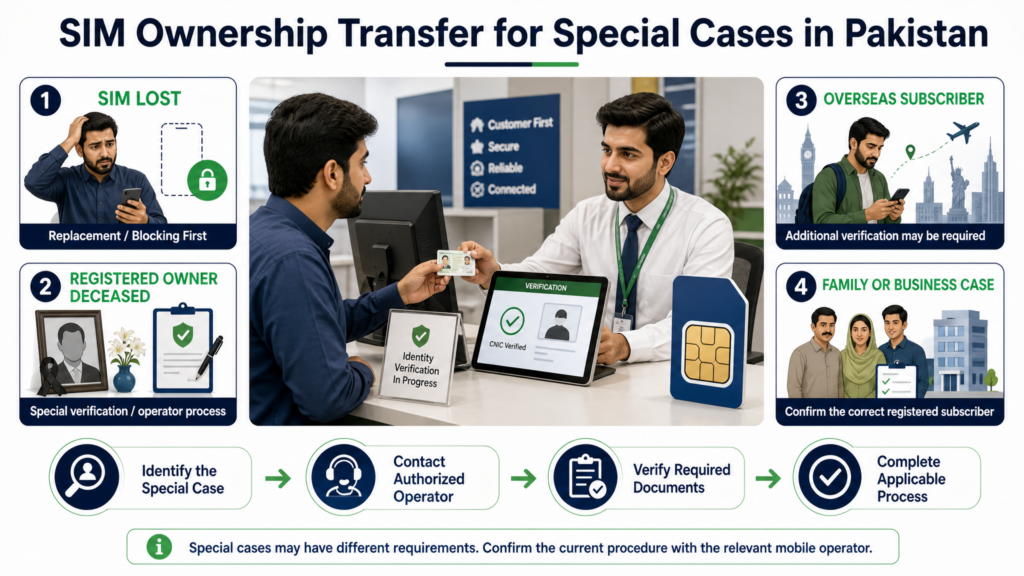
Not every SIM ownership transfer is a straightforward transaction between two people. Some situations involve a lost SIM, a deceased registered owner, a family member, a business connection, an overseas subscriber, or a disagreement about who should control the number.
These cases should not be handled by simply following the normal transfer procedure. The correct approach is to identify the situation first and then confirm the current requirements with the relevant mobile operator.
SIM Ownership Transfer After Losing the SIM
If the physical SIM has been lost, SIM replacement and ownership transfer are separate issues.
First, secure the mobile connection through the operator.
A basic sequence is:
Lost SIM → Contact operator → Secure/block connection → Verify ownership → Request replacement or applicable ownership service
Do not wait for an ownership-transfer appointment while an important mobile number is potentially accessible to someone else.
If the number is also registered under another person’s CNIC, explain the complete situation to the operator rather than attempting to solve it through an unofficial agent.
SIM Ownership Transfer After the Registered Owner Dies
This is a special situation.
A deceased subscriber cannot participate in an ordinary voluntary transfer in the same way as a living subscriber.
The operator may therefore require additional documentation and verification.
Depending on the circumstances, relevant documents could include proof of death and documents establishing the relationship or legal authority of the person requesting the change.
Do not assume that being a family member automatically means the number can be transferred.
The correct approach is:
Contact operator → Explain deceased-subscriber situation → Ask for current requirements → Provide required documentation → Complete applicable verification
What If a Parent Wants to Transfer a SIM to a Child?
This is a common family situation.
For example, a mobile number may have been registered under a parent’s CNIC for years but is now permanently used by an adult child.
The family should determine whether the number should remain under the parent’s registration or whether ownership should formally change.
If the transfer is appropriate:
Parent/current owner → Child/new owner → Operator verification → Applicable transfer process
Do not simply assume that long-term usage automatically changes ownership.
What If a Husband or Wife Uses the Other Spouse’s SIM?
Marriage does not automatically change the registered subscriber.
If a SIM is registered under one spouse’s CNIC but permanently belongs to the other spouse, the couple should discuss whether formal ownership transfer is necessary.
The same principle applies:
Physical possession ≠ registered ownership
If a transfer is desired, follow the operator’s current process.
What If a Sibling Uses Your SIM?
Family sharing can create confusion over registration.
If your brother or sister uses a SIM registered under your CNIC, decide whether:
- You remain the genuine subscriber, or
- The connection should be transferred to the sibling.
If ownership should change permanently, ask the operator about the applicable transfer process.
Do not give an unrelated person access to your identity information simply because they are using your number.
Business and Employee SIMs
Companies often have multiple mobile connections.
A business may assign numbers to:
- Employees
- Sales teams
- Managers
- Drivers
- Customer-support staff
- Field workers
The company should maintain a private inventory showing:
Mobile Number → Registered Entity → Assigned User → Status
This becomes especially important when an employee leaves the organization.
What Happens When an Employee Leaves?
Before the employee leaves, the company should review any SIMs and mobile accounts associated with that person.
Depending on the ownership arrangement, the business may need to:
- Recover the SIM
- Deactivate the number
- Transfer responsibility
- Update subscriber information
- Confirm account ownership
The correct action depends on how the connection was originally registered and the operator’s current corporate procedures.
Company-Owned SIM vs Employee-Owned SIM
These should not be treated as the same.
Company-Owned SIM
The organization may be the relevant subscriber/entity.
Employee-Owned SIM
The employee may personally own the connection even if the company paid the bill or used it for work.
Therefore, before requesting a transfer, establish who actually owns the registration.
Payment of a mobile bill alone does not necessarily determine registered ownership.
SIM Ownership Transfer for an Overseas Owner
If the registered subscriber is outside Pakistan, do not assume that an ordinary transfer can be completed remotely.
The operator may have special requirements depending on:
- Location of the subscriber
- Type of connection
- Identity verification
- Authorized representative
- Documentation
- Current operator rules
Contact the operator before sending CNIC documents or appointing anyone to act on your behalf.
Never send fingerprints or sensitive identity information to an unknown person overseas or in Pakistan.
What If Someone Else Has Your SIM?
If the SIM is registered under your CNIC but another person physically possesses it, consider the security implications.
If you no longer want that person to use the number, contact the operator and ask what legitimate action is available.
Do not try to recover the SIM through threats, impersonation, or unauthorized access.
If the situation involves harassment, fraud, threats, or cybercrime, preserve evidence and use the appropriate official reporting channel.
Disputed SIM Ownership
A disputed registration is different from an ordinary ownership transfer.
For example:
- Two people claim the same number.
- One person says the SIM was transferred without permission.
- A previous owner disputes a transfer.
- A business and employee disagree about ownership.
- A family member claims the registration was changed without authorization.
Do not attempt to settle the dispute by using an unofficial SIM database.
Instead:
Collect documentation → Contact operator → Submit formal complaint → Keep reference number → Escalate where appropriate
Unknown SIM Registered Against Your CNIC
If you discover an unfamiliar SIM registration, first determine whether it could be:
- An old SIM
- A previous number
- A replacement
- A secondary connection
- A business number
- A family connection
- A genuinely unauthorized registration
If you cannot explain it, contact the relevant operator.
Your existing CNIC SIM Check Pakistan article can be internally linked here because it gives readers additional information about checking registrations associated with their identity.
Your 668 SIM Check Pakistan guide can also be linked where the reader needs a detailed explanation of the 668 verification process.
What If the SIM Was Transferred Without Your Permission?
This is more serious than a normal ownership transfer.
If you believe your SIM registration was changed without authorization:
- Contact the operator immediately.
- Explain that you did not authorize the transaction.
- Request an investigation.
- Keep the complaint/reference number.
- Secure important accounts linked to the number.
- Preserve relevant SMS or account notifications.
- Escalate through the applicable telecom complaint mechanism if necessary.
If the matter involves suspected cybercrime or identity misuse, consider the appropriate cybercrime reporting route after documenting the issue.
PTA’s Role in a Disputed Transfer
PTA Complaint Management System
The operator should generally be the first place to address a SIM/account transaction.
If an applicable telecom complaint remains unresolved, PTA’s complaint mechanism can provide a route for escalation.
Keep:
- Operator complaint number
- Date of complaint
- Relevant screenshots/messages
- Transaction receipts
- Any correspondence
Documentation makes escalation much easier.
NADRA and Special SIM Cases
NADRA-related identity information can be relevant to subscriber verification, but NADRA should not be treated as the ordinary destination for transferring a mobile number.
For special cases:
Identity/document issue → Follow the appropriate identity-service process
SIM/account issue → Contact the mobile operator
Telecom complaint → PTA where applicable
Keeping these responsibilities separate prevents confusion.
NCCIA and Serious SIM-Related Fraud
If an ownership dispute involves suspected cyber-enabled fraud, impersonation, identity misuse, or another relevant digital crime, the situation may go beyond an ordinary telecom complaint.
In that case:
Preserve evidence → Secure your accounts → Contact the operator → Use the appropriate cybercrime reporting channel
Do not publicly accuse another person based solely on an unexplained SIM record.
Never Use a “SIM Transfer Agent”
Special cases are exactly where scammers may target people.
Be suspicious if someone promises:
- Transfer without the registered owner
- Transfer without biometric verification
- Instant online ownership change
- PTA backdoor access
- NADRA database access
- Transfer using only a CNIC photo
- Transfer using an OTP
These promises should not replace the operator’s legitimate procedure.
Special-Case Decision Guide
Lost SIM
Secure the connection first → Contact operator → Replacement/other applicable action
Deceased Owner
Contact operator → Ask for special-case documents → Complete applicable verification
Parent-to-Child
Confirm desired ownership → Current owner + new owner → Official transfer process
Spouse/Sibling
Determine actual intended owner → Use operator’s applicable transfer process
Business SIM
Confirm company ownership → Review authorization → Use corporate/operator process
Overseas Owner
Contact operator first → Confirm remote/special requirements
Unknown Registration
Verify → Identify operator → Complaint → Escalate if necessary
Unauthorized Transfer
Contact operator immediately → Preserve evidence → Secure accounts → Escalate where applicable
Key Takeaway
Special SIM ownership cases should never be solved by guessing or using unofficial agents.
Whether the problem involves a lost SIM, deceased owner, family member, employee, overseas subscriber, business connection, or disputed registration, start by identifying the exact situation and then confirm the current process with the relevant operator.
The safest formula is:
Identify the situation → Contact the operator → Complete legitimate verification → Keep documentation → Escalate when appropriate
This protects both the mobile number and the identity associated with it.
SIM Ownership Transfer Cost, Time, Eligibility, Rejection Reasons & Common Problems in Pakistan
The cost and processing time for a SIM ownership transfer in Pakistan can depend on the mobile operator, the type of request, and the circumstances of the subscriber. Because operator charges and procedures can change, users should confirm the current information directly with their operator before visiting a service center.
Is SIM Ownership Transfer Free?
There is no single universal charge that can safely be stated for every operator and every situation.
The applicable cost may depend on:
- Operator
- Type of transaction
- Replacement requirement
- Special-case documentation
- Current operator policy
Therefore, do not rely on an old blog claiming a fixed nationwide transfer fee.
Before starting the process, ask the operator:
“What is the current ownership-transfer fee for this number?”
If a person asks you for an unofficial “PTA fee” or “NADRA fee” through a personal account, verify the claim directly with the operator.
How Long Does SIM Ownership Transfer Take?
A normal request may be processed during the service visit, but the exact timing can vary.
Factors can include:
- Identity verification
- Biometric verification
- Operator system status
- Documentation
- Special-case requirements
- Account status
For that reason, avoid promises such as:
“Every SIM transfer takes exactly 10 minutes.”
The operator’s current process should be treated as the authoritative source.
Basic Eligibility
Before requesting a transfer, make sure the situation is legitimate.
A normal transfer generally involves:
Current registered subscriber → New subscriber → Required verification → Operator processing
The operator may refuse or delay a request if required identity verification cannot be completed.
Common Reasons a SIM Ownership Transfer May Be Rejected
1. Identity Verification Problem
If the identity information cannot be properly verified, the transaction may not proceed.
Confirm that the required identity documents are valid and match the relevant subscriber.
2. Biometric Verification Failure
A biometric verification attempt may fail for technical or identity-related reasons.
If this happens, ask the authorized operator representative what the current procedure is for resolving the verification problem.
Do not give your fingerprints to an unofficial person who claims they can bypass the process.
3. Current Owner Is Not Available
A standard voluntary transfer may require participation or verification from the registered subscriber.
If the current owner is unavailable, ask the operator whether a special procedure applies.
Do not attempt to bypass the registered owner’s involvement through an unofficial agent.
4. Special Subscriber Situation
A different procedure may apply when the registered owner is:
- Deceased
- Overseas
- A company
- Represented by an authorized person
- Involved in a disputed ownership situation
Always explain the complete situation to the operator.
5. Incorrect Documentation
A transfer can be delayed if the required documentation is incomplete or does not meet the operator’s current requirements.
Before visiting, confirm:
- Which CNIC documents are required
- Whether originals are required
- Whether both parties must appear
- Whether additional documents are necessary
What If the Transfer Request Is Delayed?
Don’t immediately submit multiple requests.
Instead, ask the operator:
- What is causing the delay?
- Is additional verification required?
- Is any document missing?
- Is there a technical issue?
- Is the number eligible for transfer?
- Is there a reference number for the request?
Keep the reference number and date.
What If the Operator Says the Number Is Not Eligible?
Ask for clarification rather than assuming the operator is wrong.
Possible reasons can relate to:
- Account status
- Verification requirements
- Special-case restrictions
- Incorrect documentation
- Current operator policy
If you believe the response is incorrect, request a formal explanation or complaint reference.
What If the SIM Is Blocked?
A blocked SIM is not automatically an ownership-transfer problem.
First determine why the SIM is blocked.
It may require:
- Reactivation
- Replacement
- Account verification
- Another operator-specific procedure
Resolve the underlying issue before assuming that an ownership transfer will fix it.
What If the Number Is Already Registered to You?
If the number is already correctly registered under your own CNIC, you may not need an ownership transfer.
Instead, determine whether you actually need:
- SIM replacement
- Account update
- Number recovery
- Service activation
- Another operator service
This is why checking the current registration before starting a transfer can save time.
What If the Number Is Registered Under an Unknown Person?
This situation requires additional caution.
Do not use a random online “SIM owner database” to identify the person.
Instead:
Verify your own registration → Identify the operator → Contact the operator → Explain the situation
If you have legitimate documentation showing that the number belongs to you, keep it available for the operator’s review.
What If the Previous Owner Has Given You the SIM?
Even if the previous owner voluntarily gave you the physical SIM, that does not automatically mean the registration has changed.
The safest approach is to complete the applicable official ownership process if the number is intended to become your permanent connection.
What If You Paid for the Number?
Payment alone does not automatically establish the telecom subscriber record.
For example, buying a used phone that contains a SIM does not automatically make the SIM registered under your CNIC.
Always separate:
Physical possession
from
Registered subscriber ownership
What If the SIM Is Used for Important Accounts?
Before changing ownership, identify services connected to the mobile number.
These may include:
- Email recovery
- Banking alerts
- Social-media accounts
- Business accounts
- Two-factor authentication
- Messaging applications
If the number changes ownership, both the old and new users should ensure that their accounts are properly separated.
Ownership Transfer and Privacy
A mobile number can be connected to personal information, so privacy should remain a priority during the transfer.
Do not publicly share:
- CNIC numbers
- CNIC photographs
- Biometric information
- OTPs
- Account passwords
- Private operator correspondence
Keep transaction receipts and documents in a secure location.
PTA Complaint Process
If the operator does not resolve an applicable telecom complaint, PTA’s complaint mechanism may provide an escalation route.
PTA Complaint Management System
Before escalating, keep:
- Operator complaint/reference number
- Date
- Relevant screenshots
- Receipts
- SMS confirmations
- Details of the issue
This gives you a clear record of what happened.
When NADRA Is Relevant
NADRA is relevant to identity-related matters, but it should not be treated as the organization that performs every mobile-SIM transaction.
If your problem is:
Identity document issue → Relevant identity-service channel
If your problem is:
SIM ownership/account issue → Mobile operator
If your problem is:
Unresolved telecom complaint → PTA mechanism where applicable
Understanding these roles prevents wasted time.
When NCCIA May Be Relevant
A normal SIM transfer problem is not automatically a cybercrime case.
NCCIA becomes relevant when the situation involves suspected cybercrime or digital fraud, such as:
- Identity misuse
- Online impersonation
- Cyber-enabled fraud
- Digital harassment
- Other applicable cybercrime matters
If you suspect such activity, preserve evidence and use the appropriate official reporting route.
Do not make accusations solely because an ownership record is confusing.
Common Scam: “Pay Me and I’ll Transfer It”
Be careful if someone offers:
“Send me money and I’ll transfer the SIM remotely.”
Especially if they promise:
- No biometric verification
- No current owner
- No franchise visit
- Instant transfer
- PTA/NADRA internal access
- Transfer through WhatsApp
Use the official operator instead.
Common Scam: “Send CNIC + OTP”
Never send your CNIC and OTP to an unknown person simply because they claim to be processing SIM ownership.
If you receive an unexpected OTP, stop and verify the request independently.
Cost and Time Checklist
Before visiting the operator, ask:
- Current transfer fee
- Required documents
- Whether both parties must appear
- Biometric requirements
- Expected processing time
- Special-case requirements
- Whether the number is eligible
- Whether a receipt/reference will be provided
Key Takeaway
There is no single fee or processing time that should be assumed for every SIM ownership transfer in Pakistan.
The correct information depends on the operator and the specific situation.
The safest process is:
Confirm eligibility → Ask current fee → Confirm documents → Complete verification → Submit request → Keep reference → Verify completion
If a transfer fails, do not immediately search for an unofficial solution. Find out why it failed and use the appropriate operator, PTA, identity-service, or cybercrime channel depending on the actual problem.
SIM Ownership Transfer vs SIM Replacement, Registration & Porting

Many people use the terms SIM ownership transfer, SIM replacement, SIM registration, and SIM porting as if they mean the same thing. They do not.
Understanding the difference is important because choosing the wrong service can waste time and may leave the registration under the wrong person’s CNIC.
SIM Ownership Transfer
SIM ownership transfer means changing the registered subscriber from one person to another.
Example:
Ahmed’s CNIC → Ownership Transfer → Ali’s CNIC
The mobile number may remain the same, but the registered subscriber changes through the applicable operator process.
This is useful when a number is permanently changing hands.
SIM Replacement
SIM replacement generally means replacing the physical SIM while continuing the relevant mobile service.
Common examples include:
- Lost SIM
- Damaged SIM
- Faulty SIM
- Replacement requirement
The key point is:
Replacement does not automatically mean ownership transfer.
If the number is registered under your CNIC and you replace the physical SIM, the registration situation is fundamentally different from transferring the number to another person.
SIM Registration
SIM registration is the process through which a mobile connection is associated with the subscriber’s identity according to the applicable requirements.
This is why a SIM can be physically possessed by someone while the registered subscriber remains another person.
For readers who want to understand the broader concept, your existing SIM Registration Pakistan article is a natural internal-link opportunity here.
SIM Ownership Transfer vs Registration
| Feature | SIM Registration | Ownership Transfer |
|---|---|---|
| Main purpose | Register subscriber | Change registered subscriber |
| Existing owner | May be new registration | Existing subscriber |
| New owner | Usually not applicable | New subscriber |
| CNIC verification | Required according to applicable process | Required according to applicable process |
| Biometric verification | May apply | May apply |
| Mobile number | New/existing connection | Usually existing connection |
| Main objective | Establish registration | Change registration |
SIM Porting
Mobile number portability (porting) is different again.
Porting generally concerns moving a mobile number from one network/operator to another while retaining the number, subject to the applicable rules.
For example:
Existing Network → Porting Process → Different Network
The number can remain the same even though the service provider changes.
Porting should therefore not be confused with ownership transfer.
Ownership Transfer vs SIM Porting
These are two completely different questions:
Ownership Transfer
Who is the registered subscriber?
Porting
Which mobile operator currently provides the service?
A number can potentially involve both concepts at different points in its history, but one does not automatically perform the other.
Ownership Transfer vs SIM Replacement vs Porting
The easiest way to remember the difference is:
Ownership Transfer → Changes the registered subscriber
SIM Replacement → Replaces the physical SIM/service card
SIM Registration → Establishes subscriber registration
SIM Porting → Changes the mobile network while retaining the number, subject to applicable rules
Why This Difference Matters
Imagine a person says:
“I bought this SIM from someone, so I need a replacement.”
That may not solve the actual problem.
If the number is still registered under the previous person’s identity, simply replacing the physical SIM does not necessarily make the new user the registered subscriber.
The correct question is:
Do I need a replacement, or does the registered ownership need to change?
Example 1 — Lost SIM
You lose your own SIM.
Correct concern: SIM security/replacement.
You should contact the operator promptly.
This is normally not an ownership-transfer problem.
Example 2 — Parent’s SIM Used by Child
A parent owns the registration, but the child permanently uses the number.
Correct concern: Potential ownership transfer.
The family should determine whether the number should remain under the parent’s registration or be transferred through the applicable operator process.
Example 3 — Changing Network
You want to keep your existing number but move to another network.
Correct concern: Porting.
This is not automatically a change of ownership.
Example 4 — Used SIM From Another Person
You receive a SIM from another person and intend to make the number your permanent connection.
Correct concern: Ownership registration.
Do not assume that possessing the SIM means you are now its registered owner.
Example 5 — Damaged SIM
Your SIM stops working because the physical card is damaged.
Correct concern: Replacement.
Ownership may remain unchanged.
Example 6 — Unknown SIM Registered Against Your CNIC
You discover a registration that you cannot explain.
Correct concern: Investigation.
First verify the result, identify the operator, and contact the operator.
Do not immediately use an unofficial database to investigate another person’s identity.
Use Your 668 Guide Here
This section provides an excellent internal-link opportunity to your existing:
668 SIM Check Pakistan
article.
The reader can follow:
Understand registration → Check CNIC registrations → Identify an unexpected SIM → Investigate through the operator
This is much more useful than inserting an unrelated internal link.
SIM Verification vs Ownership Transfer
SIM verification is primarily about checking or confirming registration information.
Ownership transfer is an actual account/registration change.
Therefore:
Verification → Find out what is registered
Transfer → Change who the registration belongs to
You should verify the current situation before requesting a transfer.
What About CNIC SIM Check?
A CNIC SIM check can help you understand which SIM registrations are associated with your identity through recognized verification methods.
It does not automatically transfer ownership.
For a reader interested in this topic, your existing CNIC SIM Check Pakistan article can be linked naturally here.
The relationship is:
CNIC SIM Check → Understand current registrations
Ownership Transfer → Correct the registered subscriber where appropriate
What About SIM Owner Details?
Another common misunderstanding is believing that a SIM check provides unrestricted access to another person’s personal information.
A legitimate verification process should not be treated as a public database for obtaining:
- Private addresses
- Call records
- SMS contents
- Live location
- Banking information
- Passwords
Your existing SIM Owner Details Pakistan article can be linked here to explain the distinction between legitimate SIM registration information and claims made by unofficial databases.
PTA’s Role
For an ordinary ownership transfer, the mobile operator is generally the first place to start.
PTA’s role is different.
PTA regulates Pakistan’s telecom sector and provides applicable consumer complaint mechanisms.
If an operator-related complaint remains unresolved, PTA may become relevant for escalation.
The simple structure is:
Operator → Service/Transaction
PTA → Regulation/Applicable Complaint Escalation
NADRA’s Role
NADRA should also not be confused with the mobile operator.
For SIM-related identity verification, identity information can be relevant to the broader registration ecosystem, but a normal SIM ownership transaction is handled through the applicable mobile operator process.
Think of it as:
Identity → NADRA-related identity ecosystem
SIM service → Mobile operator
Telecom regulation → PTA
This distinction can prevent unnecessary visits and confusion.
NCCIA’s Role
NCCIA is not the normal destination for changing the registered owner of an ordinary SIM.
However, if a SIM-related problem involves suspected cybercrime, identity misuse, online impersonation, or digital fraud, the matter can move beyond an ordinary telecom transaction.
In such cases:
Preserve evidence → Secure accounts → Contact operator → Use the appropriate cybercrime reporting route
Do not label an ordinary registration mismatch as cybercrime without first investigating it.
Quick Comparison Table
| Situation | Appropriate Direction |
|---|---|
| Lost physical SIM | Replacement/security |
| Damaged SIM | Replacement |
| Number permanently changing hands | Ownership transfer |
| New subscriber registration | SIM registration |
| Moving number to another network | Porting |
| Unknown SIM under your CNIC | Investigate with operator |
| Telecom complaint unresolved | PTA complaint mechanism where applicable |
| Suspected cyber fraud | Appropriate cybercrime reporting channel |
How to Choose the Correct Service
Ask yourself one question:
What exactly has changed?
If the physical SIM has a problem:
→ Consider replacement.
If the registered person needs to change:
→ Consider ownership transfer.
If the network provider needs to change:
→ Consider porting.
If you simply want to know what is registered:
→ Use the recognized SIM verification method.
If something appears unauthorized:
→ Investigate through the operator and use the appropriate escalation route.
Final Takeaway
The four concepts should remain separate:
SIM Registration establishes subscriber registration.
SIM Verification helps you review or confirm registration information.
SIM Ownership Transfer changes the registered subscriber.
SIM Replacement replaces the physical SIM/service card.
SIM Porting concerns changing the network while retaining the number, subject to applicable rules.
Knowing this difference makes the ownership-transfer process much easier and helps prevent users from following the wrong procedure.
SIM Ownership Transfer Safety: Scams, Privacy, OTP Fraud & Fake PTA/NADRA Claims

Changing the registered owner of a SIM involves personal identity information, so security should be treated as seriously as the transfer itself.
A legitimate ownership transfer should be completed through the relevant mobile operator’s authorized process. You should never give an unknown person unrestricted access to your CNIC, OTP, biometric information, or account credentials simply because they claim to be able to transfer a SIM.
Why SIM Ownership Transfer Requires Security
A mobile number can be connected to important services such as:
- Email recovery
- Banking alerts
- Social-media accounts
- Two-factor authentication
- Messaging applications
- Business accounts
- Password recovery
If control of a number changes, the previous and new users should make sure that their accounts are properly separated.
This is one reason why ownership should not be changed through informal arrangements.
Never Share Your OTP
An OTP is designed to verify a specific action or login.
If someone says:
“Send me the OTP so I can transfer your SIM.”
Do not send it.
Instead:
Stop → Contact the operator yourself → Confirm the request → Continue only through the authorized process
An operator representative should not require you to casually disclose confidential authentication codes to an unknown individual.
Protect Your CNIC
Your CNIC is sensitive identity information.
Avoid sending CNIC photographs through:
- Unknown WhatsApp numbers
- Facebook pages
- Random websites
- Unverified SIM agents
- Telegram groups
- Social-media advertisements
If a legitimate operator service requires identification, provide it through the appropriate authorized channel.
Never Give Your Fingerprint to an Unofficial Agent
Biometric verification is particularly sensitive.
If someone says:
“Give me your fingerprint and I’ll complete the transfer.”
make sure the transaction is taking place through a legitimate operator process.
Do not allow a stranger to collect biometric information simply because they claim to have access to PTA or NADRA systems.
Fake PTA Claims
Scammers may use the name of PTA to create urgency.
For example:
“Your SIM is illegal.”
“PTA has blocked your CNIC.”
“Your SIM ownership must be transferred immediately.”
“Pay this fee to avoid SIM cancellation.”
Do not automatically believe these messages.
Instead:
End the conversation → Find the official PTA/operator website yourself → Verify the claim → Contact the relevant organization
Never use a phone number or link supplied by an unknown caller as your only method of verification.
Fake NADRA Claims
NADRA’s name may also be misused by scammers.
A person may claim:
“We have access to NADRA records and can transfer your SIM remotely.”
Treat such claims with extreme caution.
A normal SIM ownership transaction should be handled through the applicable mobile operator procedure, not through an unknown person claiming access to an identity database.
Fake “SIM Database” Websites
Search engines and social media may contain websites claiming to provide:
- Complete SIM owner details
- CNIC profiles
- All numbers owned by another person
- Addresses
- Call records
- Live locations
- Private subscriber information
Do not treat these websites as legitimate simply because they use words such as:
PTA
NADRA
SIM Database
Official
Government
A website’s wording does not prove that it is an authorized government or telecom service.
SIM Ownership Transfer Scam
A common scam pattern is:
“Send your CNIC → send OTP → pay fee → we will transfer the SIM.”
This is dangerous because you may give an unknown person enough information to attempt account manipulation.
The safer approach is:
Authorized operator → Identity verification → Official transaction → Receipt/reference
What If Someone Offers a Very Cheap Transfer?
Price alone does not prove whether a service is legitimate.
A person may advertise:
“SIM transfer in five minutes.”
“No biometric required.”
“No owner needed.”
“Online transfer available.”
“PTA special access.”
These promises should be independently verified before you provide any information.
Protect Your Old Number Before Transferring It
If you are giving a number to another person, first identify all important services connected to it.
Review:
- Email recovery
- Banking alerts
- Social accounts
- Messaging apps
- Two-factor authentication
- Business accounts
- Delivery/payment services
Remove or update your own account information before permanently handing the number over.
This is particularly important for numbers that have been used for several years.
What Should the New Owner Do?
After the transfer, the new owner should:
- Confirm the mobile number.
- Keep the transaction receipt.
- Verify the registration where appropriate.
- Update their own account information.
- Enable suitable account security.
- Avoid using the previous owner’s credentials.
- Never request the previous owner’s private account information.
The new subscriber should treat the number as a fresh personal connection from a security perspective.
Ownership Transfer Does Not Transfer Private Accounts
This is extremely important.
Transferring ownership of a mobile number does not give the new subscriber legitimate access to the previous owner’s:
- WhatsApp messages
- SMS history
- Banking account
- Social-media account
- Passwords
- Photos
- Cloud data
A mobile number and an online account are separate things.
If a previous owner has not properly removed a number from an account, that is an account-security issue—not permission for the new owner to access it.
SIM Swap vs Ownership Transfer
Do not confuse a legitimate ownership transfer with a SIM-swap attack.
Legitimate Ownership Transfer
The appropriate parties knowingly request a change through the operator.
SIM-Swap Attack
An attacker attempts to gain control of a mobile number without the legitimate subscriber’s authorization.
If your phone suddenly loses calls and SMS without an obvious reason, contact your operator promptly and ask them to investigate the SIM/account status.
Warning Signs of SIM-Swap Activity
Watch for:
- Sudden loss of mobile service
- Calls no longer reaching your phone
- SMS messages suddenly stopping
- Unexpected account-security notifications
- Unusual password-reset messages
- An unexpected SIM-related communication
One symptom alone does not prove a SIM swap, but unexplained loss of service should not be ignored.
What To Do If You Suspect Fraud
Follow this sequence:
1. Contact Your Operator
Ask them to verify the SIM/account status.
2. Secure Important Accounts
Review accounts connected to your mobile number.
3. Change Important Credentials
Where appropriate, update passwords and recovery information.
4. Preserve Evidence
Keep suspicious messages, screenshots, receipts and complaint references.
5. Escalate Where Appropriate
Use the applicable telecom complaint mechanism or cybercrime reporting channel depending on the nature of the incident.
PTA, NADRA and NCCIA — Who Handles What?
Understanding the roles of these organizations helps prevent confusion.
PTA
PTA is the telecom regulator. It can be relevant to applicable telecom complaints and regulatory matters.
For a normal SIM ownership transaction, start with the mobile operator.
NADRA
NADRA is associated with Pakistan’s identity ecosystem.
It should not be treated as the ordinary place to request a mobile SIM ownership transfer.
NCCIA
NCCIA can become relevant to applicable cybercrime matters such as digital fraud, impersonation or identity misuse.
It is not the normal first stop for a routine SIM ownership transfer.
When Is a SIM Problem a Cybercrime Issue?
Not every SIM problem is cybercrime.
For example:
Wrong registration → Telecom/operator issue
Lost SIM → Operator/security issue
Transfer rejected → Operator issue
Unknown registration → Investigate through operator
But if the situation involves suspected:
- Digital fraud
- Identity misuse
- Online impersonation
- Cyber-enabled financial fraud
- Other applicable cybercrime
then the matter may require a cybercrime reporting route.
How to Report Safely
Do not post sensitive evidence publicly.
Avoid uploading:
- Full CNIC images
- OTP screenshots
- Complete phone numbers
- Banking information
- Private correspondence
Instead, preserve the evidence privately and provide it through the appropriate official reporting channel.
Internal Link Opportunity: 668 SIM Check
If readers are concerned about whether a SIM is associated with their CNIC, this is the perfect place to link your existing:
668 SIM Check Pakistan
guide.
Suggested anchor:
668 SIM Check Pakistan
The context is natural:
Before investigating an unfamiliar mobile connection, users should first review their own registered SIM information through a recognized verification method.
Internal Link Opportunity: SIM Verification
You can also link your existing:
SIM Verification Pakistan
article here.
Suggested anchor:
SIM verification
This helps readers move from the security section to a more detailed explanation of the verification process.
Internal Link Opportunity: CNIC SIM Check
Another useful internal link is:
CNIC SIM Check Pakistan
Suggested anchor:
CNIC SIM check
This gives readers a logical path from ownership security to CNIC-based registration checking.
Security Checklist Before SIM Ownership Transfer
- Confirm the current registered owner.
- Confirm the new owner.
- Use an authorized operator channel.
- Keep your original identity documents secure.
- Complete verification yourself.
- Never share an OTP.
- Never give biometric information to an unofficial agent.
- Avoid unknown SIM databases.
- Remove your accounts from a number before giving it away.
- Keep the transfer receipt.
- Verify the updated registration.
- Report genuine fraud through the appropriate channel.
Key Takeaway
The safest SIM ownership transfer is one that happens directly through the legitimate operator process.
You do not need a mysterious “SIM database expert,” an unofficial PTA agent, a person claiming NADRA access, or someone asking for your OTP.
Remember:
CNIC → Keep private
OTP → Never share
Biometric data → Authorized process only
SIM transfer → Operator
Telecom complaint → PTA where applicable
Cybercrime → Appropriate cybercrime reporting channel
A few minutes spent verifying the legitimacy of a transfer can protect your mobile account and personal identity from much bigger problems.
What to Do After SIM Ownership Transfer

Once the ownership-transfer process has been completed, the work should not end at the operator’s service counter. The new subscriber should confirm that the transaction was completed correctly and make sure the number is no longer unnecessarily connected to the previous owner’s accounts.
1. Keep Your Transfer Receipt
Keep any receipt, reference number, confirmation SMS, or service request information provided by the operator.
Record:
- Mobile number
- Operator
- Transfer date
- Reference number
- Service center/franchise details
- Any confirmation received
Do not upload these documents publicly because they may contain personal information.
2. Confirm the Mobile Number Is Working
After the transfer, check basic services:
- Incoming calls
- Outgoing calls
- SMS
- Mobile data
- Network registration
If something does not work normally, contact the operator rather than repeatedly attempting random SIM procedures.
3. Verify the Updated Registration
After allowing the operator’s system to update, verify the registration through an appropriate official method.
This is particularly useful if the number was transferred because it previously belonged to another person.
You can internally link your existing 668 SIM Check Pakistan article here.
Suggested anchor:
668 SIM Check Pakistan
This creates a natural sequence:
Ownership Transfer → Confirmation → SIM Registration Check
4. Check Your CNIC-Based SIM Registrations
After becoming the new subscriber, it is useful to understand which SIM registrations are associated with your own CNIC.
Your existing CNIC SIM Check Pakistan article is another natural internal-link opportunity here.
Suggested anchor:
CNIC SIM check
This helps readers understand the difference between:
checking registrations
and
changing ownership.
5. Update Your Important Accounts
If the number is now yours, review accounts that use it.
These may include:
- Email recovery
- Social-media accounts
- Messaging applications
- Business accounts
- Two-factor authentication
- Payment applications
- Other legitimate services
Make sure the recovery information belongs to you.
6. The Previous Owner Should Remove the Number
The previous subscriber should also review their accounts.
This is especially important when the number has been used for years.
The previous owner should update or remove the number from services where it is no longer their active contact or recovery number.
Why This Matters
Suppose a number was previously owned by Person A and is now registered to Person B.
If Person A’s old accounts still use that number for password recovery, Person B could unexpectedly receive authentication messages.
The correct solution is not to access Person A’s account.
The correct solution is for the previous owner to update their account recovery information.
7. Do Not Access the Previous Owner’s Accounts
Ownership of a mobile number does not give you permission to access accounts previously connected to that number.
Do not attempt to access another person’s:
- Social-media account
- Banking account
- Cloud storage
- Private messages
If an old account sends an unexpected verification message to your newly acquired number, do not use it to access someone else’s account.
8. What If You Receive Someone Else’s OTP?
This can happen when a previous subscriber has not updated an account.
If you receive an OTP intended for another person:
Do not share it.
Do not enter it into another person’s account.
Do not forward it to anyone.
Simply ignore it and, where appropriate, inform the relevant service that the number now belongs to someone else.
9. Review Messaging Applications
If the number is going to be used for WhatsApp or another messaging service, configure your own account appropriately.
Do not assume that ownership transfer automatically transfers a previous user’s messaging account.
Your mobile subscription and your application account are separate systems.
10. Review Banking and Financial Services
If the number is being used with financial services, make sure the correct subscriber updates their own contact information through the financial institution’s official process.
Never attempt to access a previous owner’s financial account simply because an SMS or OTP arrives on your newly acquired number.
If you receive suspicious banking messages, contact the relevant bank directly.
11. Protect Your New SIM
After ownership transfer, follow normal mobile-security practices.
Never share:
- OTPs
- Passwords
- PINs
- CNIC copies with unknown people
- Biometric information
- Banking credentials
Be especially cautious with unexpected calls claiming to be from a mobile operator.
12. Watch for SIM-Swap Warning Signs
After any important SIM-related transaction, stay alert for unusual activity.
Potential warning signs can include:
- Unexpected loss of mobile service
- Sudden inability to receive SMS
- Unexpected account-reset messages
- Unfamiliar security alerts
- Unexpected SIM-related notifications
These signs do not automatically prove fraud, but unexplained changes should be investigated promptly.
13. Contact the Operator If Something Looks Wrong
If the number stops working or the registration does not appear to have updated as expected, contact the relevant operator.
Explain:
- Ownership transfer was recently requested/completed
- Date of transaction
- Mobile number
- Reference number
- What changed
Having your receipt/reference information makes the conversation easier.
14. What If the Registration Still Shows the Previous Owner?
Do not panic.
First confirm whether enough time has passed for the relevant system to update.
Then contact the operator and provide the transfer reference.
Ask them to verify:
- Current subscriber status
- Transfer status
- Any pending verification
- Whether additional action is required
Do not attempt to solve the issue through an unofficial SIM database.
15. What If Your CNIC Shows an Unexpected SIM?
If your own CNIC shows a registration that you cannot explain, investigate it carefully.
Possible explanations include:
- Old SIM
- Secondary connection
- Previous registration
- Family connection
- Business connection
- Replacement history
- Genuine unauthorized registration
Start with verification and the relevant operator.
Your existing SIM Information System Pakistan guide can also be linked here for readers who want broader information about SIM registration systems.
PTA After Ownership Transfer
PTA should not be treated as the place to perform every ordinary SIM transaction.
For a normal post-transfer issue:
Mobile operator → Investigation/support
If an applicable telecom complaint remains unresolved:
Operator complaint → PTA complaint mechanism where appropriate
Keep your operator reference number before escalating.
PTA Complaint as a Follow-Up Option
If you have already contacted the operator and an applicable telecom complaint remains unresolved, you can use the PTA complaint system.
PTA Complaint Management System
Keep supporting information such as:
- Complaint/reference number
- Date
- Relevant messages
- Receipts
- Screenshots
- Description of the issue
Avoid uploading unnecessary sensitive personal information.
NADRA After Ownership Transfer
NADRA should not be confused with the operator’s SIM-account service.
If your concern is about a mobile connection:
Start with the operator.
If your concern is about an identity document or identity-related service:
Use the appropriate NADRA channel.
This separation helps avoid wasting time.
NCCIA After Ownership Transfer
NCCIA is not the ordinary destination for a normal ownership-transfer follow-up.
It becomes more relevant when the situation involves suspected cybercrime, such as:
- Digital fraud
- Online impersonation
- Identity misuse
- Cyber-enabled financial fraud
- Other applicable cybercrime
If you believe a cybercrime occurred:
Preserve evidence → Secure your accounts → Contact the relevant operator → Use the appropriate reporting route
Internal Link: SIM Verification
This section is an ideal location to link your existing SIM Verification Pakistan article.
Suggested anchor:
SIM verification
Example context:
After completing the ownership transfer, a SIM verification check can help you understand the updated registration status.
This is a natural contextual link rather than a forced keyword insertion.
Internal Link: SIM Owner Details
Readers may also search for information about the registered owner of a mobile number.
Your existing SIM Owner Details Pakistan article can be linked here to explain what legitimate SIM-registration information means and what private information should not be obtained through unauthorized methods.
Suggested anchor:
SIM Owner Details Pakistan
Internal Link: SIM Information System
For readers who want a broader explanation of SIM registration, link to your existing:
SIM Information System Pakistan
Suggested anchor:
SIM Information System
This creates a useful internal structure:
Ownership Transfer → Registration → Verification → SIM Information System
What the New Owner Should Do
A simple post-transfer checklist:
- Confirm the number works.
- Keep the receipt.
- Save the reference number.
- Verify registration when appropriate.
- Review recovery accounts.
- Configure messaging services.
- Protect OTPs.
- Protect CNIC information.
- Avoid unofficial SIM databases.
- Contact the operator if anything looks incorrect.
What the Previous Owner Should Do
The previous owner should:
- Remove the number from old recovery accounts.
- Update two-factor authentication.
- Update banking/contact information where appropriate.
- Remove the number from messaging/account recovery where no longer relevant.
- Never attempt to access the new owner’s accounts.
- Keep proof of the ownership-transfer transaction.
Final Post-Transfer Security Rule
The most important principle is simple:
A transferred mobile number should become a clean connection for the new subscriber, while the previous subscriber removes it from their old accounts.
This protects both sides.
The new owner should not inherit another person’s private accounts, and the previous owner should not continue depending on a number they no longer control.
Final Checklist
- Transfer receipt saved
- Reference number saved
- SIM services tested
- Registration verified
- CNIC registration reviewed
- Previous owner’s accounts separated
- New owner’s accounts configured
- OTPs kept private
- CNIC kept secure
- Operator contacted if anything is incorrect
- PTA escalation considered only where applicable
- Cybercrime reporting considered only when genuinely relevant
Key Takeaway
Completing the ownership-transfer request is only one part of the process.
The final step is making sure the registration, mobile service, personal accounts and security information are properly separated between the previous and new subscribers.
Use official verification methods, keep your transaction records, protect your identity information, and contact the operator if anything does not match the expected result.
SIM Ownership Transfer FAQs in Pakistan 2026
1. What is SIM ownership transfer?
SIM ownership transfer is the process of changing the registered subscriber of a mobile connection from the current owner to another eligible person through the applicable operator procedure.
The physical SIM and mobile number may remain the same, while the registered subscriber changes.
2. Does giving my SIM to another person transfer ownership?
No.
Handing over the physical SIM does not automatically change the subscriber record.
If another person is going to permanently own the connection, the applicable ownership-transfer process should be followed.
3. Can I transfer a SIM to a family member?
A family relationship does not automatically transfer ownership.
If the connection is intended to become the family member’s registered connection, ask the relevant operator about its current transfer procedure and required verification.
4. Can a parent transfer a SIM to a child?
It may be possible where the operator’s applicable requirements are satisfied.
The important point is that the parent being the current subscriber and the child becoming the new subscriber must be handled through the proper operator process.
5. Can a husband transfer a SIM to his wife?
Marriage itself does not automatically change SIM registration.
If the number should permanently become the spouse’s registered connection, confirm the applicable ownership-transfer procedure with the operator.
6. Can a brother or sister transfer a SIM to me?
A sibling relationship does not itself establish ownership.
The current registered subscriber and intended new subscriber should follow the applicable verification and transfer requirements.
7. Does SIM ownership transfer change the mobile number?
Normally, ownership transfer concerns the registered subscriber, not the mobile number itself.
However, the exact service outcome depends on the operator and transaction.
8. Is SIM replacement the same as ownership transfer?
No.
SIM replacement generally concerns replacing the physical SIM or restoring the service.
Ownership transfer concerns changing the registered subscriber.
For example:
Lost SIM → Replacement
Number permanently changing hands → Ownership transfer
9. Is SIM porting the same as ownership transfer?
No.
Porting concerns moving a mobile number between networks while retaining the number, subject to applicable rules.
Ownership transfer concerns who is registered as the subscriber.
10. Do I need biometric verification?
Biometric or other identity verification may be required depending on the current operator procedure and circumstances.
Because requirements can change, confirm the current process with the operator before visiting.
Never allow an unofficial agent to perform or collect your biometric information.
11. Can SIM ownership be transferred without the current owner?
Do not assume that it can.
A normal voluntary transfer may require the participation or verification of the existing subscriber.
Special situations—such as a deceased, overseas, or otherwise unavailable subscriber—can have different requirements.
Contact the operator directly for the applicable procedure.
12. What if the registered owner has died?
A deceased-subscriber case is generally a special situation rather than an ordinary voluntary transfer.
The operator may require additional documentation and verification.
Do not assume that being a family member automatically makes you eligible to take over the number.
13. Can an overseas owner transfer the SIM remotely?
Do not assume that a normal transfer can be completed remotely.
The operator may have a special process depending on the subscriber’s circumstances.
Contact the operator before sending CNIC copies, authorization documents, or any sensitive information to another person.
14. Can a business transfer an employee’s SIM?
It depends on how the connection is registered.
A company-owned connection and an employee-owned connection are not necessarily the same.
The business should first establish who is the registered subscriber and then follow the applicable corporate/operator process.
15. Can I transfer a second-hand SIM to my CNIC?
If you have received a number from another person and want it to become your legitimate personal connection, do not assume that physical possession establishes ownership.
Ask the operator about the applicable ownership-transfer process.
16. What if the SIM is registered under someone else’s CNIC?
First determine whether the registration is expected.
For example, it could belong to:
- A parent
- A spouse
- A sibling
- A previous owner
- A business
- Another legitimate subscriber
If the number should permanently belong to you, discuss the appropriate process with the operator.
17. How can I check SIMs registered against my CNIC?
Use recognized SIM-verification methods and official operator/regulatory resources.
Your 668 SIM Check Pakistan guide can be internally linked here for readers who want a detailed explanation of the 668-related verification process.
Suggested anchor:
668 SIM Check Pakistan
18. What is the difference between checking a SIM and transferring ownership?
This distinction is important.
SIM checking/verification helps you understand registration information.
Ownership transfer changes the registered subscriber.
Checking information does not automatically change ownership.
19. What if I find an unknown SIM registered against my CNIC?
Do not immediately assume that the registration is fraudulent.
First investigate whether it could be:
- An old connection
- A secondary SIM
- A family connection
- A business connection
- A previous registration
- Another legitimate connection
If you still cannot explain it, contact the relevant operator.
Your existing CNIC SIM Check Pakistan article can be linked here for additional guidance.
20. Can I get another person’s private SIM owner details?
A legitimate SIM-verification process should not be treated as permission to obtain another person’s private information.
Be cautious of websites claiming to provide:
- Private addresses
- Call history
- SMS contents
- Live location
- Banking information
- Complete private CNIC profiles
Do not assume that a website is legitimate simply because it uses the names of PTA, NADRA, or other institutions.
21. What role does PTA have?
PTA is Pakistan’s telecom regulator.
For a normal SIM ownership transaction, the mobile operator is generally the first place to contact.
PTA can become relevant to applicable telecom complaints or regulatory matters, particularly where an issue has not been resolved through the operator’s normal process.
22. What role does NADRA have?
NADRA is associated with Pakistan’s national identity ecosystem.
However, users should not assume that NADRA directly performs ordinary mobile-SIM ownership transfers.
For a SIM/account transaction, start with the relevant mobile operator.
For an identity-document matter, use the appropriate identity-service channel.
23. What role does NCCIA have?
NCCIA should not be treated as the normal destination for an ordinary SIM ownership transfer.
If a situation involves suspected cybercrime, digital fraud, online impersonation, or identity misuse, the appropriate cybercrime reporting process may become relevant.
For a normal ownership problem:
Operator first.
For suspected cybercrime:
Preserve evidence → Secure accounts → Use the appropriate reporting route.
24. What if someone asks for my OTP to transfer the SIM?
Do not share it.
An OTP is confidential authentication information.
If someone unexpectedly requests an OTP:
Stop → Contact the operator independently → Verify the request
Never forward an OTP simply because someone claims to be an operator, PTA, NADRA, or another organization.
25. Can an agent transfer my SIM through WhatsApp?
Do not rely on an unofficial WhatsApp agent for an identity-sensitive transaction.
If an agent claims to offer ownership transfer remotely, verify the claim directly with the relevant operator.
Do not send:
- CNIC images
- OTPs
- Passwords
- Banking information
- Biometric information
to an unknown contact.
26. What if someone promises transfer without biometric verification?
Treat the claim cautiously.
There can be different procedures for different circumstances, but an unofficial person should not be allowed to bypass the legitimate identity-verification process simply because they promise a faster service.
Confirm the current requirements directly with the operator.
27. Is SIM ownership transfer always free?
Do not assume a single nationwide fee.
Charges, if applicable, can depend on the operator and the specific transaction.
Before visiting, ask the operator for the current applicable charges.
Do not pay an unofficial “PTA fee” or “NADRA fee” to a personal account without independently verifying the claim.
28. How long does SIM ownership transfer take?
There is no single processing time that should be guaranteed for every operator and situation.
Processing can depend on:
- Identity verification
- Biometric verification
- Operator systems
- Documentation
- Special-case requirements
Ask the operator for the current expected processing time.
29. What if the transfer request is rejected?
Ask the operator why it was rejected.
Possible issues can include:
- Identity verification problem
- Missing documentation
- Eligibility issue
- Special-case requirement
- Technical problem
Keep the request/reference number and ask what action is required next.
30. What if the biometric verification fails?
Do not attempt to bypass the verification through an unofficial agent.
Ask the authorized operator representative about the appropriate next step.
The correct solution can depend on the reason for the failed verification.
31. What if the previous owner refuses to transfer the SIM?
Do not try to bypass the person’s identity verification or use an unofficial service.
Contact the operator and explain the circumstances.
If you have a genuine legal or contractual dispute, obtain appropriate professional advice rather than attempting unauthorized access to the registration system.
32. What if I receive the previous owner’s OTP after the transfer?
Do not use it.
Do not forward it.
Do not attempt to access the previous owner’s account.
The previous owner should update their recovery/contact information, while you should treat the OTP as someone else’s confidential authentication code.
33. What if the new SIM owner receives my old account messages?
If you previously owned the number, update your own accounts as soon as possible.
Review:
- Recovery numbers
- Two-factor authentication
- Banking/contact information
- Email accounts
- Social accounts
- Messaging services
A transferred number should no longer remain unnecessarily connected to your private accounts.
34. Can ownership transfer give the new owner access to my WhatsApp?
No.
Mobile-number ownership and application-account ownership are separate matters.
The new subscriber should never attempt to access another person’s private account simply because the number has changed ownership.
35. What should I do if I suspect an unauthorized SIM transfer?
Act promptly:
- Contact the operator.
- Explain that you did not authorize the change.
- Ask for the relevant complaint/reference number.
- Secure important accounts.
- Preserve SMS and other evidence.
- Use the applicable telecom complaint mechanism if necessary.
- If genuine cybercrime is involved, use the appropriate cybercrime reporting channel.
Final SIM Ownership Transfer Checklist
Before considering the process complete, make sure you have:
- Confirmed the current registered owner
- Identified the intended new owner
- Confirmed the current operator procedure
- Prepared the required identity documents
- Completed applicable verification
- Used an authorized service channel
- Saved the receipt/reference number
- Confirmed the mobile service
- Verified the updated registration where appropriate
- Updated important account information
- Removed the old number from previous accounts
- Protected CNIC and OTP information
Final Conclusion
SIM ownership transfer in Pakistan should be treated as an official subscriber-management process rather than a simple exchange of a physical SIM card.
The most important principles are straightforward:
Using a SIM does not automatically make you its registered owner.
Giving someone a SIM does not automatically transfer ownership.
Replacement is not the same as ownership transfer.
Porting is not the same as ownership transfer.
CNIC verification and applicable biometric procedures should be completed through legitimate channels.
PTA, NADRA and NCCIA have different roles and should not be treated as interchangeable services.
Never share OTPs, passwords or biometric information with unofficial agents.
If a number is genuinely changing hands, confirm the current operator requirements, complete the appropriate identity verification, keep proof of the transaction, and verify the result afterward.
Internal Linking Opportunities for This Article
This article naturally supports links to your older content on:
- 668 SIM Check Pakistan
- CNIC SIM Check Pakistan
- SIM Verification Pakistan
- SIM Information System Pakistan
- SIM Owner Details Pakistan
- SIM Registration Pakistan
- PTA SIM Check Pakistan
These links should be placed inside the relevant explanatory paragraphs rather than grouped together at the end.