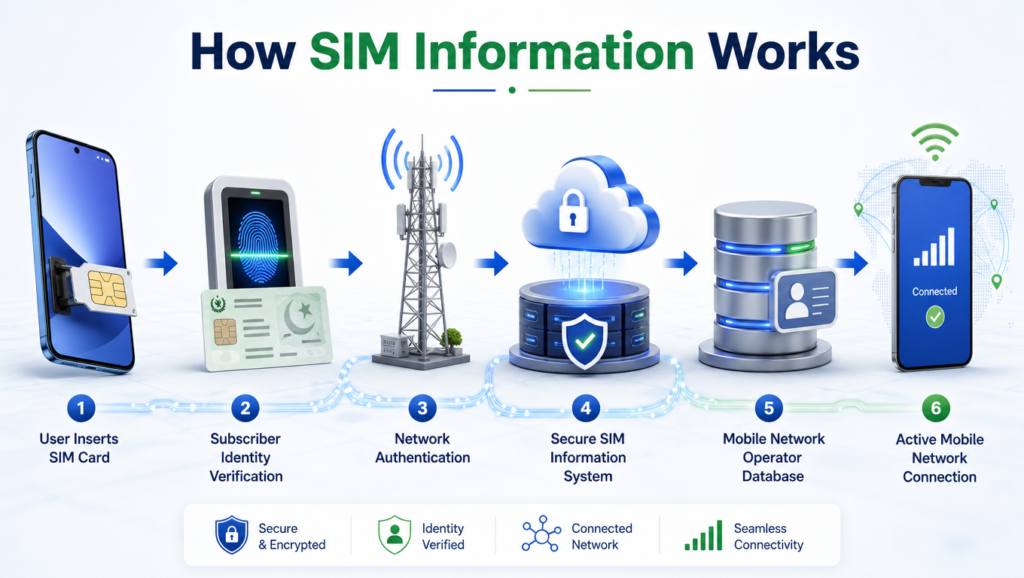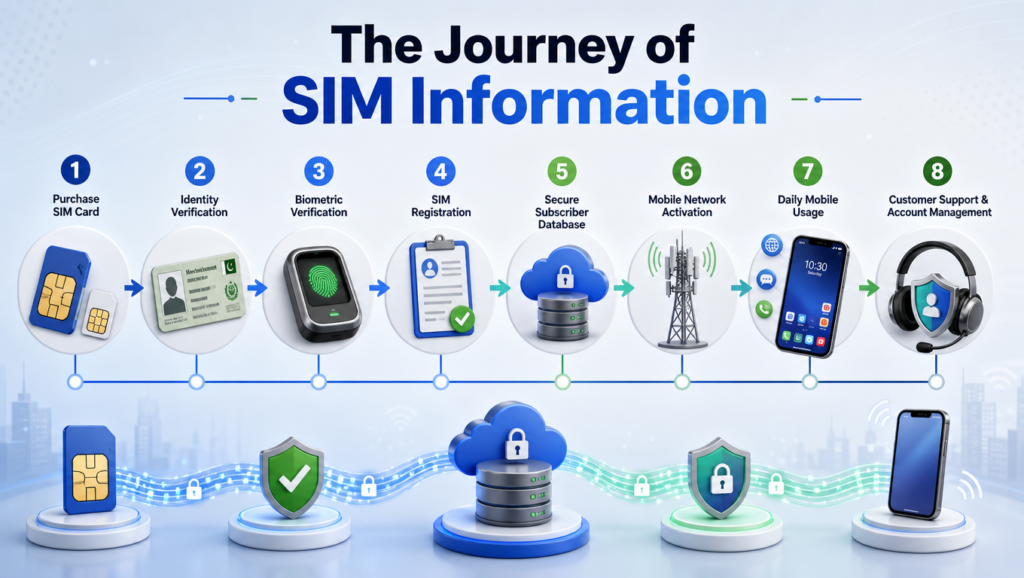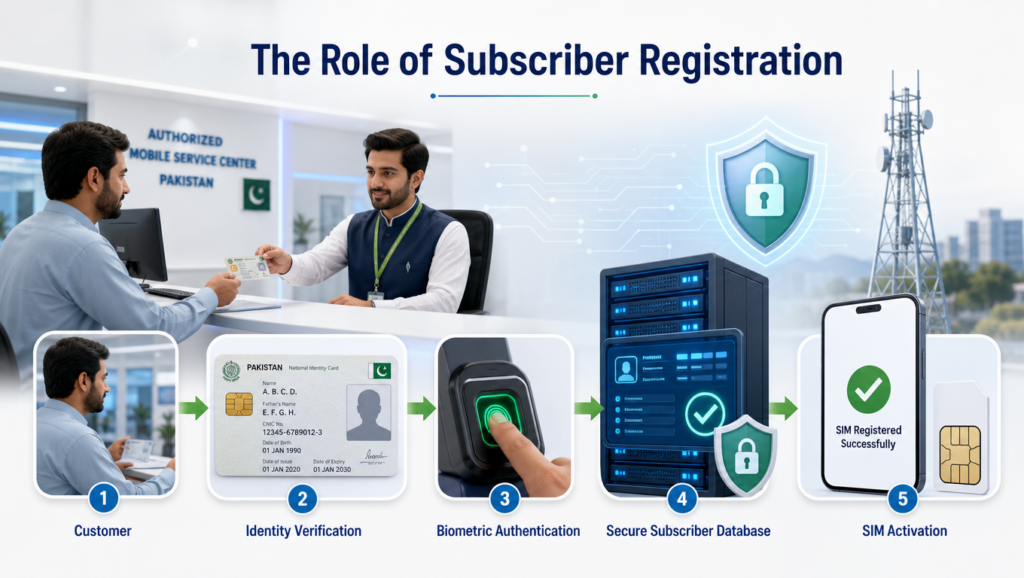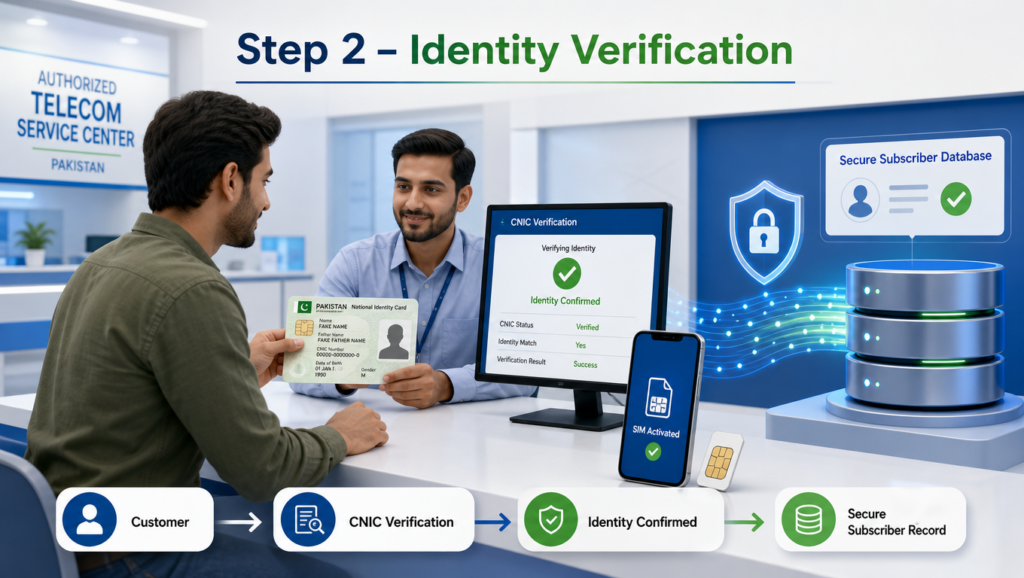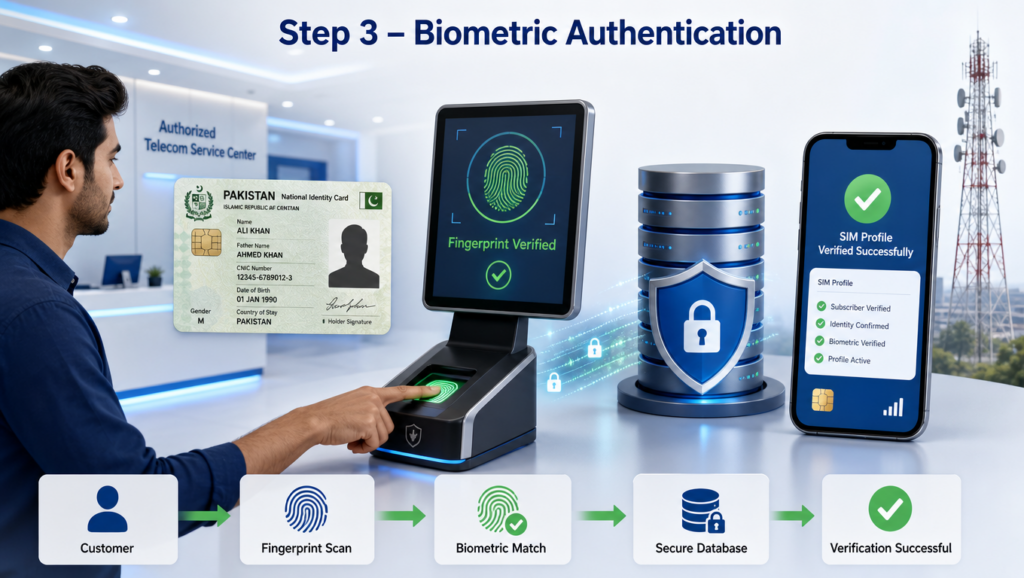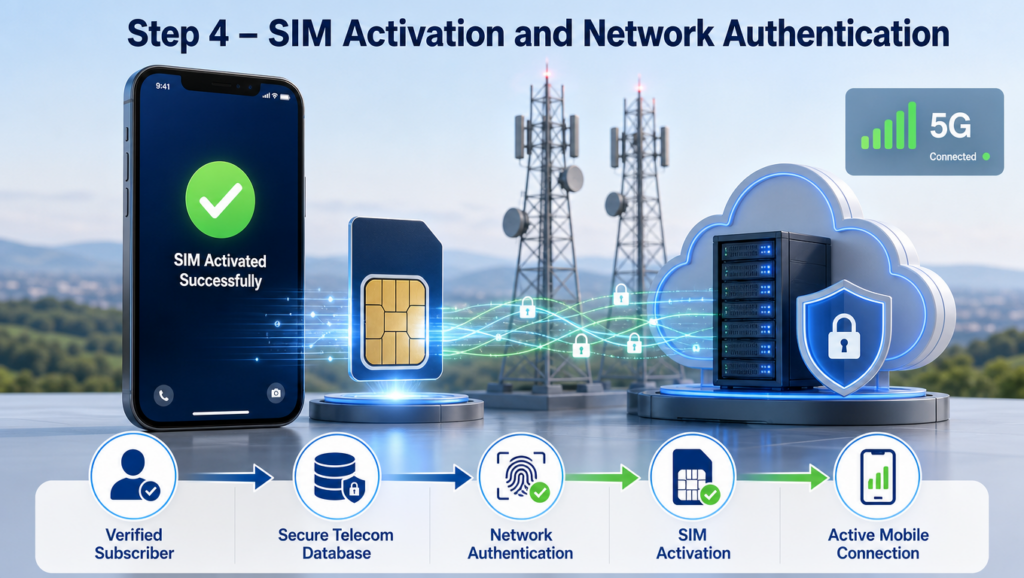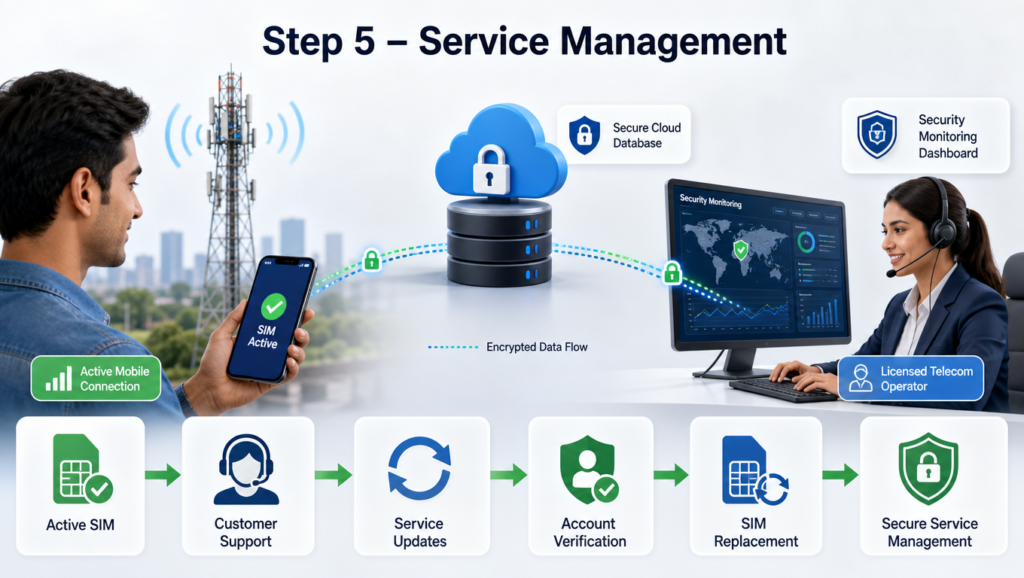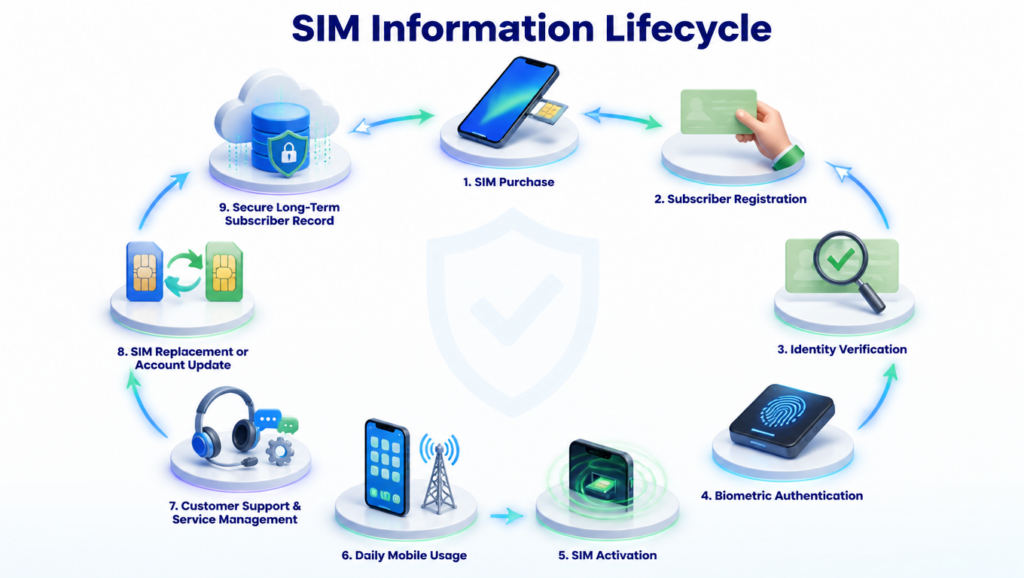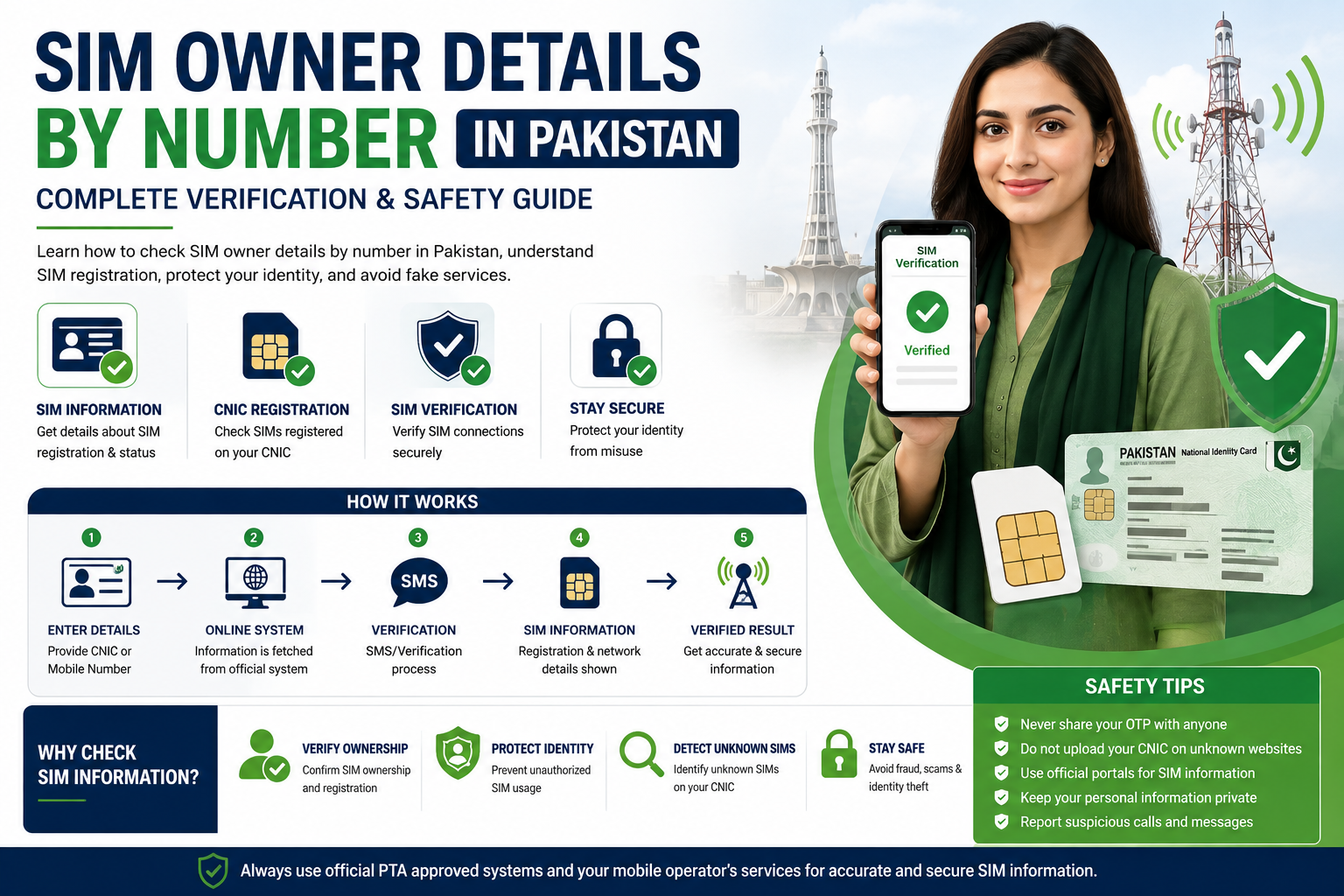
Finding information about a mobile number can be useful when you want to understand its registration status, verify a SIM connection, or identify whether a number is associated with a legitimate registration. However, there is an important difference between checking SIM registration information and obtaining private subscriber information that is not publicly available.
This complete guide explains SIM Owner Details by Number in Pakistan from a practical and privacy-conscious perspective. Instead of relying on random websites or unverified SIM databases, the goal is to understand which information can actually be verified, which methods are appropriate, and how to protect your CNIC and personal information during the process.
What Are SIM Owner Details by Number?
The phrase SIM Owner Details by Number is commonly used when someone wants to learn more about a mobile connection using its phone number as the starting point.
People may search for this information for several reasons, including:
- Verifying an unfamiliar mobile number
- Checking whether a SIM belongs to a known connection
- Understanding SIM registration status
- Checking information related to a personal SIM
- Investigating an unexpected or unwanted mobile connection
- Confirming information before taking further action
- Learning which official verification method applies to a particular situation
However, a mobile number should not automatically be treated as a public identity lookup key.
A number may be associated with subscriber records maintained by a telecom operator, but that does not mean a person’s complete name, CNIC number, address, or other private information should be publicly exposed through an ordinary online search.
This distinction is extremely important when researching SIM Owner Details by Number in Pakistan.
Why People Search for SIM Owner Details by Number
The search intent behind this keyword is broader than simply wanting someone’s name.
For example, a person may receive repeated calls from an unknown number and want to understand whether the number is legitimate. Another user may have an old SIM and want to confirm its registration status. Someone else may discover an unfamiliar SIM connection and want to determine what action should be taken.
In each situation, the correct solution can be different.
A reliable SIM verification process should therefore answer three basic questions:
- What information are you trying to verify?
- Which official or recognized method is appropriate?
- What information should you avoid giving to an unknown website or service?
Understanding these questions can prevent users from relying on misleading “SIM database” websites that promise more information than they can legitimately provide.
SIM Number Verification vs. Private Owner Information
One of the biggest misconceptions surrounding SIM searches is that entering any mobile number into a website should reveal complete subscriber details.
That assumption is not safe.
There is a major difference between:
SIM registration verification
and
private subscriber identification.
Registration-related information may be available through appropriate telecom or regulatory verification channels, depending on the purpose and method being used.
Private information such as a person’s complete CNIC, residential address, personal records, or other sensitive identity information should not be treated as publicly searchable data.
Therefore, throughout this guide, SIM Owner Details by Number refers primarily to understanding legitimate SIM-related verification options rather than obtaining unauthorized private information.
What Information Can You Actually Check From a Mobile Number?
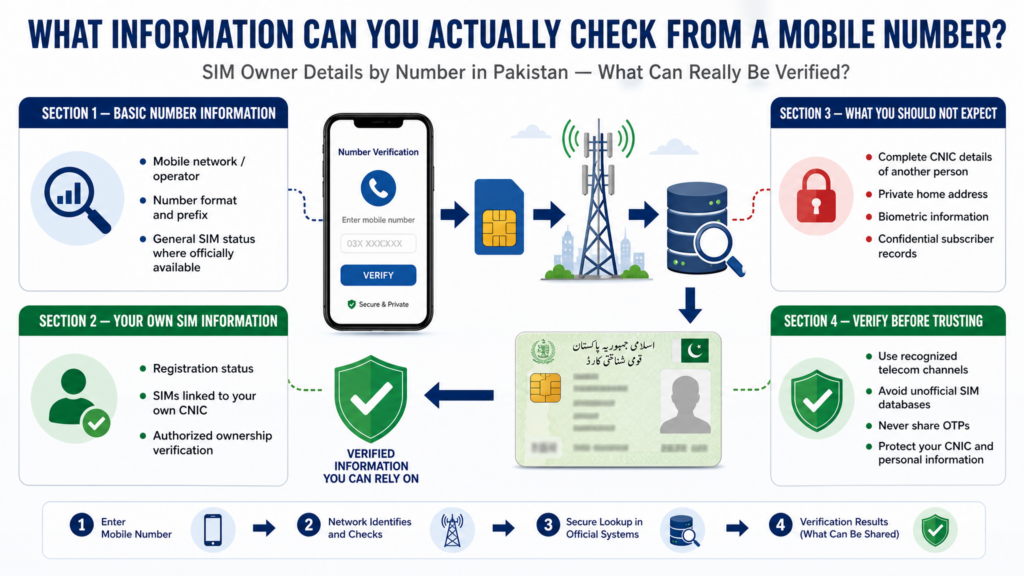
When people search for SIM Owner Details by Number in Pakistan, they often expect a complete profile to appear after entering a mobile number. In reality, the information that can be verified depends on the service, the telecom operator, the purpose of the check, and whether the verification is being performed through an authorized channel.
Understanding this limitation is important because it helps users distinguish between legitimate SIM verification and websites that make unrealistic promises.
1. Mobile Number and Network Information
A mobile number can provide basic clues about the connection, such as the number’s format and potentially the associated mobile network or operator.
However, users should not assume that a network prefix alone proves the current operator. Mobile numbers can be affected by number portability and other changes, so the original prefix should not always be treated as definitive evidence of the current network.
For someone researching SIM Owner Details by Number, this is the first distinction to understand: identifying basic number information is not the same as identifying the private subscriber.
2. SIM Registration Status
One of the more useful purposes of SIM verification is determining whether a connection is properly registered.
If you are checking a SIM that belongs to you, the appropriate verification process can help you understand whether the connection is associated with your subscriber record.
This is particularly useful when:
- You have recently obtained a new SIM.
- You have an old connection that you no longer use.
- You suspect an unfamiliar connection may be associated with your identity.
- You want to review your mobile registrations periodically.
- You are dealing with a registration or ownership issue.
The important point is that registration verification should be performed through recognized channels, rather than assuming that an unknown website has access to an official subscriber database.
3. Does a Mobile Number Reveal the Complete CNIC?
No legitimate assumption should be made that entering a mobile number into a random website will reveal someone’s complete CNIC information.
A CNIC is sensitive identity information. Users should be extremely careful with websites, apps, social-media accounts, or individuals claiming that they can provide complete CNIC details simply from a mobile number.
Requests for unnecessary identity information should be treated as a warning sign.
If a service asks you to upload your CNIC, provide an OTP, enter banking information, or submit other sensitive credentials merely to perform an ordinary SIM-related search, stop and evaluate the source before proceeding.
4. Can You Get a Person’s Full Address?
Another common expectation behind SIM Owner Details by Number searches is finding the subscriber’s home address.
A person’s residential address is private information and should not be treated as something that can legitimately be obtained from a public SIM lookup.
Websites advertising “complete address,” “live location,” or similar private information through a simple mobile-number search should therefore be approached with extreme caution.
A professional SIM-information guide should make this distinction clear rather than encouraging users to search for private data through questionable databases.
5. Why Online SIM Databases Can Be Misleading
Search engines may display pages claiming to provide:
- Complete SIM owner name
- CNIC information
- Home address
- Live location
- Family details
- Complete subscriber records
- Private telecom database access
The presence of such a claim does not establish that the service is official or accurate.
Some pages may simply collect information from public sources, provide outdated records, generate misleading results, or use attractive terminology such as “PTA database” or “SIM database” to appear authoritative.
Therefore, when checking SIM Owner Details by Number in Pakistan, always separate search results from verified information.
6. The Safer Principle
The safest approach is simple:
Use a mobile number as the starting point for legitimate verification, not as permission to obtain someone’s private identity information.
This approach protects both the person performing the check and the subscriber whose information is involved.
It also makes your SIM verification process more reliable because you are focusing on information that can actually be confirmed rather than chasing unverified database claims.
In the next sections, we will look more closely at official SIM verification methods in Pakistan, how number-based checking differs from CNIC-based checking, and which method is appropriate for different situations.
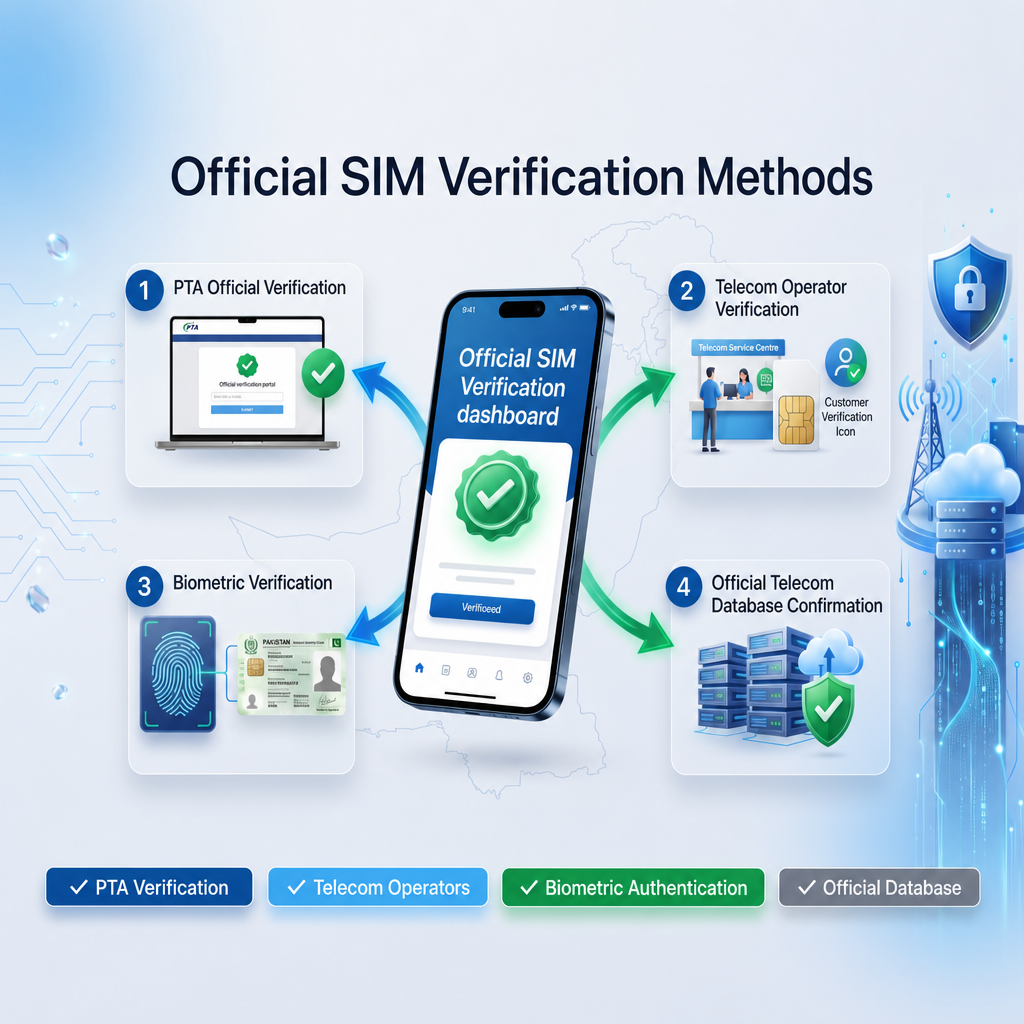
Official Ways to Verify SIM Information in Pakistan
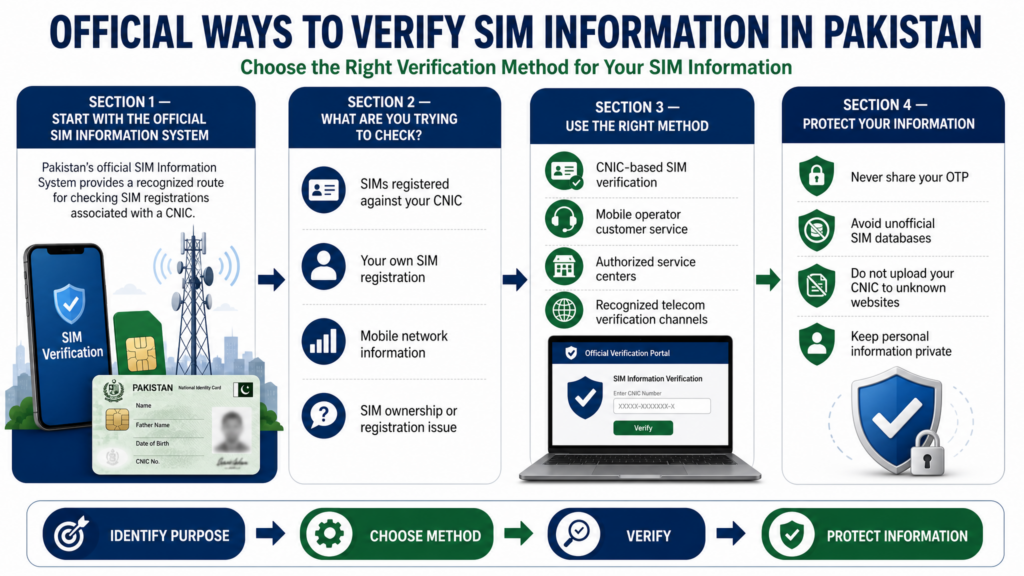
If your goal is to understand SIM Owner Details by Number in Pakistan, the first step should always be identifying the correct verification method. Different SIM-related questions require different checks, and using the wrong method can produce confusion.
For example, checking the total number of SIMs registered against a CNIC is different from investigating one particular mobile number. Similarly, checking a network is different from obtaining private subscriber information.
Start With the Official SIM Information System
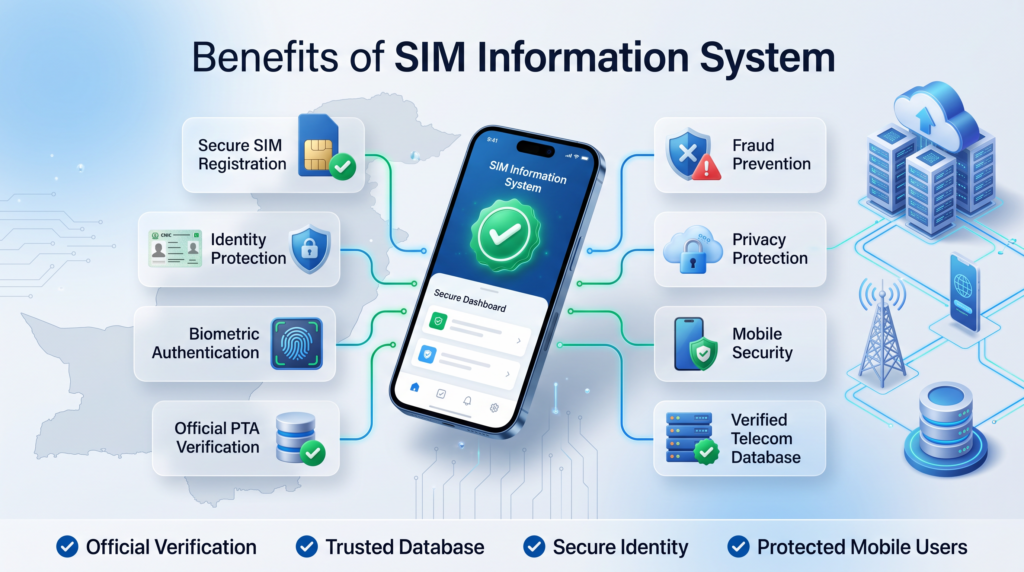
Pakistan’s official SIM Information System provides a recognized route for checking SIM registrations associated with a CNIC.
The system allows users to submit their CNIC information and view the number of SIMs registered against that identity, with the result organized by mobile network. This makes it particularly useful when the concern is how many SIMs are associated with your own CNIC.
The important distinction is that this is a CNIC-based verification, not a public tool for searching another person’s private details by entering their mobile number.
When Should You Use a CNIC-Based Check?
A CNIC-level check is useful when you want to:
- Review your own registered SIMs
- Identify an unexpected registration
- Check whether your SIM records match your personal records
- Review old or unused connections
- Investigate an unexplained increase in your registered SIM count
- Maintain better control over your telecom identity
For example, if you have used several networks over the years, you may not remember every connection that was previously registered under your CNIC.
A periodic review can help you identify registrations that need clarification.
What About Checking One Specific Number?
This is where many users misunderstand SIM Owner Details by Number.
A specific mobile number and a CNIC-level SIM count are two different starting points.
If your concern is one particular SIM that you personally use, the appropriate verification process may involve the relevant mobile operator and its current subscriber-verification procedures.
If your concern is the total number of connections registered under your identity, use the CNIC-level SIM Information System.
The correct approach therefore depends on the question you are trying to answer.
Use the Relevant Mobile Operator
When a problem involves a specific connection, contacting the relevant mobile operator through an authorized channel is often the safest next step.
This can be important when:
- A SIM appears to be registered incorrectly.
- You recently purchased a connection.
- A SIM is being used by someone else.
- You need to clarify ownership.
- A number has been lost or stolen.
- You believe an unauthorized change occurred.
Instead of relying on a third-party “SIM owner database,” explain the issue directly to the operator and ask what verification or corrective procedure currently applies.
Do Not Confuse Verification With Public Lookup
A legitimate verification process is designed to help you manage or confirm information you are authorized to access.
It should not be interpreted as permission to obtain another person’s private subscriber profile.
Therefore, a website claiming:
“Enter any Pakistani mobile number and get complete owner information instantly”
should not automatically be treated as an official service.
The more sensitive the information being promised, the more carefully you should evaluate the source.
Official Sources Should Come First
When dealing with SIM registration, CNIC information, ownership, or telecom complaints, prioritize:
Official telecom operator channels
Official PTA resources
Recognized SIM verification systems
rather than random databases or social-media sellers.
This approach is not only safer; it also reduces the chance of relying on outdated or fabricated information.
A Simple Verification Decision Tree
You can remember the process like this:
Want to check your total SIM registrations?
→ Use the CNIC-based SIM Information System.
Want to investigate one particular SIM?
→ Use the relevant operator’s current verification process.
Found something you cannot explain?
→ Contact the operator and request clarification.
Issue remains unresolved?
→ Use the appropriate official complaint route.
This distinction will become especially important when we compare SIM Owner Details by Number vs. SIM Owner Details by CNIC in the following parts.
SIM Owner Details by Number vs. CNIC: What Is the Difference?
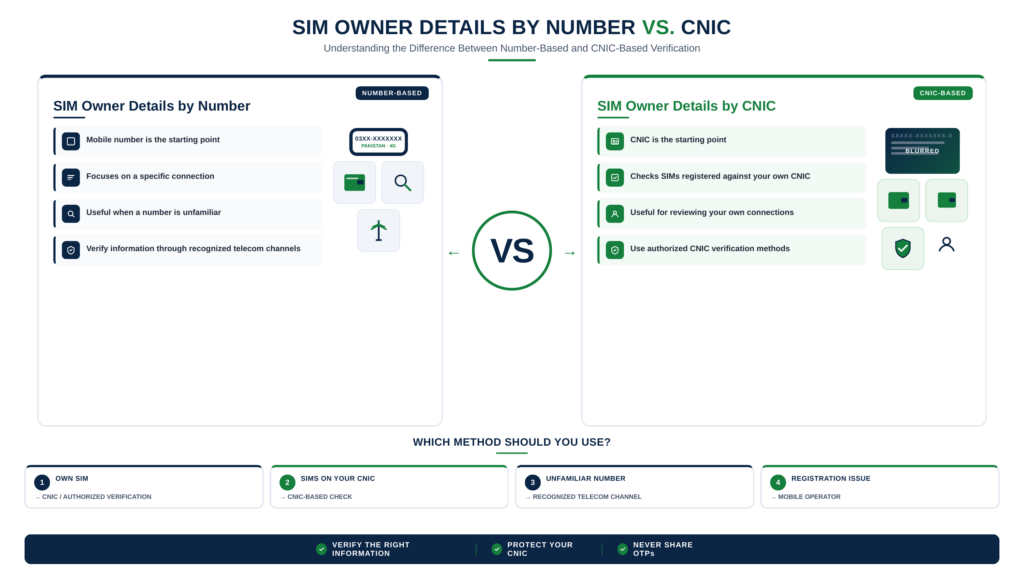
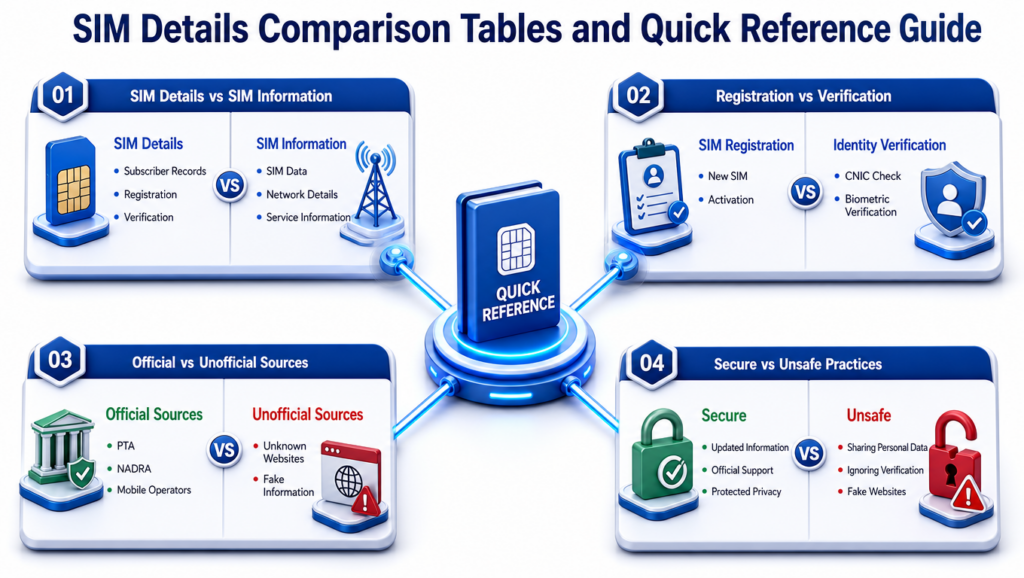
The terms SIM Owner Details by Number and SIM Owner Details by CNIC are often used interchangeably in online searches, but they describe two different starting points for SIM-related verification.
Understanding this difference can save you time and also prevent you from using an inappropriate or unofficial service.
SIM Owner Details by Number
With a number-based search, the mobile number is the starting point.
A user may want to investigate a particular connection because:
- The number is unfamiliar.
- They received repeated calls.
- They want to verify a SIM they personally use.
- They are dealing with an ownership issue.
- They want to understand which verification method applies.
However, starting with a phone number does not automatically provide access to the subscriber’s complete private identity record.
The information that can legitimately be verified depends on the specific service and the user’s authorization.
SIM Owner Details by CNIC
With a CNIC-based check, the CNIC is the starting point.
This approach is particularly useful when the question is:
How many SIMs are registered under my identity?
The official SIM Information System is designed to provide a network-wise count of SIMs associated with a CNIC.
For example, a result may show separate counts for different mobile networks.
This makes CNIC-based checking useful for identifying unexpected registrations or reviewing your own telecom connections.
Quick Comparison
| Feature | By Mobile Number | By CNIC |
|---|---|---|
| Starting information | Mobile number | CNIC |
| Main purpose | Investigate a particular connection | Review registrations under your identity |
| Suitable for your own SIM | Yes | Yes |
| Complete private subscriber profile | Not automatically available | Not a public lookup |
| Network-level information | May be relevant | Usually shown as registration count |
| Unauthorized SIM investigation | Possible starting point | Particularly useful |
| Privacy sensitivity | High | Very high |
| Best approach | Relevant operator/official process | Official SIM Information System |
Why the Difference Matters
Suppose you receive a call from an unfamiliar number.
Your first instinct might be to search that number online for a complete owner profile.
That is where many users encounter misleading websites.
A safer approach is to avoid assuming that a public number lookup should reveal private information. If the number is causing a legitimate problem, use appropriate telecom or complaint channels.
Now consider a different situation.
You discover that several SIMs may be registered against your own CNIC.
Here, a CNIC-level SIM check is much more relevant because your question concerns your own registrations, not another subscriber’s private information.
Number-Based Checking Is Not a Public Identity Search
This point deserves special attention.
A mobile number can be associated with a subscriber record, but that does not mean every detail in that record should be publicly searchable.
Therefore, when users search for SIM Owner Details by Number in Pakistan, they should understand that the phrase does not guarantee access to:
- Complete CNIC information
- Residential address
- Family information
- Private account records
- Biometric information
- Live location
- Confidential telecom data
Any website promising all of these through a simple number search should be treated cautiously.
CNIC Checking Has a Different Purpose
CNIC-based verification is primarily useful for managing your own SIM registrations.
It can help you identify whether the number of connections associated with your identity appears consistent with your records.
If an unexpected registration appears, the appropriate response is not to search for the supposed user’s private details.
Instead:
Check → Compare → Identify the network → Contact the operator → Follow the official corrective process → Recheck
Which Method Should You Use?
Use this simple rule:
Have a specific number and a legitimate reason to investigate it?
→ Start with the relevant operator or recognized verification process.
Want to know how many SIMs are registered under your CNIC?
→ Use the official CNIC-based SIM Information System.
Found an unfamiliar registration under your CNIC?
→ Contact the relevant operator and follow the official resolution process.
This distinction makes the entire topic of SIM Owner Details by Number much easier to understand while keeping the focus on legitimate verification and personal-data protection.
How to Check SIM Owner Details by Mobile Number in Pakistan
When someone searches for SIM Owner Details by Number in Pakistan, the first thing to understand is that there is no single public lookup method that should be treated as a universal database for private subscriber information.
The correct process depends on what you are trying to verify and whether the SIM belongs to you.
Start by Identifying Your Purpose
Before entering a mobile number into any website or service, ask what information you actually need.
For example:
- Do you want to verify your own SIM?
- Are you checking the registration status of a connection you use?
- Are you trying to identify an unfamiliar caller?
- Are you checking whether a SIM is registered under your CNIC?
- Are you dealing with an ownership problem?
These questions have different answers.
A common mistake is searching for a “SIM owner database” when the real requirement is simply to verify a SIM registration.
For Your Own SIM
If the mobile number belongs to you, start with the mobile operator’s recognized verification and customer-service channels.
This is the safest approach because the operator maintains the relevant subscriber relationship and can guide you through the appropriate process.
You may need to provide identity information when the service legitimately requires subscriber verification, but you should only provide it through an authorized channel.
For an Unknown Number
If an unfamiliar number is calling or messaging you, do not assume that an online search should reveal the person’s private identity.
Instead, consider the nature of the contact.
If the number is:
- Repeatedly calling
- Sending suspicious messages
- Asking for OTPs
- Requesting money
- Claiming to represent an organization
- Sending suspicious links
then the priority should be security, not trying to obtain the person’s private information.
Block the number where appropriate, avoid interacting with suspicious messages, and use the relevant official complaint or reporting channel if the situation requires escalation.
Be Careful With “Owner Details” Websites
Search results may contain websites advertising instant information from a mobile number.
Some may use phrases such as:
“100% accurate SIM owner details”
“Complete CNIC by number”
“Live SIM database”
“Full address and owner information”
These claims should not automatically be trusted.
A professional approach to SIM Owner Details by Number should focus on information that can actually be verified rather than promising access to confidential subscriber records.
Do Not Upload Your CNIC Unnecessarily
A website may ask you to upload:
- CNIC front image
- CNIC back image
- Selfie
- Phone number
- OTP
- Email address
- Other personal information
Before providing anything, determine whether the service is actually an official or authorized provider.
If an ordinary number lookup demands excessive personal information, that is a reason to stop and investigate the service first.
What About 667 and 668?
667 and 668 are often mentioned alongside SIM verification searches, but they should not be treated as a universal solution for obtaining private owner details.
The 668/SIM Information System context is primarily relevant when checking SIM registrations associated with a CNIC.
For a specific mobile number, the relevant operator or applicable official verification procedure may be more appropriate.
This is why searching for SIM Owner Details by Number in Pakistan should begin with understanding the verification objective rather than simply finding the first website appearing in Google.
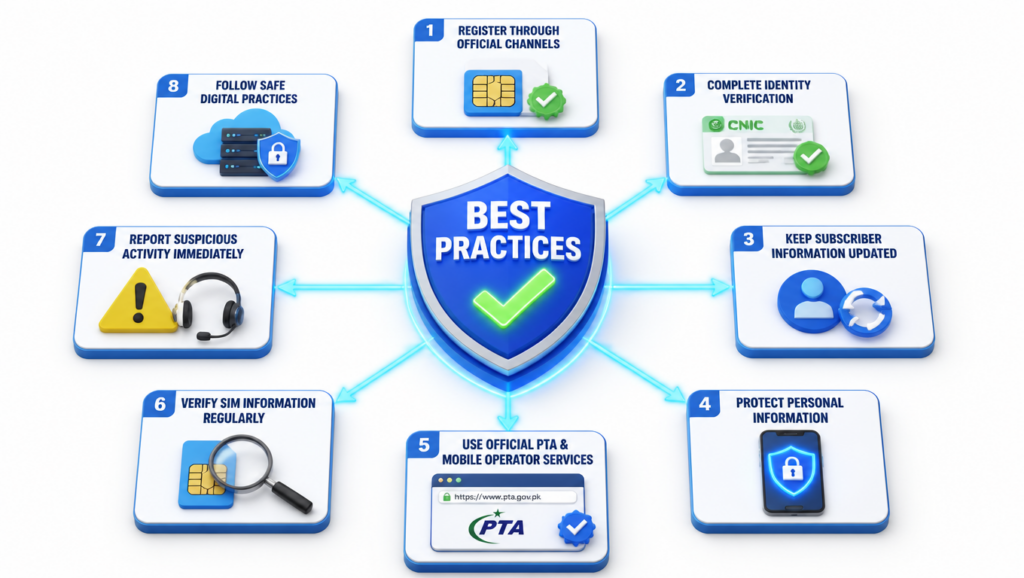
A Safer Number-Check Workflow
Use this sequence:
Mobile Number
↓
Identify the Purpose
↓
Choose the Relevant Official Method
↓
Verify Only Authorized Information
↓
Protect Personal Data
↓
Take Action if a Problem Is Found
This workflow is more reliable than entering a mobile number into multiple random databases.
The Most Important Rule
A mobile number can be the starting point for legitimate verification, but it should not be treated as a permission slip to obtain another person’s private identity information.
If your purpose is to manage your own SIM, use your operator and recognized verification channels.
If your purpose is to investigate suspicious communication, prioritize blocking, reporting and security rather than attempting to uncover private subscriber information.
That distinction will remain important throughout this guide because the goal is not simply to provide information about a mobile number—it is to help users understand what can legitimately be checked and what should remain private.
Can You Find the SIM Owner Name by Mobile Number?
One of the most common searches related to SIM Owner Details by Number in Pakistan is whether a mobile number can be entered online to reveal the registered owner’s complete name.
This is where users need to separate legitimate SIM verification from claims made by unofficial websites.
Can a Mobile Number Reveal the Owner’s Name?
A mobile operator may maintain subscriber information associated with a mobile connection, but that does not mean the complete subscriber profile should be publicly searchable by anyone who enters the number.
A telecom subscriber record can contain sensitive information. Therefore, users should not assume that a public website claiming to display a person’s name from a mobile number is an official or reliable source.
The important question is not:
“Which website can show me the owner’s name?”
The better question is:
“What information am I legitimately authorized to verify about this SIM?”
That change in approach makes SIM verification much safer.
Why Do So Many Websites Claim to Show Owner Names?
Search engines may contain pages using phrases such as:
- SIM owner name
- SIM owner details
- SIM owner by number
- CNIC by mobile number
- complete SIM database
- live SIM information
Some pages may appear convincing because they use telecom-related terminology, logos, screenshots or claims about accessing a “database.”
However, appearance alone does not establish that a website has legitimate access to current telecom subscriber records.
Information may also be outdated, incomplete, incorrectly attributed or simply presented as if it were official.
Therefore, never treat a search result as proof that the displayed information is genuine.
What About Your Own Number?
If you want to confirm information about a SIM that belongs to you, the situation is different.
Your mobile operator is the appropriate starting point for subscriber-related questions concerning your own connection.
An authorized customer-service channel or service center can explain:
- Registration status
- Ownership-related issues
- SIM replacement requirements
- Ownership transfer procedures
- Account-related verification
- Other services available for the connection
The exact process can vary depending on the operator and the type of request.
What If You Want to Identify an Unknown Caller?
This is another situation where people commonly search for SIM Owner Details by Number.
Suppose an unfamiliar number repeatedly calls you.
Instead of trying to obtain the caller’s private identity information through an unofficial database, first consider whether the communication appears suspicious.
Warning signs can include:
- Requests for OTPs
- Requests for money
- Fake prize announcements
- Suspicious links
- Threatening messages
- False banking or government claims
- Requests for CNIC information
If the communication appears suspicious, protecting yourself is more important than finding the caller’s personal details.
You can block the number, avoid responding to suspicious requests, and use appropriate official reporting channels where necessary.
Do Not Confuse Caller Identification With Subscriber Verification
A phone number appearing under a person’s name in a third-party application does not necessarily prove that the person is the official telecom subscriber.
Similarly, information found through social media does not automatically establish SIM ownership.
There can be:
- Shared phones
- Business numbers
- Family connections
- Old registrations
- Reassigned numbers
- Number portability
- Incorrect third-party information
Therefore, third-party information should never be treated as definitive telecom ownership proof.
Why Privacy Matters
A person’s mobile number is connected to their communications and potentially to other online accounts.
Attempting to obtain private subscriber information without authorization can create privacy and security risks.
This is why a strong SIM Owner Details by Number guide should explain both sides of the topic:
What users can legitimately verify
and
What information should not be obtained through unofficial methods.
The Safe Rule
If you are checking your own SIM, use the operator’s authorized verification process.
If you are checking your CNIC’s SIM registrations, use the appropriate official CNIC-based SIM verification method.
If you are dealing with an unknown or suspicious number, prioritize blocking, reporting and personal security.
Do not give an unofficial website your CNIC, OTP, biometric information or account credentials simply because it promises to reveal an owner’s name.
The most reliable SIM verification is not necessarily the service that promises the most information. It is the service that provides accurate, authorized and appropriate information while protecting subscriber privacy.
How to Verify the Registration of a SIM You Own
If you are searching for SIM Owner Details by Number in Pakistan because you want to verify a SIM that you personally use, the safest approach is to focus on the connection’s registration and ownership status rather than trying to obtain private information through an unofficial database.
A mobile number that works in your phone is not, by itself, proof that the registration record is correctly associated with you.
Start With Your Own Mobile Number
Take the SIM you currently use and identify the exact number you want to verify.
Then ask:
- Is this SIM registered in my name?
- Did I purchase it myself?
- Have I ever transferred or received this number?
- Is it an old family or business connection?
- Have I recently replaced the physical SIM?
- Has the ownership ever changed?
These questions can help you determine whether there is a genuine registration issue or simply an old connection you forgot about.
Use the Relevant Official Channel
For subscriber-related questions concerning your own connection, the mobile operator is the appropriate place to begin.
Use the operator’s official customer-service channel or an authorized franchise when you need to clarify registration or ownership.
Depending on the situation, the operator may guide you through:
- Subscriber verification
- Ownership confirmation
- SIM replacement
- Ownership transfer
- Registration correction
- Other account-related procedures
The exact requirements can vary, so avoid relying on old screenshots or instructions copied from random websites.
CNIC-Based Verification Has a Different Purpose
If your question is:
How many SIMs are registered against my CNIC?
then a CNIC-based SIM check is more appropriate.
The official SIM Information System is designed to show SIM registration counts associated with a CNIC, organized by network.
This can help you compare the result with the SIMs you actually know about.
For example, if you currently use one connection but your CNIC-level result shows additional registrations, you can investigate those registrations through the relevant operators.
What If Your SIM Is Registered Under Someone Else?
This can happen when a person continues using an old family member’s SIM, receives a connection from another person, or uses a number whose ownership was never formally transferred.
Do not assume that physically possessing the SIM changes its registered owner.
If you discover a mismatch, contact the relevant operator and ask about its current ownership-transfer or registration-correction procedure.
Avoid unofficial agents who promise to change ownership remotely.
Keep Your Transaction Evidence
If you recently purchased, replaced or transferred a SIM, keep any relevant:
- Receipt
- Confirmation message
- Reference number
- Service-center documentation
This can be useful if the registration does not appear as expected later.
It also gives you something concrete to provide when contacting the operator.
What If the Registration Looks Wrong?
Use a simple process:
Verify → Compare → Contact Operator → Correct → Keep Proof → Recheck
Do not immediately assume that an unexpected result means your identity has been misused.
First determine whether the registration could be connected to an old, family, business or previously used connection.
If you still cannot explain it, then request clarification through the appropriate operator channel.
Protect Your CNIC During Verification
Never send your CNIC image, OTP or biometric information to an unknown person who claims they can “check the SIM owner” for you.
A legitimate verification process should not require you to hand over sensitive information to an unrelated third party simply because you found their website through Google.
This is particularly important because searches for SIM Owner Details by Number can lead users toward unofficial services promising information they may not legitimately provide.
Final Check
After the operator completes any required correction or ownership procedure, verify the status again when appropriate.
Your goal should be:
Correct registration + documented action + secure personal information.
That is much more useful than simply finding a name on an unverified website.
How to Check SIM Registration Information Safely Online
If you are researching SIM Owner Details by Number in Pakistan, using an online service may seem like the fastest option. However, the most important part of an online SIM check is not speed—it is knowing which information is legitimate to verify and which websites should not be trusted.
Start With the Correct Verification Method
Before searching online, determine whether you are checking:
- Your own SIM
- Your own CNIC registrations
- A specific mobile connection
- An ownership problem
- An unfamiliar or suspicious number
This prevents you from using a CNIC-based service when your actual requirement concerns one specific SIM.
For your own CNIC registrations, the official SIM Information System provides a recognized way to review the number of SIMs associated with your identity.
For a specific connection, the relevant mobile operator remains an important source for registration and ownership-related questions.
Use Recognized Sources
When searching online, prioritize:
Official telecom operator websites
Official PTA resources
Recognized SIM verification systems
Avoid treating a random search result as an official database simply because its page contains words such as “PTA,” “SIM Database,” or “Owner Details.”
A professional website should clearly distinguish between information it can verify and information it cannot legitimately provide.
Check the Website Before Entering Information
Before entering your mobile number or CNIC into an unfamiliar website, examine the page carefully.
Look for:
- Clear ownership information
- A legitimate privacy policy
- Secure connection
- Transparent contact information
- A clear explanation of the service
- Reasonable information requirements
Be especially cautious if a simple SIM lookup asks for significantly more information than appears necessary.
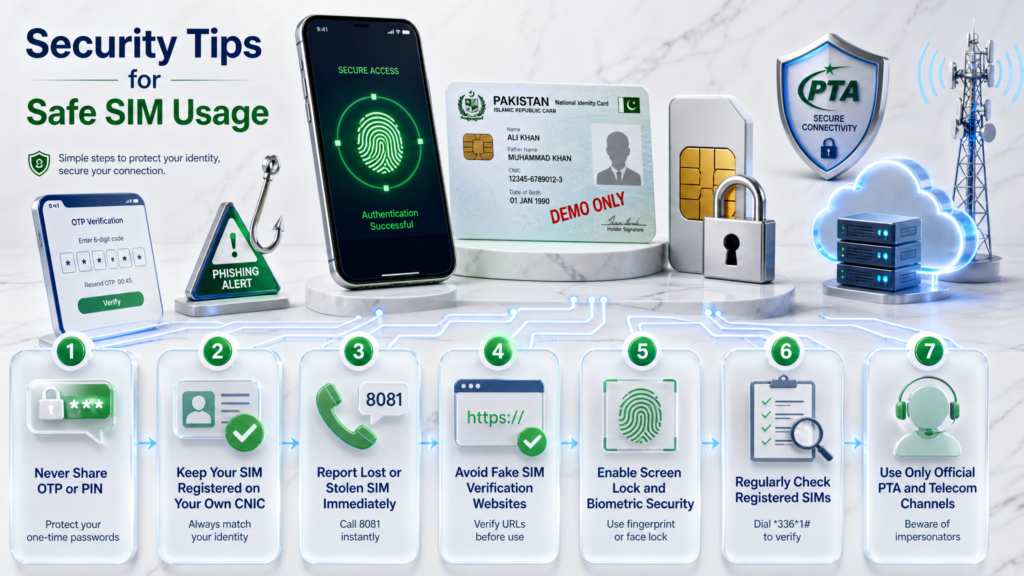
Never Give Away Your OTP
An OTP should remain private.
If a website or person asks you to provide an OTP so they can “verify the SIM owner,” stop before proceeding.
An OTP can be connected to account authentication or other security processes. Giving it to an unknown person can create risks far beyond the original SIM search.
The same principle applies to passwords and account recovery codes.
Be Careful With CNIC Upload Requests
Some websites may request a photograph of your CNIC.
Before uploading it, ask:
Why is this information required?
Who operates the website?
Is this an official or authorized service?
Can the same task be completed through an official telecom channel?
If the answer is unclear, do not upload your identity document simply to obtain information about a mobile number.
Avoid “Live SIM Database” Claims
One of the biggest warning signs is a website promising instant access to a “live” or “complete” telecom database.
Be cautious of claims such as:
- Complete owner name
- Full CNIC
- Home address
- Family details
- Live location
- All numbers belonging to a person
- Private subscriber history
Such claims should not be accepted merely because the website presents a professional-looking interface.
What If the Result Looks Suspicious?
Suppose you enter information and receive a result that appears inaccurate.
Do not immediately share the result publicly.
Instead:
Save the relevant information privately → Verify through an official source → Contact the operator if necessary → Take corrective action if required.
This prevents an unverified result from being treated as fact.
Protect Your Browser and Device
When using online verification services, basic digital-security practices also matter.
Keep your browser and operating system updated, avoid downloading unknown files from SIM-related websites, and do not install an application merely because a page claims it is required for verification.
A SIM check should not require you to compromise the security of your device.
The Safe Online SIM Check Formula
Remember:
Recognized source → Minimum required information → No OTP sharing → No unnecessary CNIC upload → Verify important results → Contact the operator when needed
This approach allows you to research SIM Owner Details by Number without turning a simple verification task into a privacy or cybersecurity problem.
How to Check Whether a SIM Is Registered in Your Name
If you are searching for SIM Owner Details by Number in Pakistan because you want to confirm whether a particular SIM actually belongs to you, the safest approach is to verify the registration rather than relying on a third-party name lookup.
A SIM can be physically in your possession while its official registration is associated with another subscriber. This can happen with old family connections, transferred numbers, business SIMs, or connections that were never formally updated.
Start With the SIM You Actually Use
First identify the mobile number you want to verify.
Then review its history:
- When did you obtain the SIM?
- Did you purchase it yourself?
- Was it given to you by someone else?
- Has the number been used by a family member?
- Was ownership ever transferred?
- Have you replaced the physical SIM recently?
This simple review can explain many apparent ownership mismatches.
Use the Operator’s Official Channel
For a specific SIM, the relevant mobile operator is the appropriate starting point for ownership or registration questions.
Use an official customer-service channel or authorized franchise and explain that you want to confirm the registration status of the connection you use.
Depending on the situation, the operator may guide you through the applicable process for:
- Registration verification
- Ownership confirmation
- Ownership transfer
- SIM replacement
- Registration correction
Requirements can vary, so always follow the operator’s current procedure.
Check Your CNIC Separately
A CNIC-level SIM check answers a different question.
It helps you understand how many SIMs are registered against your identity, rather than providing a public owner lookup for any mobile number.
This is useful if you want to compare your known connections with the registrations associated with your CNIC.
For example, you might know that you currently use two SIMs but discover a higher number during your CNIC-level check.
That does not immediately prove unauthorized activity.
First investigate whether the additional registrations belong to:
- An old number
- A previous network
- A family connection
- A business SIM
- A connection you forgot about
What If the SIM Is Registered to Someone Else?
If you discover that the SIM you regularly use is registered under another person, contact the operator.
Do not assume that continuing to use the number changes its official subscriber record.
Ask about the current ownership-transfer process and follow the authorized procedure.
If the previous subscriber is available, the operator may provide a process involving both parties and identity verification.
If the previous subscriber is unavailable, explain the situation directly to the operator and ask what options are currently available.
Keep Proof After Any Change
If you complete an ownership transfer, replacement or registration correction, keep any relevant documentation.
This may include:
- Receipt
- Transaction/reference number
- Confirmation message
- Service-center documentation
After the change has had time to update, perform an appropriate verification again.
The ideal sequence is:
Original verification → Identify mismatch → Official correction → Keep proof → Recheck
Do Not Trust a Third-Party Name Result
Suppose a website claims that your number belongs to a particular person.
That information alone should not be treated as definitive proof of telecom ownership.
Third-party databases can be outdated, incomplete or inaccurate.
The relevant telecom operator is a much more appropriate source when you need to resolve an actual registration or ownership issue.
Why This Matters
Correct SIM registration is important for practical reasons.
If a connection is registered under another person, you may face complications when you later need to:
- Replace a lost SIM
- Resolve an account issue
- Transfer ownership
- Make a subscriber-related request
- Deal with a disputed registration
Correcting the registration while you still have access to the number is generally better than waiting until an urgent problem occurs.
A Simple Ownership Verification Checklist
Before considering your SIM registration properly verified, ask:
☑ Do I know who the registered subscriber is?
☑ Is the SIM associated with my own identity where appropriate?
☑ Can I explain the registration history?
☑ Did I use an authorized verification channel?
☑ Do I have proof of any recent ownership change?
☑ Have I avoided sharing sensitive information with unofficial services?
If you can answer these questions confidently, you have a much stronger understanding of your SIM’s registration status than you would get from an unverified online “owner details” search.
What to Do If You Find Incorrect or Unfamiliar SIM Registration
If you are checking SIM Owner Details by Number in Pakistan and discover that a SIM does not appear to match your records, do not immediately assume that the registration is fraudulent. The first step is to verify the information and understand why the mismatch may exist.
An unfamiliar registration can sometimes be connected to an old number, a family connection, a business SIM, or an ownership change that was never formally completed.
Confirm the Information First
Before taking corrective action, repeat the relevant verification through an appropriate official channel.
Check:
- The exact mobile number
- The network involved
- Your current SIM records
- Any old SIMs you previously used
- Recent ownership or replacement activity
- Any relevant receipts or confirmation messages
This helps distinguish a genuine registration problem from a simple misunderstanding.
Review Your Previous Connections
Think about SIMs you have used over the years.
An unexpected registration may relate to:
- An old personal number
- A previous network
- A family member’s connection
- A business or work SIM
- A replacement connection
- A number transferred between users
The fact that you no longer use a SIM does not necessarily mean you should assume its registration has automatically disappeared.
If you no longer need a connection, ask the relevant operator about the current procedure for handling it.
Identify the Relevant Network
If your verification shows that an unfamiliar registration belongs to a particular operator, contact that operator through an official customer-service channel or authorized service point.
Explain the situation clearly:
“I have found a SIM registration that I cannot identify and would like to verify its status.”
The operator can tell you what verification or corrective procedure applies.
Keep Evidence
If you report a registration problem, keep any information provided during the process.
Useful records may include:
- Complaint number
- Reference number
- Receipt
- Confirmation SMS
- Date of your request
- Service-center documentation
This becomes particularly useful if the issue requires follow-up.
What If the SIM Is Actually Yours?
Sometimes users discover a registration they initially do not recognize and later realize that it belongs to an old or secondary connection.
In that case, maintain a private record of the connection and decide whether it is still required.
If it is no longer needed, contact the operator instead of simply discarding the physical SIM.
What If the Registration Is Not Yours?
If you genuinely cannot explain the registration, follow the operator’s official process for investigating or correcting it.
Do not attempt to identify the unknown subscriber yourself.
In particular, avoid websites promising:
- Complete owner information
- Private CNIC details
- Home address
- Family information
- Live location
The objective is to correct your own telecom registration, not to obtain another person’s private information.
When Should You Escalate?
If you have contacted the relevant operator and the issue remains unresolved, use the appropriate official telecom complaint mechanism.
Keep your previous reference or complaint information so that you can explain what action has already been taken.
This creates a much stronger record than repeatedly submitting the same issue through unrelated websites.
Recheck After the Correction
Do not consider the matter finished simply because an operator representative tells you that a correction has been requested.
Where appropriate, perform another verification after the relevant update.
The ideal process is:
Check → Confirm → Investigate → Contact Operator → Correct → Keep Proof → Recheck
This process is useful whether you are dealing with an old registration, an ownership mismatch or a genuinely unfamiliar connection.
Protect Your Identity During the Process
Never give an unknown person your:
- OTP
- Password
- Full CNIC image
- Banking details
- Biometric information
just because they claim they can remove an unwanted SIM or reveal its owner.
Use recognized telecom channels yourself.
That is especially important when searching for SIM Owner Details by Number, because unofficial services may use the user’s interest in SIM information to collect additional personal data.
SIM Owner Details by Number: Understanding Network and Operator Information
When checking SIM Owner Details by Number in Pakistan, identifying the relevant mobile network can be an important part of the verification process. However, the network associated with a number should not be confused with the private identity of the subscriber.
A mobile number can tell you something about its telecom connection, but it does not automatically provide permission to access confidential subscriber information.
Why Network Information Matters
Suppose you receive a number from an unfamiliar contact and want to understand which operator is associated with it.
Knowing the relevant network can help you determine where to direct a legitimate telecom-related inquiry.
It can also be useful when:
- You are troubleshooting your own SIM.
- You are investigating a registration issue.
- You are preparing to contact a mobile operator.
- You are reviewing your own SIM connections.
- You are comparing information after a network change.
However, never assume that a number’s original prefix alone proves its current network.
Mobile Number Prefixes Are Not Always Enough
Pakistan has multiple major mobile operators, and mobile numbers traditionally use different prefixes.
But number portability means a subscriber can move a number from one operator to another while retaining the same mobile number.
Therefore, using a prefix as permanent proof of the current operator can lead to an incorrect conclusion.
For important verification, use an appropriate current network-check or operator-based method instead.
Network Information Is Different From Owner Information
This distinction is essential.
Network information answers a question such as:
Which telecom operator is associated with this number?
Owner information concerns:
Who is the registered subscriber?
These are not the same thing.
Finding the network does not automatically reveal the subscriber’s complete identity.
A website that correctly identifies a network should not therefore be assumed to have legitimate access to the operator’s private subscriber records.
When You Should Contact the Operator
If you are dealing with your own number, the relevant operator is the most appropriate place for registration-related questions.
For example, contact the operator if:
- Your SIM registration appears incorrect.
- You need ownership clarification.
- You recently transferred a number.
- Your SIM replacement created confusion.
- You believe an unauthorized change occurred.
- You need information about an account-related issue.
Use the operator’s official customer-service channels or authorized service locations.
What If You Only Have an Unknown Number?
If the number belongs to someone else and your concern is suspicious communication, do not attempt to obtain their private subscriber record through an unofficial database.
Instead, assess the behavior of the number.
Be cautious if the caller:
- Requests an OTP.
- Asks for your CNIC.
- Requests money.
- Sends suspicious links.
- Claims to represent a bank or government organization.
- Threatens you.
- Attempts to obtain account credentials.
In such cases, security and reporting are more important than identifying the private subscriber.
Number Portability and Owner Searches
Number portability also explains why some online databases can produce outdated information.
A database might have been created or updated at a different point in time. The number may have changed networks, while an old record remains available somewhere online.
This is another reason not to treat an unofficial “SIM owner details” result as definitive evidence.
For reliable information, use current and appropriate telecom verification channels.
A Better Verification Process
If you are researching SIM Owner Details by Number, use this sequence:
Mobile Number
↓
Check Relevant Network Information
↓
Determine Your Actual Purpose
↓
Use the Appropriate Official Channel
↓
Verify Authorized Information
↓
Take Corrective or Security Action if Required
This process keeps network information and subscriber information separate.
Important Privacy Reminder
A mobile number should not be treated as a shortcut for obtaining someone’s private identity.
Avoid websites or individuals offering:
- Private CNIC records
- Residential addresses
- Family information
- Biometric data
- Live location
- Confidential subscriber history
If the service promises information that would normally be private, that is a strong reason to question its legitimacy.
The best SIM verification process is one that provides useful, current and authorized information without unnecessarily exposing anyone’s personal data.
SIM Owner Details by Number: How to Handle an Unknown Caller Safely
Receiving a call from an unfamiliar mobile number is one of the main reasons people search for SIM Owner Details by Number in Pakistan. However, trying to identify an unknown caller through unofficial databases can create more problems than it solves.
A safer approach is to first determine whether the number represents a genuine communication, a marketing call, a wrong number, or potentially suspicious activity.
Start With the Nature of the Call
Before searching for any supposed owner information, consider what happened.
Was the caller:
- Calling repeatedly?
- Asking for your CNIC?
- Requesting an OTP?
- Asking for money?
- Claiming to represent a bank?
- Offering a prize or investment?
- Sending suspicious links?
- Threatening or harassing you?
The behavior of the caller is often more useful than an unverified name displayed by a random website.
Do Not Trust Every Online Owner Result
A search result claiming that a mobile number belongs to a particular person does not automatically prove that information is accurate.
Third-party databases may contain:
- Old information
- Incorrect information
- User-submitted information
- Incomplete records
- Information copied from other sources
A person’s name appearing beside a number on an unofficial website should therefore not be treated as definitive proof of telecom ownership.
For legitimate registration questions, use the relevant operator or recognized verification channel.
What to Do With a Suspicious Caller
If the number appears suspicious, avoid providing personal information.
Never give an unknown caller:
- CNIC number
- OTP
- Banking password
- PIN
- Account recovery code
- Card details
- Biometric information
A legitimate organization should not require you to disclose sensitive authentication information to an unknown caller simply because they contacted you.
If the Caller Claims to Be From a Bank
Do not rely on the caller ID alone.
If someone claims to represent your bank, end the call and contact the bank using the official number listed on its website, card or official account documentation.
Do not use a callback number supplied by the suspicious caller.
This simple habit can prevent many social-engineering attempts.
If the Caller Claims to Be From a Government Organization
The same principle applies.
Do not provide your CNIC, OTP or other sensitive information simply because someone says they are calling from a government department.
Verify the organization independently through its official communication channels.
When Should You Block the Number?
If a number repeatedly sends unwanted calls or messages and there is no legitimate reason to continue communication, blocking it can be an appropriate first step.
Most modern smartphones provide built-in options for:
Block → Report → Delete
Use these options when appropriate.
Blocking a number does not establish who the subscriber is. It simply prevents further unwanted communication from reaching you.
What If the Number Is Harassing You?
Keep evidence.
Useful records can include:
- Call history
- Message screenshots
- Dates and times
- Relevant messages
- Any threats or suspicious requests
Do not edit evidence unnecessarily if you may need it for a formal complaint.
If the behavior is serious, use the appropriate official reporting or complaint channel.
Should You Publish the Number Online?
Avoid publicly posting an individual’s mobile number along with accusations about their identity.
Even if you believe the caller is suspicious, an unverified accusation can create privacy and reputational problems.
Instead, keep the evidence private and report the issue through an appropriate channel.
SIM Owner Details Are Not the Same as Caller Identification
This distinction is worth remembering:
Caller identification may tell you how a number is labeled by a particular service.
SIM registration information concerns the subscriber relationship maintained through telecom systems.
These should not automatically be treated as identical.
That is why a strong SIM Owner Details by Number guide should encourage verification rather than encouraging users to trust every name displayed online.
A Safe Unknown-Caller Workflow
Use this simple process:
Unknown Number
↓
Assess the Call
↓
Do Not Share Sensitive Information
↓
Block or Ignore if Unwanted
↓
Save Evidence if Suspicious
↓
Report Through an Appropriate Official Channel
This keeps the focus on your safety instead of attempting to obtain private subscriber information.
Final Reminder
If you are searching for SIM Owner Details by Number in Pakistan, remember that the safest solution is not always the one that claims to reveal the most information.
For your own SIM, use the operator’s recognized verification process.
For your own CNIC registrations, use the appropriate official SIM-checking method.
For an unknown caller, prioritize privacy, security, blocking and reporting rather than relying on an unofficial owner database.
SIM Owner Details by Number: How to Verify Information Before Trusting It
When searching for SIM Owner Details by Number in Pakistan, finding information is only the first step. The next and more important step is deciding whether that information is actually reliable.
A name, network, registration claim, or other detail displayed by an online service should not automatically be treated as confirmed subscriber information. Before taking action based on any result, verify its source, purpose, and relevance.
Why Verification Matters
Online SIM-related information can come from many different sources.
A page may contain:
- Official information
- User-submitted information
- Old records
- Automatically generated content
- Unverified database entries
- Information copied from another website
These sources do not have the same level of reliability.
For this reason, a result should be treated as information to verify, not automatically as proof.
Check Where the Information Came From
Before trusting a result, ask:
Who operates the website?
Is the source connected to the relevant telecom operator or an official authority?
Does the page explain how the information was obtained?
Is the information current?
Does the service clearly explain its limitations?
A trustworthy service should not need to hide what it does.
Compare With Official Information
If the result concerns your own SIM, compare it with information available through your mobile operator’s recognized channels.
For example, if an online page claims that a number has a particular registration status, but the operator provides different information when you make an authorized inquiry, the operator’s current records should receive greater weight.
The same principle applies when checking your own CNIC registrations.
Be Careful With Old SIM Data
One reason online results can be misleading is that mobile connections can change over time.
A number may have:
- Changed users
- Been transferred
- Changed networks
- Been replaced
- Become inactive
- Been reissued under applicable telecom procedures
Therefore, an old database entry may not represent the current registration status.
This is particularly important when a website presents information without showing when it was last updated.
Do Not Treat Screenshots as Proof
A screenshot showing someone’s alleged SIM owner information is not necessarily evidence of current ownership.
Screenshots can be:
- Edited
- Outdated
- Taken from an unofficial service
- Missing important context
If a matter is important, verify it through an appropriate official channel instead of relying on a screenshot circulating on social media.
Check the Difference Between a Claim and a Verification
Consider these two statements:
“This website says the number belongs to X.”
and:
“The relevant authorized telecom process confirms the registration.”
They are not equivalent.
The first is simply a claim made by a website.
The second represents information obtained through an appropriate verification process.
This distinction is one of the most important concepts when researching SIM Owner Details by Number.
What If Different Websites Show Different Names?
Do not choose the result that looks most convincing.
Instead, stop relying on third-party databases and determine whether your question can be answered through an official source.
If the number is yours, contact the relevant operator.
If the number belongs to someone else and is involved in suspicious activity, focus on reporting or blocking the number rather than trying to establish the person’s private identity through unofficial sources.
Avoid “100% Accurate” Claims
Be cautious with websites that promise:
- 100% accurate owner details
- Live subscriber information
- Complete CNIC records
- Guaranteed address information
- Real-time private databases
The stronger the promise, the more important it is to verify the source.
A professional SIM information resource should explain what it can verify and what it cannot legitimately provide.
A Practical Verification Checklist
Before trusting any SIM-related result, ask:
☑ Is the source recognized?
☑ Is the information current?
☑ Is the result relevant to my actual question?
☑ Can I verify it through the operator?
☑ Am I being asked for unnecessary personal information?
☑ Is the service promising private information that should not be publicly available?
If several answers raise concerns, do not rely on the result.
The Three-Level Verification Rule
A simple framework can help:
Level 1 — Online claim
Treat it as unverified information.
Level 2 — Recognized source
Check whether the information comes from an established telecom or official source.
Level 3 — Authorized verification
Use the appropriate operator or official process when the information actually matters.
This approach makes SIM Owner Details by Number in Pakistan much safer and more useful.
The objective is not simply to find a name attached to a number. The objective is to determine what information is genuinely verifiable, current, and appropriate to use.
SIM Owner Details by Number: What to Do When Information Does Not Match
Sometimes a user searches for SIM Owner Details by Number in Pakistan and finds information that does not match what they expected. A mismatch does not automatically mean that the information is fraudulent. Mobile connections can have different histories, and online third-party information may also be outdated or inaccurate.
The correct response is to verify the discrepancy before taking action.
First, Identify What Does Not Match
Start by identifying the exact difference.
For example:
- The displayed network is different.
- The registration appears unfamiliar.
- A third-party name does not match your records.
- An old number appears to have different information.
- Your own SIM appears to have an unexpected registration status.
- An online result conflicts with information provided by the operator.
Do not treat all mismatches as the same problem.
Check Whether the Number Has a History
A mobile number can have a history that explains why different sources show different information.
Consider whether the number has:
- Been used for a long period
- Changed networks through portability
- Been transferred between users
- Been replaced
- Been inactive for a period
- Been associated with a family or business connection
This is one reason an old online database should not automatically be considered more accurate than a current authorized telecom record.
If It Is Your Own SIM
If the number belongs to you, contact the relevant mobile operator through its official customer-service channel when the registration information appears incorrect.
Explain exactly what you are trying to verify.
For example:
“I am using this mobile number and need to confirm its current registration status.”
The operator can then explain what verification or correction process is available.
If the Number Belongs to Someone Else
The situation is different when you are checking a number that belongs to another person.
An information mismatch does not give you permission to obtain that person’s private subscriber information through unofficial methods.
Instead, if there is a legitimate reason for concern, focus on the actual problem.
For example, if the number is being used for suspicious calls, scams or harassment, preserve relevant evidence and use the appropriate reporting route.
Don’t Try to “Fix” a Third-Party Database
If an unofficial website displays incorrect information about a number, do not assume that you need to contact the person listed there.
The website may simply have outdated or inaccurate data.
For an actual telecom registration issue, the relevant operator is the more appropriate source.
This is especially important when researching SIM Owner Details by Number, because search results can sometimes create the impression that every online database has access to current subscriber records.
What If Your CNIC Is Involved?
If the mismatch concerns a SIM registered against your own CNIC, switch from a number-only investigation to a CNIC-level verification.
Review your registered SIM count and compare it with your own records.
If you discover an unexplained registration:
Confirm the result → Identify the network → Contact the operator → Follow the correction process → Keep proof → Recheck
This focuses the investigation on protecting your own identity rather than trying to identify another subscriber.
Keep a Record of the Discrepancy
If the issue is important, maintain a private record of:
- Mobile number
- Date of verification
- Source of the information
- Relevant screenshot
- Operator response
- Complaint/reference number
- Any corrective action
Do not publish the complete number or personal information publicly unless there is a legitimate reason and you understand the privacy implications.
Avoid Quick Conclusions
An online result saying one thing while another source says something different does not automatically prove:
- Identity theft
- Fraud
- Illegal SIM issuance
- Fake registration
- Subscriber impersonation
Those conclusions require proper verification.
The safer approach is to treat the discrepancy as a verification problem first.
A Simple Mismatch Resolution Process
Use this five-step method:
1. Identify
Determine exactly which piece of information is different.
2. Verify
Check whether the information comes from a current and recognized source.
3. Compare
Compare the result with your own SIM history or authorized operator information.
4. Correct
If the issue concerns your own registration, contact the relevant operator.
5. Recheck
After corrective action, verify the status again where appropriate.
This approach prevents a questionable online result from turning into unnecessary confusion.
The Key Lesson
When researching SIM Owner Details by Number in Pakistan, the most reliable answer is not always the first answer you find online.
A current, authorized verification should take priority over an old database, social-media post, screenshot or anonymous website.
If the information does not match, verify first, document the issue, and use the appropriate official channel for resolution.
SIM Owner Details by Number: How to Protect Your CNIC and Personal Information
Searching for SIM Owner Details by Number in Pakistan can expose users to another important issue: privacy. The biggest mistake is focusing only on finding information while ignoring how much personal information you may reveal during the search itself.
A safe verification process should protect your CNIC, mobile number, OTP, account credentials, and biometric information just as carefully as the SIM information you are trying to verify.
Never Share Your CNIC With Unknown Services
Your CNIC is sensitive identity information.
If an unfamiliar website claims that it can provide SIM owner information but first asks you to upload your complete CNIC, stop and evaluate the service.
Ask yourself:
- Why does this service need my CNIC?
- Is the website an official telecom service?
- Is there a recognized privacy policy?
- Can the same verification be completed through an operator?
- Who will have access to the information I submit?
A simple mobile-number search should not automatically justify handing your identity document to an unrelated website.
Protect Your OTP
An OTP should remain private.
Never give an OTP to:
- Unknown callers
- Social-media contacts
- Unofficial SIM agents
- Random websites
- People claiming to be “SIM verification experts”
If someone asks for an OTP so they can check, transfer, block, activate or “verify” a SIM on your behalf, treat the request with caution.
Complete the process yourself through the appropriate official channel whenever possible.
Be Careful With Biometric Information
Biometric verification is highly sensitive.
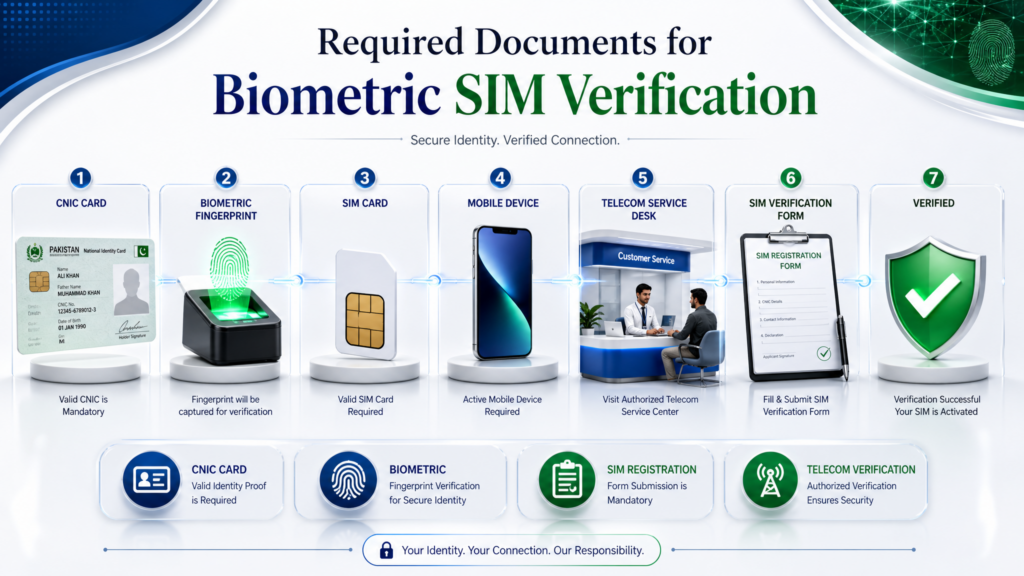
If a SIM-related transaction legitimately requires biometric verification, complete it through an authorized operator process.
Do not provide biometric information to an unknown person who promises to:
- Remove a SIM
- Change ownership
- Check an owner
- Activate a number
- Provide database information
Convenience should never outweigh identity security.
Avoid Posting Your SIM Information Publicly
If you need help with a SIM-related problem online, do not publicly post:
- Complete CNIC number
- Full mobile number
- CNIC photographs
- OTP messages
- Account credentials
- Personal addresses
- Screenshots containing sensitive information
If a screenshot is genuinely necessary, hide sensitive information before sharing it.
Don’t Trust “Complete SIM Database” Claims
One of the biggest risks associated with searches for SIM Owner Details by Number is the large number of websites claiming to have complete telecom databases.
Be cautious when a service promises:
Full CNIC
Complete home address
Family information
Live location
All registered numbers
Private subscriber history
A professional verification service should clearly explain what it can legitimately provide instead of promising unrestricted access to confidential records.
Use Official Channels for Your Own SIM
If you need information about a SIM that belongs to you, start with the relevant mobile operator or recognized telecom verification system.
This gives you a much safer route for questions involving:
- Registration
- Ownership
- Replacement
- Transfer
- Account-related issues
- Unexpected SIM activity
Do not rely on a random third party simply because it promises an instant result.
Protect Your Mobile Account
Your mobile number can be connected to important online services.
For additional security:
- Use strong account passwords.
- Avoid reusing passwords.
- Enable additional security features where available.
- Keep recovery information updated.
- Be cautious about unexpected password-reset messages.
- Contact your operator quickly if your SIM suddenly loses service without explanation.
A SIM-related security problem can sometimes affect access to other accounts, so unusual activity should not be ignored.
What If You Already Shared Your Information?
If you have already given your CNIC, OTP or other sensitive information to a suspicious person or website, do not continue communicating with them.
Instead:
Stop sharing information → Secure relevant accounts → Contact the appropriate service provider → Monitor for unusual activity → Report where appropriate
Keep screenshots, messages and other evidence privately if you believe the information may be needed later.
Privacy Should Be Part of SIM Verification
A good SIM Owner Details by Number in Pakistan process is not simply:
Search → Find Information
It should be:
Identify Your Purpose → Use an Appropriate Source → Share Minimum Information → Verify → Protect Your Identity
This approach makes the process safer while still allowing legitimate SIM-related questions to be answered.
The most valuable result is not simply finding information about a number. It is being able to verify what you are authorized to know without unnecessarily exposing your own personal information.
SIM Owner Details by Number vs. CNIC: Which Verification Method Should You Use?
When people search for SIM Owner Details by Number in Pakistan, they may come across several different verification methods and assume that all of them provide the same information. They do not.
The correct method depends on whether you are checking a specific mobile number, reviewing SIMs registered against your own CNIC, or trying to resolve an ownership or registration problem.
Mobile Number Check
A number-based search begins with the mobile number itself.
This can be relevant when you are:
- Investigating a particular connection
- Checking a SIM that you personally use
- Dealing with an unfamiliar number
- Trying to understand which verification route applies
- Looking into a telecom-related issue
However, a mobile number should not be treated as a public key for obtaining someone’s complete private identity information.
CNIC-Based SIM Check
A CNIC-based check begins with your own identity document.
Its main purpose is different:
How many SIM connections are registered against my CNIC?
This is particularly useful for reviewing your own telecom registrations.
If the result shows more registrations than you recognize, you can investigate the relevant network and contact the appropriate operator.
Operator-Based Verification
A third route is going directly to the mobile operator.
This is especially useful when you have a problem involving:
- Ownership
- Registration
- SIM replacement
- Transfer
- Incorrect subscriber information
- An unexpected connection
For a specific SIM that you use, the operator can explain which current verification procedure applies.
Quick Comparison
| Verification Method | Starting Point | Best Use |
|---|---|---|
| Mobile-number based | Mobile number | Specific connection/inquiry |
| CNIC-based | Your CNIC | Review your own SIM registrations |
| Operator verification | SIM/account + required identity verification | Ownership and registration issues |
| Complaint route | Existing complaint/problem | Unresolved telecom issue |
The important lesson is that SIM Owner Details by Number is not a single universal process.
Example: You Receive an Unknown Call
Suppose an unknown number repeatedly contacts you.
Your first instinct might be to search for the person’s name.
Instead, consider the behavior.
If the caller is asking for:
- OTP
- CNIC information
- Money
- Banking credentials
- Passwords
- Suspicious links
your priority should be security.
You can block the number, preserve evidence and use an appropriate reporting route when necessary.
You do not need to obtain the person’s private subscriber profile to protect yourself.
Example: You Find an Extra SIM Under Your CNIC
This situation is completely different.
Here, your concern is about your own identity record.
Start with the official CNIC-based SIM verification process.
Then:
Review the result → Identify the network → Check your old SIM history → Contact the relevant operator → Follow the correction procedure → Recheck
This is a much more appropriate use of CNIC-based verification.
Example: Your SIM Is Registered Under Someone Else
If you personally use a number but discover that its registration does not match your identity, contact the relevant operator.
The appropriate solution may involve an ownership transfer or another registration procedure, depending on the circumstances.
Do not assume that physically possessing a SIM automatically makes you its registered owner.
Why Choosing the Right Method Matters
Using the wrong verification method can create unnecessary confusion.
For example, someone trying to investigate their own CNIC registrations might spend time searching third-party websites for a particular number when a CNIC-level check would be more appropriate.
Likewise, someone dealing with an unknown caller might search multiple “owner details” websites when the actual problem is unwanted or suspicious communication.
The best method is therefore determined by the problem you are trying to solve, not simply by the keyword you searched.
A Simple Decision Guide
If you want to check your own registrations:
Use the CNIC-based SIM verification route.
If you want to verify your own specific SIM:
Use the relevant operator’s authorized process.
If you are dealing with an unknown caller:
Prioritize security, blocking and reporting.
If you find an unexplained registration:
Contact the relevant operator and follow the official correction process.
If an operator does not resolve the issue:
Use the appropriate official complaint mechanism.
Final Takeaway
There is no reason to force every SIM-related question into a single “owner details by number” lookup.
A reliable approach separates:
Number verification
from
CNIC registration checking
from
operator ownership verification
and from
telecom complaint handling.
Understanding these differences makes your search more accurate, protects personal information, and reduces the risk of relying on misleading third-party SIM databases.
How to Check SIM Owner Details by Number for Different Mobile Networks
When searching for SIM Owner Details by Number in Pakistan, users may also want to know whether the process differs between Jazz, Zong, Ufone, and Telenor connections. While the basic principles of SIM verification remain similar, the exact customer-service process can vary from one operator to another.
Jazz SIM Verification
If the number you are checking belongs to Jazz, use Jazz’s official customer-service or authorized service channels for questions concerning your own SIM registration, ownership, replacement, or account-related issues.
Avoid assuming that a third-party website showing a Jazz number has access to current Jazz subscriber records.
If you are dealing with an unfamiliar Jazz number because of suspicious calls or messages, focus on your own security rather than attempting to obtain private subscriber information.
Zong SIM Verification
For a Zong connection, the appropriate approach is to use Zong’s recognized customer-service and authorized service channels when you need help with your own SIM.
This may be relevant when:
- You need registration clarification.
- Your SIM information appears incorrect.
- You need an ownership-related service.
- You have lost or replaced your SIM.
- You suspect an issue with your connection.
Third-party “SIM owner database” results should not be treated as a replacement for operator verification.
Ufone SIM Verification
Ufone users should similarly rely on Ufone’s official channels for subscriber-related questions.
If a number is personally yours, an authorized operator process is more useful than searching multiple unofficial databases for a name attached to the number.
Keep any relevant receipts, confirmation messages, or service documentation if you recently obtained or transferred the SIM.
Telenor SIM Verification
For Telenor connections, use the operator’s recognized support or authorized service channels when dealing with registration or ownership questions.
This is particularly important if your physical SIM and the registration information do not appear to match.
Why Network-Specific Searching Can Be Misleading
A search such as:
“Jazz SIM Owner Details”
or:
“Zong SIM Owner Details”
does not mean that a public website should be able to reveal confidential subscriber information.
Network-specific pages may provide general guidance, but current subscriber verification should be handled through the relevant operator or recognized telecom process.
Network vs. Subscriber
Always separate these two concepts:
Network information identifies the telecom operator or connection context.
Subscriber information relates to the registered user and may be protected information.
Knowing that a number is associated with a particular network does not automatically reveal the person’s private identity.
The Best Approach
Regardless of whether the number is Jazz, Zong, Ufone, or Telenor, follow the same basic principle:
Identify the network → Determine your purpose → Use the relevant official channel → Share only necessary information → Keep verification records.
This makes SIM Owner Details by Number searches more practical while reducing the risk of relying on outdated or unauthorized information.
SIM Owner Details by Number: Common Mistakes to Avoid
When searching for SIM Owner Details by Number in Pakistan, many users make mistakes because they expect a simple number search to reveal complete subscriber information. Understanding these mistakes can help you choose safer verification methods and avoid unreliable results.
1. Using the First Website You Find
A high Google ranking does not automatically mean a website is an official telecom source.
Some pages may use attractive titles such as “complete SIM database” or “100% accurate owner details,” but their claims should still be evaluated carefully.
Always determine who operates the service and whether it is actually relevant to your verification requirement.
2. Assuming a Name Is Proof of Ownership
Finding a person’s name beside a mobile number on an unofficial website does not necessarily prove current SIM ownership.
The information may be:
- Outdated
- Incorrect
- User-submitted
- Copied from another source
- Associated with an old registration
For important ownership questions, use the relevant operator’s authorized process.
3. Sharing Your CNIC With Unknown Websites
This is one of the most serious mistakes.
A website should not automatically receive your CNIC simply because you want to check a mobile number.
Before submitting identity information, confirm the source and understand why the information is required.
4. Giving Someone Your OTP
Never provide an OTP to someone claiming they can check or update SIM information for you.
An OTP can be used as an authentication mechanism, so treating it like an ordinary piece of information can put your accounts at risk.
5. Believing “Live Database” Claims
Terms such as:
- Live SIM database
- Complete owner database
- Real-time CNIC records
- Full subscriber information
can make a service sound authoritative.
However, terminology is not proof.
A reliable verification process should explain its purpose and limitations instead of promising unrestricted access to private telecom records.
6. Confusing Prefix With Current Network
A mobile-number prefix may provide information about the number’s original allocation, but number portability means it should not always be treated as proof of the current network.
For important verification, use an appropriate current network or operator-based method.
7. Treating Third-Party Apps as Official Sources
Some apps claim to identify SIM owners or provide detailed mobile-number information.
Before installing such an application, consider:
- Who developed it?
- What permissions does it request?
- Does it require unnecessary personal information?
- Is it connected to an official telecom organization?
- Why does it need access to your contacts, messages or files?
Never install an unknown app simply because it promises instant owner details.
8. Publishing Someone’s Number and Alleged Identity
If you find information about an unfamiliar number, avoid publicly posting the number alongside accusations or personal details.
An unverified result can be wrong, and publishing personal information can create privacy and reputational problems.
Keep relevant evidence private and use an appropriate reporting channel if there is a genuine issue.
9. Ignoring Your Own SIM Registration
Sometimes users focus so much on identifying unknown callers that they forget to check their own registrations.
A periodic review of SIMs associated with your own CNIC can help you identify connections you no longer recognize.
If something appears unfamiliar, investigate it through the appropriate operator instead of trying to identify the supposed subscriber yourself.
10. Repeating the Same Search Across Random Databases
Using ten different websites does not make an unverified result more accurate.
If several sites copy information from the same source, they can all display the same outdated or incorrect data.
Quality matters more than quantity.
A Better Approach
Instead of:
Search → Trust Result → Share Information
use:
Identify Purpose → Select Appropriate Source → Verify → Protect Personal Data → Take Action
This simple change can significantly improve the quality of your SIM-related research.
Final Checklist
Before trusting any result related to SIM Owner Details by Number, ask:
☑ Is the source recognized?
☑ Is the information current?
☑ Am I checking my own SIM or someone else’s?
☑ Am I being asked for unnecessary personal information?
☑ Have I avoided sharing my OTP?
☑ Can the result be verified through an appropriate telecom channel?
☑ Am I avoiding public disclosure of someone else’s information?
The safest SIM verification process is one that gives you useful information without compromising your own privacy or someone else’s.
SIM Owner Details by Number: Benefits of Using a Proper Verification Process
When searching for SIM Owner Details by Number in Pakistan, the real benefit is not simply finding information about a mobile number. A proper verification process helps you make better decisions, protect your identity, and avoid unreliable sources.
1. Better Understanding of Your SIM
A structured verification process helps you understand the difference between a mobile number, its network, and its registration status.
This is especially useful when you have used several SIMs over the years or recently changed a connection.
2. Helps Identify Registration Issues
If you are checking your own SIM or reviewing registrations associated with your CNIC, proper verification can help you notice information that does not match your records.
An unexpected result can then be investigated through the appropriate operator.
3. Reduces Dependence on Unofficial Databases
One of the biggest advantages is avoiding websites that promise unrealistic access to private subscriber information.
Instead of trusting an unknown database, you can identify the correct official route for your particular problem.
4. Protects Your CNIC
A proper verification process encourages you to provide sensitive identity information only when it is genuinely required.
This reduces the risk of unnecessarily exposing your CNIC to unknown websites, agents or applications.
5. Helps Protect OTPs and Account Access
SIM-related scams can involve requests for OTPs or other authentication information.
Following a recognized verification process makes it easier to understand when information should remain private.
An OTP should never be handed to someone simply because they claim they can check SIM owner information.
6. Makes Unknown-Number Situations Easier to Handle
If an unfamiliar number contacts you, you do not necessarily need to discover the subscriber’s private identity.
Instead, you can evaluate the behavior of the caller, block unwanted communication, preserve evidence when necessary, and use appropriate reporting channels.
This keeps the focus on solving the actual problem.
7. Helps With Ownership Problems
If a SIM you personally use appears to be registered incorrectly, proper verification can help you identify that issue early.
You can then contact the relevant operator and ask about the current ownership-transfer or registration-correction process.
8. Creates a Clear Verification Record
When you use recognized channels, you may have useful records such as:
- Confirmation messages
- Service receipts
- Reference numbers
- Complaint numbers
- Transaction records
These can be valuable if you need to follow up later.
9. Supports Better Digital Security
Your mobile number can be connected to important online accounts.
Maintaining accurate SIM registration information and protecting your telecom credentials can therefore become part of your broader digital-security routine.
10. Helps You Avoid False Conclusions
An unofficial result may make you believe that a particular person owns a number when the information is outdated or incorrect.
A proper verification process reduces this risk by giving greater importance to current, authorized information.
The Real Benefit
The biggest benefit of SIM Owner Details by Number in Pakistan is not unrestricted access to private information.
It is having a clear, responsible and reliable method for understanding what can actually be verified about a SIM.
The ideal process is:
Identify the purpose → Choose the right method → Verify through an appropriate source → Protect personal information → Take action when necessary.
This approach provides practical value while respecting subscriber privacy.
SIM Owner Details by Number: Frequently Asked Questions
When users search for SIM Owner Details by Number in Pakistan, they often have very specific questions about what can be checked, which method should be used, and whether online owner-information services can be trusted. This FAQ section answers the most common questions in a simple and practical way.
Can I check SIM Owner Details by Number in Pakistan?
You can investigate legitimate SIM-related information about a number, but you should not assume that entering a mobile number into a random website will provide a complete private subscriber profile.
For important registration or ownership questions, use the relevant telecom operator or recognized verification channel.
Can I find the complete owner’s CNIC from a mobile number?
You should not expect a legitimate public lookup service to provide another person’s complete CNIC simply because you have their mobile number.
CNIC information is sensitive personal data and should be handled through appropriate authorized processes.
Be cautious of websites promising complete CNIC information from any mobile number.
Can I find someone’s home address from their SIM number?
A person’s residential address should not be treated as publicly available SIM information.
Websites claiming to provide a complete home address from a mobile number should be approached with extreme caution.
If your concern involves suspicious communication, focus on blocking, preserving evidence and reporting rather than attempting to obtain private address information.
How can I check SIMs registered against my CNIC?
If you want to know how many SIM connections are registered against your own CNIC, use the recognized CNIC-based SIM Information System.
This is different from searching for another person’s details by mobile number.
After receiving the result, compare the registrations with your own records and investigate anything you do not recognize through the relevant operator.
Can I verify whether my own SIM is registered in my name?
Yes, if you are trying to verify a SIM you personally use, contact the relevant mobile operator through its authorized customer-service or service-center channels.
The operator can explain the current process for registration, ownership verification, transfer or correction.
What should I do if I find an unfamiliar SIM registered against my CNIC?
First, confirm the result.
Then identify the relevant network and contact the operator through an official channel.
Use this process:
Check → Confirm → Identify Network → Contact Operator → Correct → Keep Proof → Recheck
Do not attempt to identify the supposed subscriber through unofficial databases.
Is every SIM owner website trustworthy?
No.
A website can claim to provide “complete SIM owner details” without being an official telecom service.
Be particularly cautious about services promising:
- Complete CNIC
- Full address
- Family information
- Live location
- Private subscriber history
- Real-time telecom database access
Always evaluate the source before submitting personal information.
Should I give my OTP to someone checking SIM information?
No.
Never share an OTP with an unknown person, agent, website operator or caller simply because they claim they need it for SIM verification.
An OTP can be part of an authentication process and should remain private.
Does a mobile-number prefix prove the current network?
Not necessarily.
Number portability means that a number can move between networks while retaining the same number.
Therefore, a prefix should not automatically be treated as definitive proof of the current operator.
Can I use third-party apps to find SIM owner details?
You should be cautious.
Before installing an app, check who developed it, what permissions it requests and whether it is genuinely connected to an authorized service.
Do not install unknown applications merely because they promise private subscriber information.
What is the safest way to investigate an unknown number?
Start by considering why the number concerns you.
If it is simply unfamiliar, you may choose to ignore or block it.
If it is making suspicious calls or sending fraudulent messages, preserve evidence and use an appropriate reporting mechanism.
Your priority should be personal security, not obtaining someone’s private identity information.
What if an online SIM result conflicts with the operator?
Give greater weight to current information obtained through the relevant authorized telecom process.
Third-party databases can be outdated or inaccurate.
If the discrepancy concerns your own registration, ask the operator to clarify the current status.
Can I publicly post a number and its alleged owner?
It is better to avoid publishing someone’s mobile number together with unverified personal information or accusations.
An online result may be incorrect, outdated or associated with another person.
Keep evidence private and use appropriate reporting channels if necessary.
What is the main purpose of SIM Owner Details by Number?
The useful purpose is legitimate SIM verification and understanding available information, not unrestricted access to private subscriber records.
A responsible approach helps users verify their own connections, understand registration procedures, identify potential issues and protect personal information.
How to Check SIM Owner Details by Number Without Compromising Privacy
When searching for SIM Owner Details by Number in Pakistan, users often focus on getting an answer as quickly as possible. A better approach is to make the search accurate, authorized, and privacy-conscious.
Start With the Minimum Information
Before using any verification service, determine exactly what you need.
If you only need to understand a network or verify your own connection, do not provide unnecessary CNIC information, photographs, OTPs, or other sensitive data.
The principle is simple:
Only provide information that is genuinely required for the legitimate verification process.
Don’t Turn a Number Search Into a Personal-Data Search
A mobile number may be associated with a subscriber record, but that does not mean every piece of information connected to that record should be publicly available.
Avoid trying to obtain:
- Complete CNIC information
- Residential address
- Biometric information
- Family records
- Private account information
- Live location
A responsible SIM verification process should focus on information you are authorized to access.
Verify Your Own Information Through Appropriate Channels
If the number belongs to you, use the relevant operator’s official customer-service or authorized service channel for registration and ownership questions.
If you want to review SIM registrations associated with your own CNIC, use the recognized CNIC-based SIM verification method.
These approaches are safer than submitting your information to multiple third-party websites.
Protect Your Search From Fake Services
Before using an unfamiliar website, look for basic trust indicators:
- Clear website ownership
- Transparent contact information
- Privacy information
- Secure connection
- Clear explanation of the service
- Reasonable information requirements
A page that immediately asks for extensive personal information should be treated cautiously.
Never Exchange OTPs for Information
One particularly important rule is:
Never give an OTP to someone in exchange for SIM owner information.
An individual may claim they need your OTP to access a “SIM database” or complete a verification request.
Do not provide it.
If an authentication code is required for a legitimate service, enter it yourself through the appropriate official interface.
Protect Screenshots Too
Even screenshots can expose sensitive information.
Before sharing a screenshot of a SIM-related result, check whether it contains:
- Full mobile number
- CNIC number
- Name
- Address
- OTP
- Account information
- Reference numbers
Hide sensitive information before sharing anything publicly.
Use Official Sources for Important Decisions
If the result could affect your SIM ownership, CNIC registration, account security or complaint, do not make an important decision based solely on an anonymous website.
Use an appropriate telecom operator or recognized official source to confirm the information.
This is especially important if two websites provide conflicting results.
Keep Your Own Records
If you complete a legitimate SIM-related transaction, keep relevant evidence privately.
Useful records may include:
- Receipts
- Confirmation messages
- Reference numbers
- Complaint numbers
- Service-center documents
These records can make future verification much easier.
A Privacy-First Verification Routine
A simple routine can be:
Define the purpose
↓
Choose the appropriate verification method
↓
Use a recognized source
↓
Provide minimum necessary information
↓
Never share OTPs
↓
Verify important results
↓
Keep evidence privately
This routine allows you to research SIM Owner Details by Number without unnecessarily exposing your identity.
Why This Approach Is Better
A fast result is not necessarily a reliable result.
A privacy-first approach helps you:
- Reduce exposure of your CNIC
- Avoid suspicious websites
- Protect authentication codes
- Reduce false conclusions
- Keep better records
- Resolve genuine registration problems through the correct channel
The purpose of SIM verification should ultimately be clarity and security, not unrestricted access to private subscriber information.
SIM Owner Details by Number: How to Deal With Fake or Misleading Results
When searching for SIM Owner Details by Number in Pakistan, one of the biggest challenges is separating useful information from misleading claims. A website may display a name, number, network, or other details and present them as an official result even when there is no clear evidence that the information is current or authorized.
Learning how to recognize these situations can protect both your privacy and your decisions.
Check the Source Before Trusting the Result
Before accepting any SIM-related result, identify where it came from.
Ask:
- Is this an official telecom source?
- Is the website clearly operated by a legitimate organization?
- Does it explain its verification method?
- Is the information dated or otherwise supported?
- Does it provide realistic limitations?
A professional resource should not pretend to have unrestricted access to confidential subscriber records.
Be Careful With Unrealistic Promises
Some websites may use phrases such as:
- “100% accurate SIM owner”
- “Live SIM database”
- “Complete CNIC details”
- “Full address by number”
- “Instant owner information”
- “Private telecom database”
These claims should immediately encourage you to investigate the source more carefully.
The more sensitive the promised information is, the more important verification becomes.
A Search Result Is Not Automatically Proof
Search engines index information from many different websites.
A result appearing on Google does not mean that Google has verified the accuracy of the information.
For example, several websites may publish the same name because they copied it from one original source. Seeing the same information repeatedly does not necessarily make it accurate.
This is why important SIM-related information should be confirmed through an appropriate telecom or official channel.
Watch for Outdated Information
Mobile-number information can change.
A number may have:
- Changed users
- Been transferred
- Changed network
- Been replaced
- Become inactive
- Been reissued according to applicable procedures
An old database may continue displaying information that no longer reflects the current situation.
Therefore, the date and source of information matter.
Don’t Enter Sensitive Information Just to “Unlock” Results
Another warning sign is a website that initially shows a partial result and then asks you to provide additional personal information to reveal the supposed owner details.
Be cautious if it asks for:
- CNIC photographs
- OTP
- Password
- Banking information
- Biometric information
- Contact-list access
- Unnecessary app permissions
Do not provide sensitive information simply because a website claims it will reveal more details.
What If the Result Concerns Your Own Number?
If you are checking a SIM that belongs to you, the safest way to resolve a disagreement is to use the relevant operator’s recognized verification process.
An unofficial website cannot replace an authorized telecom record when you need to resolve an actual registration or ownership issue.
What If the Result Concerns an Unknown Number?
If an unfamiliar number is involved in suspicious activity, focus on the behavior rather than trying to obtain private subscriber information.
You can:
Block → Save evidence → Avoid sharing information → Report through an appropriate channel
This is generally more useful than trusting an anonymous owner lookup.
A Simple Fake-Result Test
Before trusting a SIM-related website, ask four questions:
1. Is the source recognized?
If not, treat the information cautiously.
2. Does it promise private information?
If it promises complete confidential records from a simple number search, be skeptical.
3. Does it demand sensitive information?
Unnecessary CNIC, OTP or biometric requests are warning signs.
4. Can the result be independently verified?
If the answer is no, do not treat the result as confirmed.
Final Rule
The safest way to handle SIM Owner Details by Number in Pakistan is to distinguish between:
Online claim → Information to investigate
and
Authorized verification → Information you can rely on
This simple distinction can prevent users from trusting outdated databases, fake owner profiles, or misleading SIM-check services.
Final Verification Checklist
Before relying on any information related to SIM Owner Details by Number in Pakistan, always verify the purpose of your search and use the appropriate channel. A mobile number can help you identify the connection you are concerned about, but it should not be treated as permission to access another person’s confidential identity information.
For your own SIM, use the relevant operator’s authorized verification process. For SIMs registered against your own CNIC, use the recognized CNIC-based SIM verification method. If an unfamiliar number is contacting you, prioritize security, blocking and reporting instead of attempting to obtain private subscriber information.
A reliable verification routine should follow:
Identify → Verify → Protect → Document → Take Action
Keep receipts, reference numbers and confirmation messages when completing legitimate SIM-related transactions.
Part 24 — Quick Safety Tips
Keep these points in mind whenever you search for SIM Owner Details by Number:
- Never share your OTP with anyone.
- Do not upload your CNIC to unknown websites.
- Avoid unofficial “live SIM database” claims.
- Do not trust screenshots as proof of ownership.
- Do not publicly expose another person’s mobile number or alleged identity.
- Verify important information through recognized telecom channels.
- Keep evidence of genuine registration or ownership transactions.
- If you discover an unfamiliar SIM under your own CNIC, contact the relevant operator.
- Recheck important registration changes after corrective action.
These simple habits can make SIM verification considerably safer.
Part 25 — Final Conclusion
SIM Owner Details by Number in Pakistan is a broad search topic, but responsible verification requires understanding the difference between legitimate SIM information and private subscriber data.
A mobile number may help you investigate a specific connection, but complete CNIC details, addresses, family information, biometric data and other confidential records should not be treated as ordinary public lookup information.
The best approach is to use the right method for the right situation:
Own SIM → Operator verification
Own CNIC registrations → CNIC-based SIM check
Unknown or suspicious number → Block, document and report
Registration problem → Relevant operator and official complaint route
Avoid websites that promise unrestricted access to private telecom databases, especially when they request unnecessary CNIC information, OTPs or other sensitive credentials.
The goal of SIM verification should always be accurate information, personal security and responsible use of telecom services.